
Bookkeeping for Franchises: A Step-by-Step Guide
You bought a franchise for the system. Then the financial reports started arriving.
One location looks busy but barely produces cash. Another seems quieter yet posts a stronger margin. Your consolidated Profit & Loss says one thing, your bank account suggests another, and the report your franchisor wants doesn't match the way your bookkeeper set up QuickBooks. That disconnect is where most franchise owners realize that bookkeeping for franchises isn't just ordinary bookkeeping with extra locations.
Franchise bookkeeping has been moving in this direction for a long time. As large-scale franchising expanded in the U.S., bookkeeping became more formalized, and the postwar rise of multi-location operations made monthly reconciliation, standardized procedures, and consolidated reporting essential controls, as noted in QMK Consulting's discussion of multi-unit franchise accounting. The practical problem today is that owners still get generic advice when what they need is a system that shows true unit-level performance without breaking franchisor reporting.
Table of Contents
Building Your Financial Foundation - Start with the franchisor's chart - Add tracking before transactions pile up
Accounting for Franchise-Specific Costs - Treat the initial fee differently from ongoing fees - Automate the recurring pieces
Solving the Multi-Location Puzzle - Why consolidated reports hide the problem - A practical allocation framework
Your Monthly Close and Reporting Rhythm - What a franchise monthly close should include - The three reports that matter most
Optimizing for Growth and Tax Readiness - Plan for variable fees before they hit cash flow - Keep books tax-ready while you scale
The Franchise Owner's Dilemma
A new multi-unit owner usually sees the same pattern by the second or third month. Store managers are sending numbers in different formats. Payroll sits in one account for all locations. Marketing charges land centrally. Vendor bills are paid from one operating account. Then the owner tries to answer a basic question: which unit is performing well?
That answer should be simple. In practice, it rarely is.
One location may look profitable only because shared payroll wasn't pushed down to the unit. Another may look weak because national marketing or software costs were dumped into that store's books. Owners often think they have a bookkeeping problem when they really have a structure problem. The books can be clean and still be useless if they don't separate standardized franchisor reporting from unit-level operating insight.
Most new franchisees aren't confused because they're bad with numbers. They're confused because the default bookkeeping setup for a small business doesn't fit a multi-location franchise.
There's also a mindset gap. Franchise owners expect the brand's operating system to carry over neatly into finance. It doesn't. Operations may be standardized, but financial reporting still breaks if each location isn't coded consistently and reviewed on a regular rhythm.
That's why many owners end up looking for outside support early, especially once the books need to serve both management and compliance. A practical starting point is understanding what bookkeeping services for small businesses should include when the business has multiple units, recurring fees, and franchisor reporting requirements.
Building Your Financial Foundation
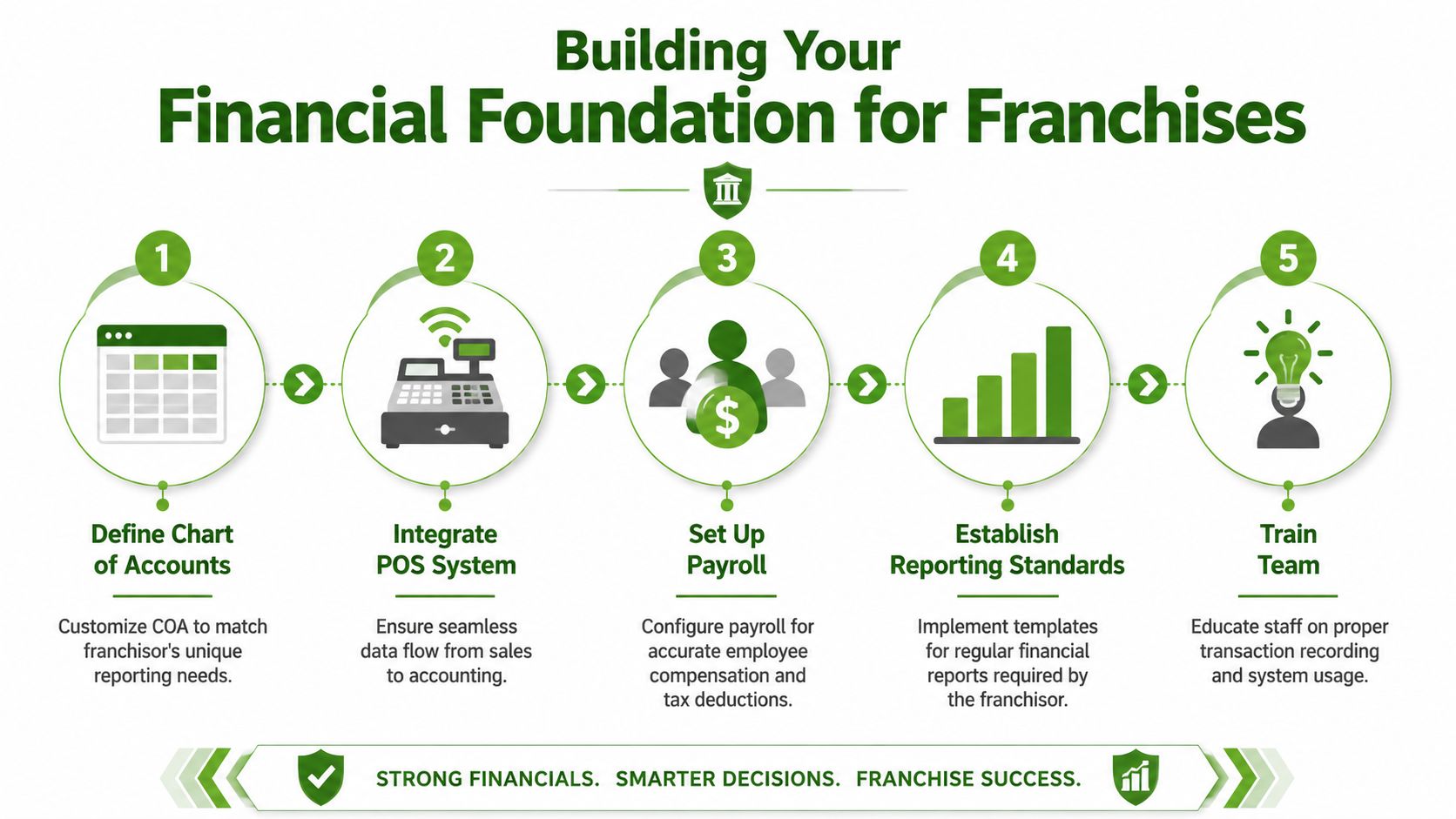
The setup phase determines whether your books stay usable or become a cleanup project six months later. Franchise owners often want to start entering sales right away. That's understandable, but it's the wrong place to begin. The first job is structural.
Start with the franchisor's chart
Your Chart of Accounts is not a draft. In a franchise system, it is usually part of the reporting architecture. The most common pitfall in franchise accounting is the franchisee renaming or re-categorizing accounts from the franchisor's standardized COA, a mistake tied to 68% of audit failures; strict adherence can reduce monthly close times by 45% and achieve 99% accuracy in royalty calculations.
Well-meaning owners create problems by adding accounts like "Other Store Expenses," "Local Admin," or "Miscellaneous Income" because those names make sense to them. But the franchisor's reporting logic depends on exact account alignment. Once names and codes drift, royalty reporting, benchmarking, and audits get messy fast.
Set it up this way:
Pull the approved COA first. Get it from the franchise agreement, operations manual, or franchisor finance team.
Mirror it exactly in QuickBooks Online or Xero. Match names, numbering, hierarchy, and account type.
Hold local customization unless approved in writing. If a store-level need exists, solve it with classes, locations, tracking categories, or memo fields before creating new accounts.
Lock down permissions. Staff should not be able to create ad hoc accounts during bill entry or bank feed review.
A lot of owners understand debits and credits well enough, but they still underestimate how much the COA controls reporting. If you need a quick refresher on why the structure matters, the core logic behind the basic accounting equation is still the framework underneath every franchise setup.
Add tracking before transactions pile up
The next layer is location and class tracking. This is how bookkeeping for franchises goes from generic bookkeeping to management accounting.
Use one dimension for the physical unit. Use another for shared or functional categories when your software supports it. For example:
Location or tracking category for each store. Every sale, labor cost, rent charge, and supplies purchase should attach to the correct unit.
Class or secondary tag for shared items. This helps separate local operating activity from centralized items like corporate payroll processing, software, or admin support.
Consistent naming rules. "Store 1," "Location 1," and "Unit A" should not all coexist.
Practical rule: If a transaction can't be tied to a store, a shared function, or a balance sheet purpose at the time of entry, your reporting will need guesswork later.
A simple setup checklist helps:
Setup area | What works | What breaks |
|---|---|---|
COA | Exact franchisor match | Local renaming |
Sales feed | Direct sync from POS | Summary journal entry with no unit detail |
Expense coding | Mandatory location/class fields | Posting first and cleaning up later |
User access | Restricted account creation | Anyone can add categories |
The goal isn't complexity. It's consistency. A clean franchise file should let you answer two questions without manual spreadsheet surgery: what did the group earn, and what did each unit earn after a fair share of shared costs?
Accounting for Franchise-Specific Costs
Most franchise owners understand rent, wages, and utilities. The franchise-specific items are where confusion starts. The books need to reflect not just what was paid, but how that payment should be treated over time.
Treat the initial fee differently from ongoing fees
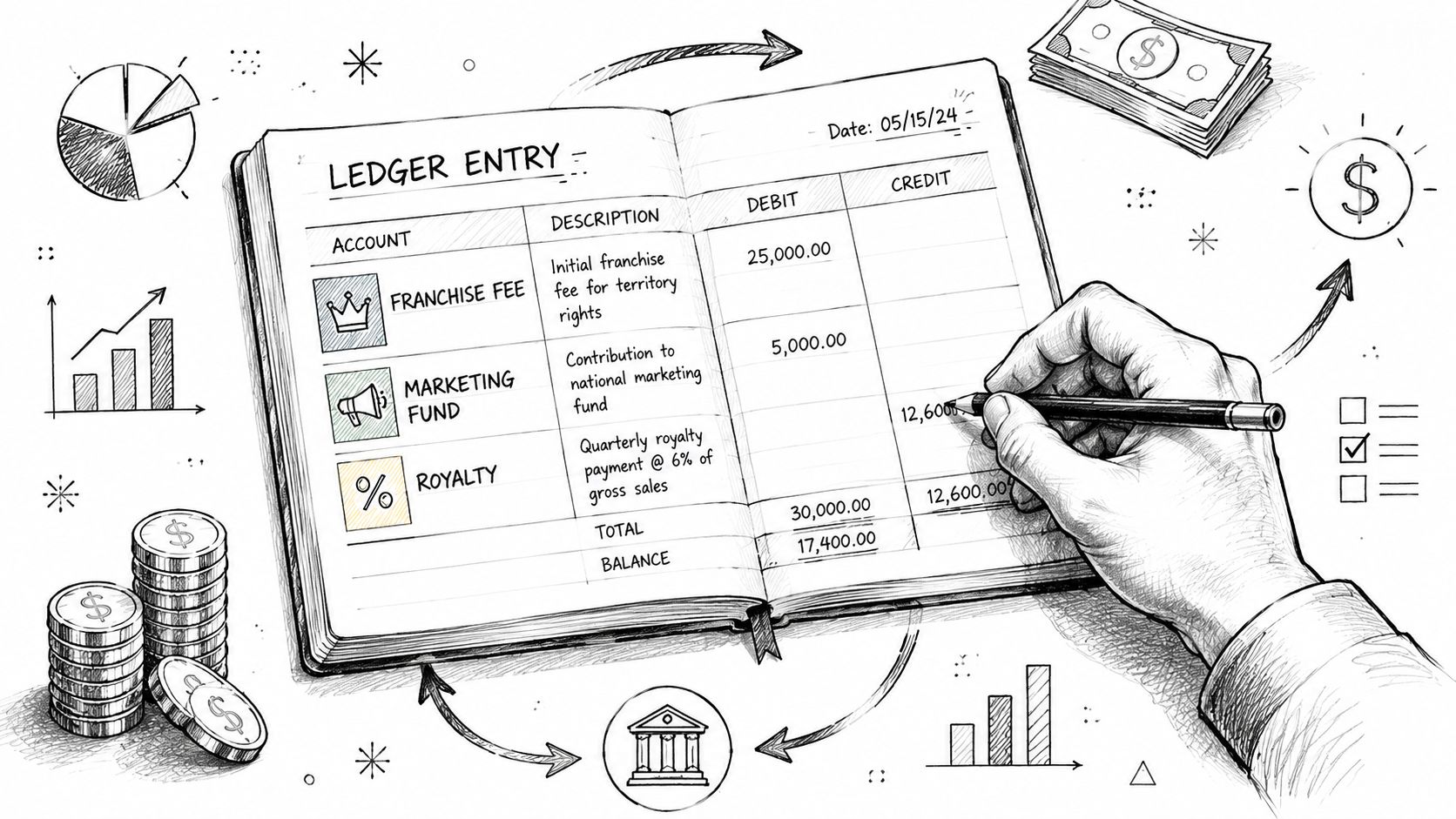
The initial franchise fee is not the same as the monthly royalty. According to NetSuite's overview of franchise accounting, franchisee accounting typically capitalizes the initial franchise fee and expenses royalties and marketing costs, while franchisors recognize initial fees over time under the revenue recognition framework tied to ASC 606 in U.S. GAAP and IFRS 15 internationally.
In plain terms, that means the upfront fee usually belongs on the balance sheet first, not entirely on the Profit & Loss in the month you paid it. Ongoing royalties and marketing fund contributions are different. Those are recurring operating costs and belong in the period they relate to.
A workable franchise setup usually includes these accounts and workflows:
Franchise fee asset account. This captures the capitalized initial fee.
Amortization expense account. Your accountant uses this to recognize the cost over the appropriate period.
Royalty expense account. Kept separate from general commissions or merchant fees.
Marketing fund expense account. Separate from local store advertising so you can see what the brand requires versus what the unit spends locally.
This distinction matters because owners often distort their first-year results by expensing the wrong item in the wrong period. Then they make decisions off a P&L that doesn't reflect how the business performs.
A related point comes up with resale and taxable purchases. Franchises that buy inventory, packaging, or resale items need the paperwork side handled correctly too. If that area is fuzzy, it's worth reviewing the basics of what a resale certificate is and how it fits into your purchasing process.
Automate the recurring pieces
Royalties and marketing contributions are simple in theory. In real life, they go wrong when someone calculates them manually from incomplete sales data.
The fix is operational, not philosophical. Connect the Point of Sale system to your accounting workflow so gross sales data flows in on a consistent basis. Then build the royalty and marketing calculations from that source. This reduces disputes, short payments, and messy month-end catch-up entries.
What usually works:
Use gross sales from the POS as the source of truth. Don't calculate from bank deposits.
Create recurring rules for royalty and marketing accruals. The books should reflect the obligation before cash leaves the account.
Hold reserve balances separately. Royalties, marketing funds, and taxes should not sit mixed into general operating cash.
Reconcile sales reports to accounting totals monthly. Delivery apps, refunds, discounts, and gift card activity often create mismatches if nobody reviews them.
If the royalty number is built from a spreadsheet someone updates by hand, it will fail at the worst possible time. Usually during an audit or a cash squeeze.
This is one area where owners benefit from discipline more than sophistication. A plain setup with clean data beats a clever setup that depends on memory.
Solving the Multi-Location Puzzle
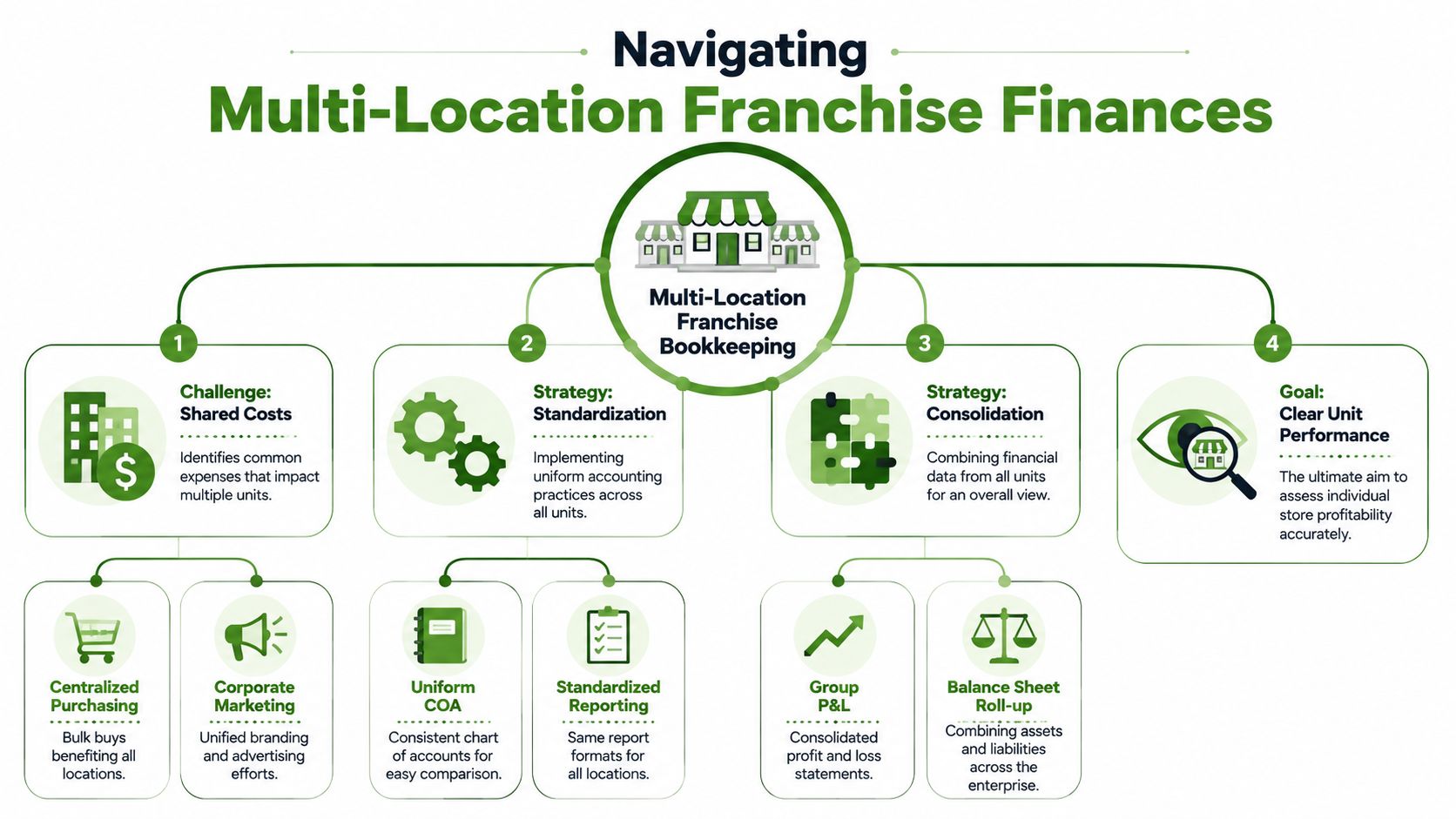
The hardest problem in bookkeeping for franchises isn't entering transactions. It's getting unit-level truth without destroying consolidated reporting.
Why consolidated reports hide the problem
A multi-unit owner can have perfectly balanced books and still have no idea which store is carrying the business. Recent industry analysis indicates that 68% of franchisees struggle with location-specific revenue drift because their accounting software blends centralized expenses with local operating costs, which makes unit performance inaccurate.
That drift usually shows up in familiar ways. One store absorbs all payroll processing fees because its manager entered the bill. Corporate software lands in the oldest location by habit. Shared regional manager wages never get allocated at all. Then the owner compares units and reaches the wrong conclusion.
The issue isn't whether to standardize or consolidate. You need both. Standardization makes the data comparable. Consolidation gives you the enterprise view. But if you consolidate before shared costs are allocated properly, the unit-level P&Ls become misleading.
A solid technology stack helps because these workflows involve repeating classifications and clean syncs across systems. For firms managing several entities or locations, Cloudvara cloud hosting for accounting firms is a useful reference point for thinking through software access, consistency, and centralized file management.
Later in the section, it's helpful to see a short visual explanation of the reporting tension involved:
A practical allocation framework
Here's the framework that works in practice.
First, separate shared costs into categories before allocating anything:
Shared cost type | Common examples | Best allocation basis |
|---|---|---|
Revenue-driven | Brand marketing, royalties tied to sales | By store sales |
Labor-support | Shared manager, payroll admin | By labor hours or headcount |
Occupancy-support | Regional storage, common equipment | By store usage or even split |
Technology and admin | Software, bookkeeping, insurance admin | By store count or defined policy |
Then apply four rules.
Post the original charge to a central bucket first. Don't guess the split during bill entry if the source document doesn't support it.
Use a consistent basis for each category. If payroll admin is allocated by headcount this month, don't switch to revenue next month because one store had a bad stretch.
Record the allocation as a separate journal or recurring entry. That preserves the original transaction and makes the logic reviewable.
Review allocated P&Ls alongside the consolidated report. If a store swings sharply after allocations, investigate the basis.
Owners often try to solve this with one location tag and no policy. That isn't enough. You need a written allocation method that anyone can follow. In QuickBooks Online, classes and locations can do the job if they're used consistently. In Xero, tracking categories can handle the same logic.
Shared costs don't become fair because they're split evenly. They become fair because the method is consistent, documented, and tied to how the business actually operates.
If the bookkeeping team can't maintain that structure internally, outside help can be appropriate. For example, outsourced bookkeeping for small business can support recurring allocations, reconciliations, and reporting workflows when a multi-unit file becomes too complex for an owner to manage directly.
Your Monthly Close and Reporting Rhythm
A franchise doesn't need heroic year-end cleanup. It needs a repeatable close every month.
The strongest systems rely on routine. Franchises that implement automated fee calculations and separate reserve accounts for royalties, marketing, and taxes achieve a 92% success rate in meeting reporting deadlines, while those relying on manual entry experience a 38% rate of late submissions.
What a franchise bookkeeping monthly close should include in
A proper close is more than bank reconciliation. It should test whether the books match operations, contracts, and cash obligations.
Use a checklist like this:
Task | Status | Notes |
|---|---|---|
Reconcile operating bank accounts | ||
Reconcile credit cards | ||
Match POS sales to recorded revenue | ||
Verify royalty and marketing fee calculations | ||
Post reserve transfers for royalties, marketing, and taxes | ||
Record and review shared cost allocations | ||
Confirm inter-location transfers and due to/due from balances | ||
Review payroll postings by location | ||
Reconcile major balance sheet accounts | ||
Finalize consolidated and location-level reports |
A few of those steps deserve extra attention.
Sales tie-out: Reconcile POS reports to accounting revenue, not just deposits.
Fee verification: Compare contractual fee logic to what posted in the books.
Balance sheet review: Check clearing accounts, gift card liabilities, and intercompany balances before you publish reports.
Reserve review: Make sure cash set aside for required payments still sits where it should.
If your reconciliation process is weak, the problem usually shows up first in suspense accounts, uncleared transfers, or unexplained differences between stores. That's why regular general ledger reconciliation matters so much in a franchise environment.
The three reports that matter most
Owners often focus on one report and miss the story. You need three views together.
Consolidated Profit & Loss shows whether the business as a whole is viable. It allows you to assess total overhead, group margin, and whether central functions are sized appropriately.
Balance Sheet shows whether the operation is stable. It tells you if reserves exist, liabilities are building, receivables are stale, or the business is funding itself with delayed obligations.
P&L by location or class tells you where performance is coming from. This is the report that helps you evaluate managers, labor patterns, pricing, and occupancy pressure by unit.
Review the consolidated P&L for strategy, the balance sheet for control, and the location P&L for decisions. Owners get into trouble when they use one report to answer all three questions.
A monthly close works when it arrives fast enough to act on it. If you're reviewing numbers too late, you're not managing. You're documenting what already happened.
Optimizing for Growth and Tax Readiness
Once the bookkeeping is stable, the next shift is strategic. The books shouldn't just satisfy the franchisor and the tax preparer. They should help you decide when to open, when to pause, and which unit economics are durable.

Plan for variable fees before they hit cash flow
A growing number of franchise systems are moving beyond static royalties. The trend of variable royalty structures and performance-based fees has increased 22% in the last 12 months, and those arrangements can create uneven cash flow and possible asset impairment concerns under GAAP if they aren't tracked properly.
Owners often budget royalty expense as if it will behave the same way every month. That assumption breaks when fees change with performance thresholds, regional targets, or hybrid revenue models. If your agreement includes variable components, build separate tracking for them from the start.
A practical approach looks like this:
Model the fee logic inside your monthly reporting package. Don't wait for quarter-end to discover the effective rate changed.
Keep the contract summary close to the books. The accounting team should know the definitions of gross sales, exclusions, and timing.
Watch the franchise asset on the balance sheet if sales weaken materially. The accounting consequences can extend beyond monthly expense recognition.
Use forecasting, not just historical reporting. Variable fees turn bookkeeping into a cash planning exercise.
For owners trying to reduce manual finance work while maintaining review controls, DigiParser's guide to finance efficiency is a useful operational resource. It helps frame where automation can support payables and document handling without replacing accounting judgment.
Keep books tax-ready while you scale
Growth usually makes tax compliance harder, not easier. More locations mean more registrations, more sales tax exposure, more payroll complexity, and more chances for one unit to drift from the system.
Tax-ready books come from year-round habits:
Separate sales tax liabilities from revenue. Don't let tax collected inflate store performance.
Reconcile liability accounts monthly. Payroll taxes, sales taxes, and franchise-related accruals should never be allowed to age without review.
Maintain documentation by location. Lease files, franchise agreements, state notices, and permit renewals should line up with the accounting records.
Standardize cutoff procedures. Bills, payroll, and deposits need to land in the right period if you want unit comparisons to mean anything.
This is also where the right service model matters. Some owners can manage with an internal admin and an outside CPA. Others need ongoing support from a bookkeeping partner that handles month-end close, reconciliations, payables, payroll coordination, and clean reporting across locations. Book Tech LLC is one example of a provider that supports monthly bookkeeping, catch-up work, payroll administration, A/P and A/R management, and QuickBooks Online or Xero workflows for small businesses, including multi-location operations.
Growth magnifies weaknesses. Clean books don't just make tax season easier. They give lenders, buyers, and your own management team a credible view of what each location is doing.
If your franchise books need tighter reporting, clearer location-level profitability, or a cleaner monthly close, Book Tech LLC can help you build a practical bookkeeping system around QuickBooks Online or Xero, with tax-ready records, reconciliations, and reporting workflows that fit multi-location operations.

