
Bookkeeping for LLC Complete Setup Guide
You're probably staring at a pile of receipts, a business bank feed, and one personal charge you can't quite remember, wondering whether your LLC books are “good enough” for tax time. That's the exact point where bookkeeping stops being a side task and starts being the system that protects your cash flow, your deductions, and your records if anyone ever asks questions later.
Book keeping for LLC works differently because an LLC is a legal structure, not a tax category. The way you record draws, distributions, payroll, owner contributions, and retained documents depends on how the LLC is taxed, and that's where a lot of clean businesses get messy fast.
Table of Contents
Why Bookkeeping for Your LLC Works Differently - The LLC is a legal wrapper, not a bookkeeping shortcut - What breaks first when the books are loose
How Your LLC Tax Status Shapes Your Books - Single-member LLCs need clean owner tracking, not fake expenses - Multi-member LLCs need capital accounts that actually mean something - S-corp LLCs add payroll to the mix
Setting Up Your LLC Chart of Accounts and Software - Build the chart around how money actually moves - Choose software that supports control, not just convenience
Your Monthly Close Routine That Keeps Books Accurate - Close in a fixed order - Watch the error rate, not just the balance - Use a short close checklist every month
Catch Up and Cleanup Without Making It Worse - Triage the mess in the right sequence - Know when automation helps and when it doesn't
Tax Ready Reports and Records That Protect Your LLC - Build a filing habit around retention, not panic - Turn the books into a management habit
Why Bookkeeping for Your LLC Works Differently
A client once brought me an LLC with active revenue and a bank feed full of personal transfers, vendor payments, and vague “miscellaneous” charges. The business existed, but the books did not explain it well. Owner draws were buried in expense accounts, reimbursements were delayed, and the tax preparer had to reconstruct the year from bank statements and memory.
That problem usually starts when owners treat an LLC like a standard small business and expect one bookkeeping setup to fit every tax treatment. It does not.
The LLC is a legal wrapper, not a bookkeeping shortcut
An LLC gives you liability structure, but the books still have to show business activity separately from owner activity. That separation matters because mixed funds weaken the record trail and make cleanup slower. Every transfer that is left unlabeled becomes another line item someone has to untangle later.
Practical rule: if a charge belongs to the business, it should hit a business account first. If money leaves the business for the owner, label it that way in the books instead of pushing it into an expense category.
The issue is often not software. It is that the chart of accounts, bank accounts, and equity tracking never matched how the LLC runs. Once those pieces drift apart, the numbers stop explaining the business and start creating extra work for everyone who touches the file.
What breaks first when the books are loose
Owner draws usually break first. After that comes capital tracking, since owners stop distinguishing contributions from distributions and the equity balance turns noisy. Add payroll for an S-corp election, and the books can quickly disagree with the tax treatment of the entity.
Record retention has the same problem when it is handled casually. The IRS record retention rules call for keeping records for the required period based on the filing and payment dates, with longer retention in certain cases and separate payroll record rules, as outlined in the IRS record retention rules. In practice, that means an LLC bookkeeper has to preserve support, not just post transactions. A clean month is useful. A supportable return is what protects the business later.
Single-member LLCs, multi-member LLCs, and S-corp elections all change the daily mechanics. Draws, capital accounts, payroll, and owner payments have to be tracked differently, and the books need to match that tax status instead of forcing everything into one generic setup.
If the books are built correctly, they do three jobs at once. They keep cash flow readable, support the tax return, and make cleanup much easier if the file ever falls behind.
How Your LLC Tax Status Shapes Your Books
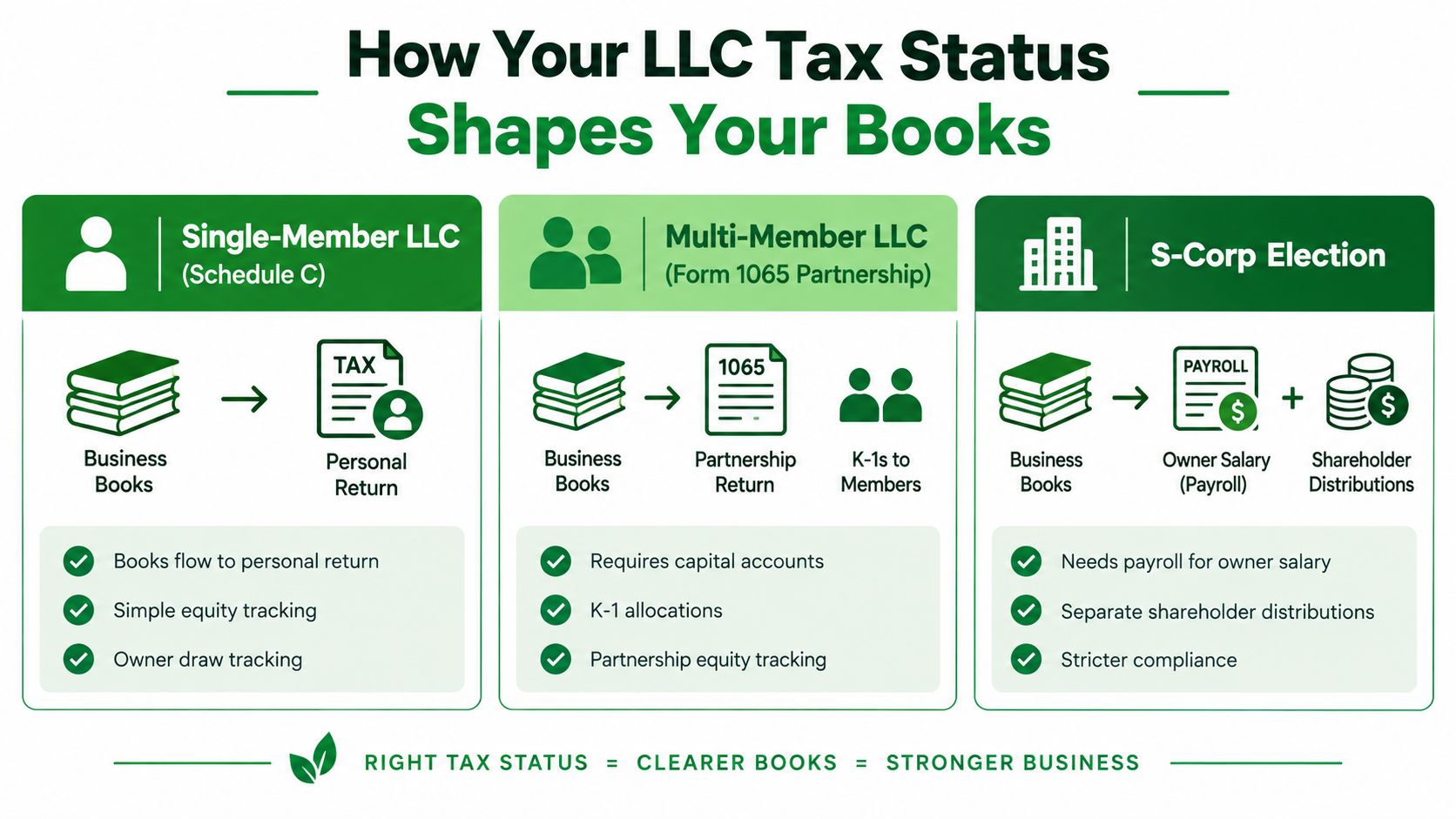
The biggest mistake I see is owners setting up bookkeeping before they know how the IRS will treat the LLC. That order is backwards. The tax classification determines the bookkeeping mechanics, not the other way around.
A useful starting point is to find the right LLC tax form before you build your chart of accounts, because the form affects how income flows, how equity is tracked, and whether payroll belongs in the picture. If you also need a deeper entity-level reference, the filing distinctions tie closely to how business payments get handled, including whether a corporation receives 1099 reporting in certain cases, which is why a reference like this corporate 1099 guide can help clarify vendor classification.
Single-member LLCs need clean owner tracking, not fake expenses
A single-member LLC taxed on Schedule C is usually the simplest setup. Income and expenses flow to the owner's return, but that doesn't mean owner activity should vanish into the P&L. Owner draws are not business expenses, so they belong in equity or owner draw accounts, not in software subscriptions or office supplies.
The practical workflow is straightforward. Put business revenue and expenses in the business books, record owner contributions separately, and tag every personal withdrawal as an owner draw. That keeps the profit-and-loss statement useful and prevents the owner's personal spending from polluting operating results.
Multi-member LLCs need capital accounts that actually mean something
A multi-member LLC taxed as a partnership is a different animal. It must track partner capital accounts and allocations carefully, because distributions don't work like vendor payments and owner draws don't work like expenses. If the books don't reflect each member's contributions and distributions accurately, the K-1 process gets messy and disputes get harder to resolve.
Many generic bookkeeping setups fail. They may show total income and total spending, but they don't preserve the ownership story behind those numbers. Multi-member books need the equity section to be active, current, and understandable to both the bookkeeper and the CPA.
S-corp LLCs add payroll to the mix
Once an LLC elects S-corp taxation, payroll enters the picture. Owner compensation needs to be tracked as salary through payroll, while shareholder distributions stay separate. That split matters because the books must clearly distinguish compensation from equity movement, and the wage records need to stay aligned with the payroll system.
The accounting method matters too. Under the IRS cash method, income is recorded when cash is received and expenses when paid. Under accrual, income is recorded when earned and expenses when incurred, regardless of payment timing, and IRS guidance notes that the cash method is generally available to many small businesses while some entities and inventory businesses may need accrual or a hybrid approach (IRS Publication 538). The clean sequence is to confirm tax-method eligibility, map each transaction to its recognition point, and keep receivables and payables subledgers aligned so the books and tax reporting don't drift apart.
If receivables, payables, and payroll don't match the tax method, month-end reports will look fine while the tax return quietly goes sideways.
Setting Up Your LLC Chart of Accounts and Software
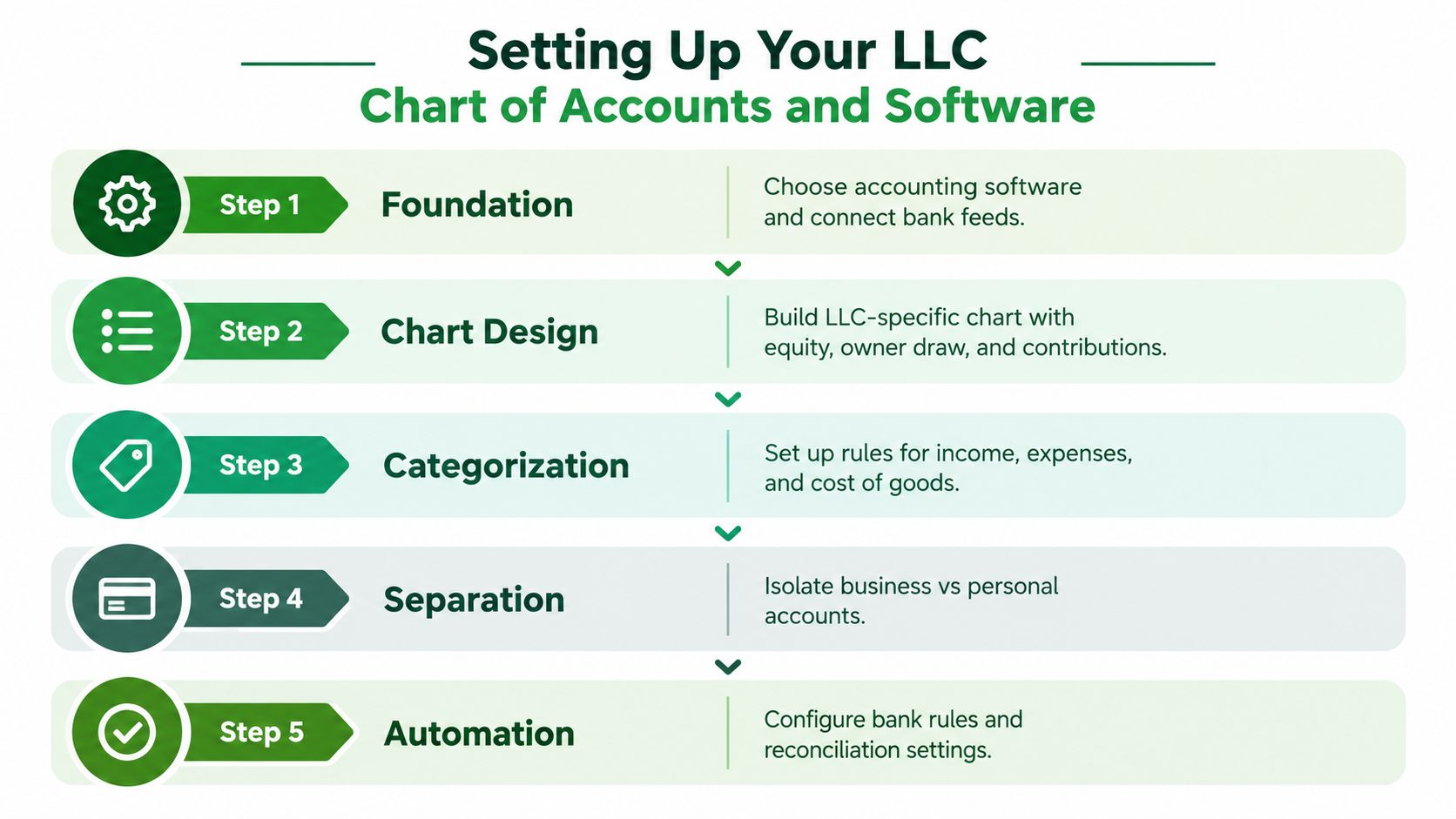
A clean chart of accounts is the difference between bookkeeping that supports decisions and bookkeeping that just stores transactions. For LLCs, the default software template is often too generic. It may work for a freelancer with a handful of invoices, but it usually falls apart once there are owner transfers, payroll, sales channels, loans, or inventory.
Build the chart around how money actually moves
Start with the equity section. You need a place for owner contributions, a place for draws or distributions, and, if the LLC has multiple members, a structure that preserves each owner's capital activity. Without those buckets, people start dumping everything into an “owner equity” catch-all, and that's where clarity dies.
Banking separation matters just as much. Business funds should live in business accounts, business cards should fund business purchases, and owner contributions should be documented when personal money enters the company. Transfers from Shopify, Stripe, and similar platforms should be mapped consistently so deposits don't get double-counted or split across unrelated income categories.
A useful rule set for fund flow:
Owner contributions: record them as equity, not income.
Owner withdrawals: record them as draws or distributions, never as expenses.
Merchant payouts: match the net deposit to the underlying sales and fee records, not to one lump income line.
Loan proceeds: keep them out of revenue categories, because they're financing activity, not sales.
Choose software that supports control, not just convenience
QuickBooks Online and Xero both can work well if they're configured with discipline. The issue usually isn't the platform, it's the setup. Bank feeds need review rules, sales tax settings need to match the business, products and services need to map correctly, and user permissions should be limited so one mistaken click doesn't rewrite a month of clean work.
A practical setup includes bank feeds, rule-based categorization, and a real review routine for exceptions. That reduces duplicate coding, but it doesn't eliminate the need for human oversight. If the feed pulls in a Stripe payout, a payroll debit, and a bank transfer at the same time, someone still has to understand the transaction trail before posting it.
For a more technical chart-of-accounts reference, the structure used in this Xero chart of accounts guide lines up well with the same logic: define equity cleanly, separate income streams, and keep liability accounts from being used as junk drawers.
The embedded workflow matters more than the app. If the chart is right, the software can help. If the chart is wrong, the software just makes the mistakes faster.
The video below is useful for owners who want to see the setup logic in one pass.
Your Monthly Close Routine That Keeps Books Accurate
A monthly close only works if it's treated like a routine, not a rescue mission. For most LLCs, the goal is to finish the period quickly, spot the odd items while they're still fresh, and keep the tax trail intact. Once owners let two or three months pile up, the cleanup time multiplies because the questions are no longer tied to memory.
The best close routines are boring in the right way. They follow the same order every time, which is exactly what keeps the books trustworthy.
Close in a fixed order
Start with bank and credit card feeds, then match and categorize the transactions that have clear support. After that, reconcile every account that moves money, including loans and payment platforms, so deposits, fees, and transfers all tie back to source records.
Practical rule: don't reconcile around a mystery. Find the missing piece first, then close the account.
A strong close also includes A/P and A/R aging, payroll review, and a quick check of the financial statements for anything that looks off. If invoices are aging in the wrong period or bills are sitting unpaid because someone forgot to post them, the income statement can look healthier than the business really is.
Watch the error rate, not just the balance
One industry source cites manual reconciliation error rates of 3% to 5%, and another recommends keeping reconciliation error rates below 2% to maintain reliable financial reporting (bookkeeping KPI guidance). The useful habit is to calculate error rate as errors ÷ total reconciliations × 100 and then investigate the cause, not just the count.
Common failure points are easy to spot once you know them. Missed timing differences happen when deposits hit the bank on a different day than the invoice, uncoded owner draws hide in personal-looking transfers, duplicated expenses show up when a receipt is entered twice, and delayed matching of deposits to invoices makes revenue look stranger than it is. These issues hit harder in high-transaction businesses such as e-commerce, construction, and multi-location operations.
Use a short close checklist every month
Categorize and match: clear the bank feed before you move to reports.
Reconcile every account: include bank, credit card, loan, and payment-platform balances.
Review open items: check A/R, A/P, and unpaid reimbursements.
Post payroll correctly: confirm wages, taxes, and owner compensation are separated where needed.
Scan the statements: look for balance sheet changes that don't make sense.
Lock the period: close the books within a tight window so changes don't drift.
If you want a software-specific walkthrough, this QuickBooks Online close guide is a useful companion when your team needs a repeatable month-end process.
Catch Up and Cleanup Without Making It Worse
Cleanup gets messy fast when someone tries to fix every month at once. Start with bank reality, then rebuild the accounting around it. Statements and transaction histories are the only stable ground once the books fall behind.
That matters even more for LLCs pulling data from multiple systems. Shopify, Stripe, payroll platforms, and bank feeds rarely line up in the same order, and skipping reconciliation usually adds a second layer of errors on top of the first.
Triage the mess in the right sequence
Reconcile the bank and card balances to the statements first. Once those balances tie out, rebuild opening balances where needed, then recode transactions methodically instead of jumping around by month.
After that, handle the platform-to-bank mismatch. A Stripe payout is not sales revenue, and a payroll debit is not an owner draw. Those distinctions matter because cleanup has to support the tax treatment of the LLC, not just make the file look neat.
Cleanup rule: never recode a transaction before you understand what cleared the bank.
Know when automation helps and when it doesn't
Automation helps with routine categorization, anomaly detection, and feed matching. It does not replace judgment when owner transfers, split deposits, or mixed-purpose charges show up. If a personal card paid for business expenses, or a business card paid for personal items, a person still has to classify it correctly.
LLC tax status changes the cleanup work too. A single-member LLC needs clean owner draw tracking, a multi-member LLC needs capital accounts that reflect each member's activity, and an S-corp election adds payroll tracking that has to stay separate from distributions. If those pieces are blurred, the cleanup will look finished on paper and still break at tax time.
A virtual bookkeeping partner like Book Tech LLC can take over those catch-up projects, rebuild the records, and keep the cleanup aligned with the entity structure instead of the transaction feed. For a practical reset, this cleanup bookkeeping guide is a useful reference when months of coding, reconciliations, and owner activity need to be untangled without losing the trail.
Tax Ready Reports and Records That Protect Your LLC
A tax-ready LLC file answers the CPA's questions before they get asked. It should show what the business earned, what it spent, what it still owes, and what needs support from receipts or contracts.
The core package is straightforward. Keep reconciled profit and loss, balance sheet, cash flow, A/R aging, A/P aging, and the source documents behind unusual or material entries. If you want a plain-language refresher on how the reports connect, this profit and loss statement reference shows how revenue, expenses, and net result fit together.
Build a filing habit around retention, not panic
Keep your files around IRS record-keeping guidance for businesses, not around whatever feels tidy in the moment. Bank statements, receipts, payroll files, contracts, and return support need to stay organized enough to survive review, including the usual lookback periods and the 4-year employment tax record rule for payroll files. That works best when each month closes with the source documents attached and archived in the same place as the reports.
Receipt and report storage also needs a real workflow. If receipts live in email, PDFs live on a desktop, and payroll reports sit in three different portals, the handoff to your CPA slows down fast. Tools that streamline document workflows help only when they keep each report tied to its source document, not when they move clutter into a new folder.
Turn the books into a management habit
Owners who review the numbers weekly usually catch trouble sooner. A short look at cash, open invoices, unpaid bills, and payroll timing keeps the books useful for decisions, not just compliance. For LLCs taxed in different ways, those reviews also keep the bookkeeping aligned with the entity's daily mechanics. A single-member LLC needs owner draws tracked cleanly. A multi-member LLC needs capital accounts that reflect each member's activity. An S-corp election adds payroll tracking that has to stay separate from distributions.
A brief advisory check-in helps too, because it forces the reports to answer real questions about spending, hiring, and growth. When the books stay current, the tax file stays easier to defend and easier to run.
That is the standard for Book keeping for LLC. Clean records, traceable support, and reports that hold up when the return is filed or questioned.