
Bookkeeping for Real Estate Agents: A Practical Guide
You're watching a commission wire clear and the balance looks healthy, but the number on the bank statement doesn't tell you what happened. You may know the gross commission, yet still need to confirm the brokerage split, a referral fee, transaction charges, marketing costs, and whether any money belongs in a trust account rather than your operating account.
That's the central bookkeeping problem for real estate agents. Revenue arrives in irregular, transaction-sized bursts, and one closing can affect income, expenses, liabilities, receivables, and cash flow at the same time. A spreadsheet that treats every deposit as simple revenue usually starts drifting as soon as multiple parties, delayed disbursements, or post-closing adjustments enter the picture.
The reliable alternative is transaction-first bookkeeping. Every entry should connect to the property address, contract and closing dates, gross commission, split percentage, fees, and the account where the money moved. That approach gives you cleaner tax records and reports you can use to decide which deals are profitable, how much cash is available, and when your books are ready for a CPA.
Table of Contents
Why Real Estate Bookkeeping Is a Different Game - One closing creates several accounting events
The Transactions Every Agent Needs to Capture - Commission income and broker deductions - Referral fees and deal expenses - Trust money and property-related funds
A Chart of Accounts Built Around Deals - Real Estate Agent Chart of Accounts
Tax Compliance and Schedule C for Agents - The three controls that matter most - Schedule C Line Items Most Relevant to Real Estate Agents
Setting Up QuickBooks Online or Xero the Right Way - Configure the system around the workflow
Reconciliations That Keep Your Books Audit-Ready - The records to preserve
Reports That Actually Move Your Business Forward - Monthly Real Estate Agent Reports
Why Real Estate Agents Bookkeeping Is a Different Game
An agent can receive a broker disbursement that looks like ordinary income, then discover that the deposit already reflects the brokerage split, transaction fees, and other deductions. To explain that one bank entry, the books must answer: What was the gross commission? What percentage went to the broker? Which referral fee remains payable? Was any amount held or returned?
Real estate agents in major markets such as the United States are typically independent contractors. They generally report business income on Schedule C and must maintain contemporaneous records for commissions, splits, referral fees, mileage, and deductible expenses, as outlined in real estate agent tax recordkeeping guidance. Irregular closings make transaction-level documentation more useful than a generic income-and-expense list.
One closing creates several accounting events
A brokerage may send one deposit after retaining its share and transaction fees. The bank feed shows one inflow, but the closing file should support each underlying accounting entry:
Gross commission income, tied to the closing date and property.
Brokerage split, recorded separately rather than hidden in net revenue.
Desk, transaction, or franchise fees, categorized by their actual purpose.
Referral fees, separated into income received or expense paid.
Deal-related marketing or insurance costs, linked to the property or closing.
Operating cash movement, reconciled to the bank statement.
Trust and escrow money requires separate treatment. Earnest money, security deposits, and other client funds generally are not operating revenue because they pass through an account. Record them as liabilities and reconcile the related account carefully.
Practical rule: If a deposit cannot be traced to a closing date, gross commission, split percentage, and supporting statement, the books are incomplete even when the bank balance reconciles.
Generic small-business templates often assume invoices, predictable collection dates, and a simple cost-of-sales pattern. Agent books need closing documentation at the center of the process. A property professional reviewing property tax accounting with INTELLI should also keep property-related accounting separate from records for commission income and deal expenses.
The Transactions Every Agent Needs to Capture
A closing deposit can look simple in the bank feed. The closing file usually tells a different story. One deposit may combine gross commission income, the brokerage split, transaction fees, referral payments, and reimbursements. Classify each component from the settlement statement and supporting documents before assigning a software category.
Commission income and broker deductions
Record the gross commission for the property and closing date first. Then record the brokerage's retained share, desk fees, and transaction charges on separate expense lines. For example, a settlement statement showing a gross commission of $12,000 and a 70% agent share produces $8,400 before other deductions. Your figures will vary, but the control stays the same: show gross revenue and each deduction independently.
A net-deposit entry hides the cost of working through the brokerage and understates production. The IRS Publication 334 guidance for self-employed businesses supports separating gross business income from deductible expenses.
Referral fees and deal expenses
Track referral income received separately from referral fees paid. A payment to another agent is an expense tied to producing a particular commission, not a reduction of commission revenue. Attach the referral agreement, identify the related transaction, and review the payment for applicable reporting requirements.
Use the same transaction-first method for E&O insurance charged per deal, listing photography, staging, signs, advertising, and client concessions. If you pay a cost and later bill it back, record the original expense and reimbursement separately unless your CPA directs another treatment. This preserves the deal's actual cost and prevents reimbursements from being mistaken for new commission income.
Trust money and property-related funds
Earnest money and security deposits belong in pass-through or liability balances, not ordinary income. Keep trust or escrow activity separate from operating funds. Match every deposit, transfer, refund, and disbursement to the related property and supporting record.
An agent who also manages rentals or investor properties needs separate tracking for property-management fees, rental collections, owner distributions, and expenses paid for an owner. A dedicated workflow for property management bookkeeping helps keep those balances apart from sales commissions.
For each closing, capture at least:
Property address: Use one consistent identifier in the ledger and document folder.
Contract and closing dates: Show when the transaction was earned and when cash cleared.
Gross commission: Record the amount before broker or referral deductions.
Split percentage: Preserve the agreed allocation.
Fees and payouts: List brokerage charges, referrals, and deal-specific costs.
Account movement: Identify transfers through operating, trust, or another segregated account.
A Chart of Accounts Built Around Deals
A deal-based chart of accounts should let you trace a deposit back to its closing. Each line needs to show the revenue stream, the cost of producing that income, or money held for another party. The account structure stays consistent, while the transaction record carries the property and closing detail.
Use account names that match how commissions move. Add classes, locations, projects, or transaction tags for the property, agent, or team when your accounting platform supports them.
Real Estate Agent Chart of Accounts
Category | Account Name | Account Type | Typical Use |
|---|---|---|---|
Income | Gross Commission Income | Income | Full commission earned on closed transactions |
Income | Referral Income Received | Income | Referral fees received from other agents or firms |
Income | Property Management Fees | Income | Fees earned for managing rental or investor property |
Cost of Sales | Brokerage Splits | Expense | Brokerage-retained share of commission |
Cost of Sales | Desk and Transaction Fees | Expense | Deal or brokerage charges tied to production |
Cost of Sales | E&O Insurance Per Deal | Expense | Transaction-specific professional coverage |
Cost of Sales | Referral Fees Paid | Expense | Referral payouts owed or paid to other agents |
Operating Expense | Marketing and Advertising | Expense | Digital ads, signs, print, website, and listing promotion |
Operating Expense | MLS and Association Dues | Expense | MLS access and professional memberships |
Operating Expense | Auto and Mileage | Expense | Business transportation records and related costs |
Operating Expense | Education and Licensing | Expense | Continuing education, licensing, and training |
Operating Expense | Office and Software | Expense | Supplies, accounting software, CRM, and technology |
Liability | Earnest Money Held | Other Current Liability | Client funds held for a transaction |
Liability | Security Deposits Held | Other Current Liability | Deposits held for managed property |
Liability | 1031 Exchange Funds Held | Other Current Liability | Funds held for an exchange workflow |
Asset | Due From Clients or Owners | Other Current Asset | Reimbursable costs or balances awaiting collection |
Keep the chart compact. Labels such as “miscellaneous fees” hide whether a charge belongs to the closing, the brokerage relationship, or general operations. A stable account structure makes monthly reports comparable. Deal-level detail belongs in classes, locations, projects, or attached transaction records.
A clean chart of accounts should make a closing recognizable before you open the supporting documents.
Do not create a new expense account for every property. That setup produces detail in the wrong place and eventually turns the income statement into a long, difficult-to-reconcile list. Record the closing date, gross commission, split percentage, brokerage deductions, and deal-specific costs in the transaction record, then use the account to identify the financial category.
For an agent whose work overlaps with investments, exchanges, or property ownership, bookkeeping for real estate investors offers a useful reference for separating sales activity from investment-related balances. The same principle applies here: keep the account list readable, and preserve the economics of each closing in the supporting fields.
Tax Compliance and Schedule C for Agents
Most licensed agents paid on commission are treated as self-employed for federal tax purposes and report business income on Schedule C. Your bookkeeping should therefore show gross commission income separately from brokerage fees, referral fees, advertising, mileage, office costs, and education. That separation supports a correct calculation of net business earnings and gives your tax preparer a usable audit trail.
The three controls that matter most
Schedule C classification. Record the commission at the gross level, then categorize the brokerage's retained share and other qualifying business costs as expenses. Don't let the bank feed decide the tax treatment merely because the deposit arrives net of deductions.
Form 1099-NEC reconciliation. At year end, compare your ledger with 1099-NEC forms issued by brokers or clients. The reconciliation should explain differences caused by timing, adjustments, duplicate postings, or payments that belong to another activity. Referral payouts to other agents should be reviewed for the applicable contractor reporting process rather than casually labeled as “commissions.”
Business mileage. The standard business mileage rate for 2026 is $0.725 per mile, as described in 2026 real estate commission and tax guidance. Maintain a contemporaneous mileage log showing the date, business purpose, destination, and miles. Apps that export mileage details into QuickBooks Online or Xero can reduce manual work, but the underlying log still needs to be complete.
Schedule C Line Items Most Relevant to Real Estate Agents
Schedule C Line | Common Agent Transaction | Notes |
|---|---|---|
Gross receipts or sales | Gross commission income | Record the full commission before brokerage splits |
Contract labor | Referral fees or contractor payments | Review payee documentation and 1099 requirements |
Advertising | Digital campaigns, signs, photography, and print | Keep invoices and connect costs to the business purpose |
Car and truck expenses | Business mileage or actual vehicle costs | Use a consistent method and retain the mileage log |
Insurance | E&O, business, or eligible professional coverage | Separate per-deal charges from general coverage |
Legal and professional services | CPA, bookkeeping, legal, or consulting fees | Keep engagement records and invoices |
Office expense | Supplies, software, and business-use office costs | Separate personal purchases and mixed-use items |
Whether an S corporation election makes sense depends on your profit pattern, payroll obligations, state rules, administrative costs, and broader tax position. Your bookkeeper can prepare clean transaction data, but an entity decision belongs with a CPA. A resource focused on CPA bookkeeping services in the USA can help clarify where bookkeeping ends and tax advice begins.
Setting Up QuickBooks Online or Xero the Right Way
A commission deposit can look correct in the bank feed while the books still miss the gross commission, brokerage split, or closing date. QuickBooks Online and Xero record entries, but they do not understand a real estate closing without a deliberate setup. Build the workflow around each deal before processing regular deposits.
QuickBooks Online often fits U.S. agents who need familiar accountant access, bank feeds, contractor workflows, and mileage or receipt integrations. Xero can suit a newer agent or small team that prefers a clear interface and close collaboration with an outside bookkeeper. Choose the platform that can preserve the gross commission, split percentage, trust balances, closing date, and cash date without forcing those details into vague categories.
Configure the system around the workflow
Import the chart of accounts. Set up commission income, brokerage splits, referral fees, operating expenses, assets, and liabilities instead of relying on a generic template.
Connect operating accounts. Link dedicated business checking and credit card accounts. Create rules only for repeatable transactions, then review exceptions manually.
Separate trust activity. Record trust funds through liability accounts, whether connected or entered manually. Earnest money must not become commission income.
Add deal identifiers. Use classes, locations, projects, or memo fields for the property address, closing date, and agent. Select one convention and apply it to every related entry.
Capture documents at purchase. Attach receipts for marketing, mileage support, education, and office costs while the transaction is still easy to identify.
Test one closing. Enter a sample from gross commission to brokerage split, referral fee, and bank deposit. Confirm that the final deposit reconciles to the commission statement.
The guide for San Diego business owners provides general QuickBooks setup context. Real estate workflows still need custom treatment for splits, trust balances, and closing-level records.
QuickBooks Online may be the better fit when U.S. 1099 workflows and third-party integrations drive the work. Xero may be easier for a smaller operation that values a straightforward dashboard. Both platforms require careful handling of split-payee checks, closing-date fields, multi-state filings, and complicated trust arrangements. Xero bookkeeping services in the USA can help configure those records without reducing every closing to a generic expense category.
Reconciliations That Keep Your Books Audit-Ready
A closing can look profitable in the bank feed while the books still miss a brokerage split, referral fee, or client obligation. Reconciliation is the control that connects each deposit and payment to the closing date, gross commission, split percentage, and supporting document.
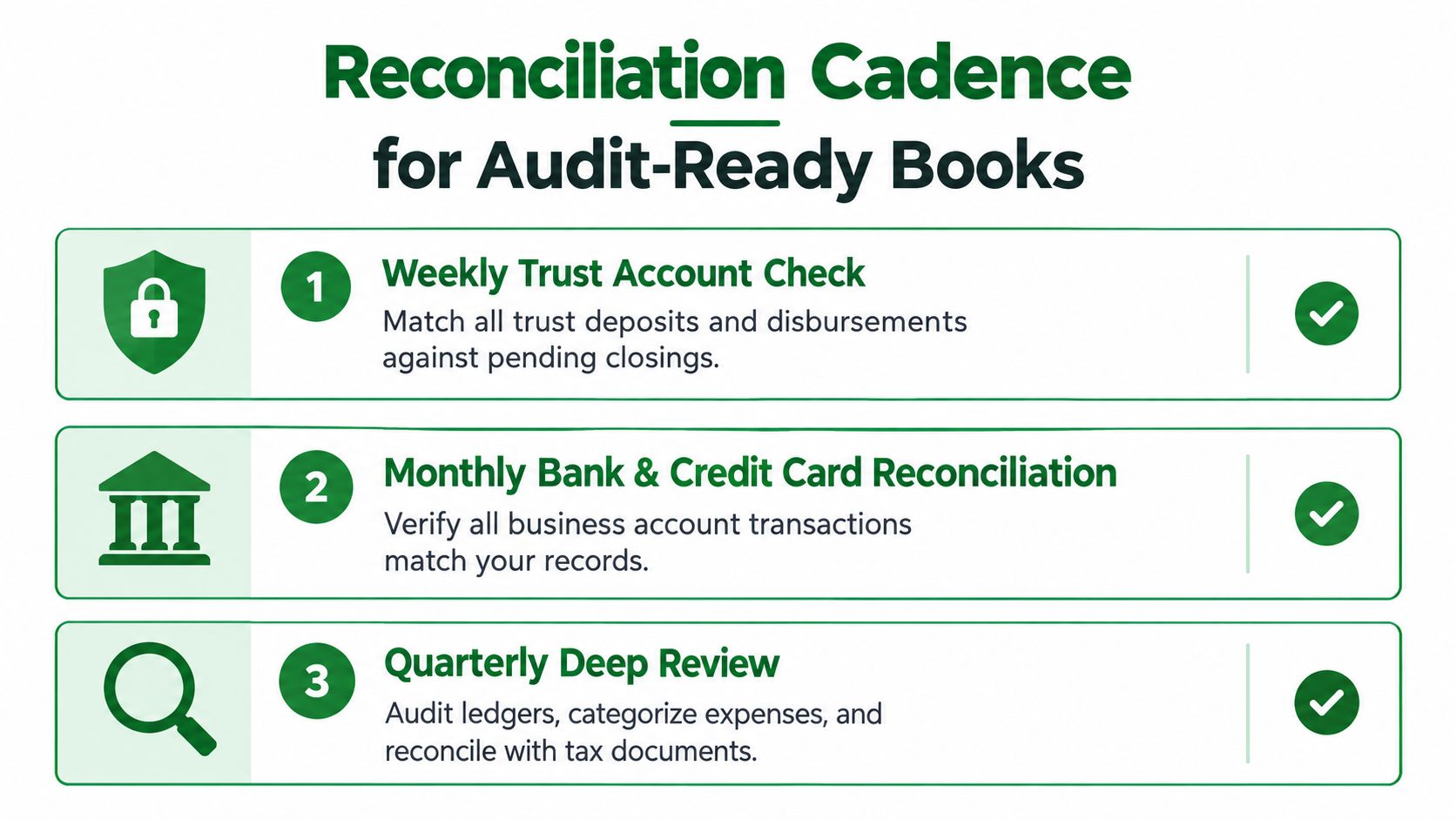
Use a cadence tied to the transaction cycle:
Weekly trust review: Match deposits and disbursements to pending closings, refunds, and authorized transfers.
Monthly bank and credit card close: Match every statement line, investigate duplicates, and attach missing receipts.
Quarterly vendor and tax review: Compare referral payables, contractor records, and 1099 information before filing deadlines create pressure.
Brokerage deposits create frequent errors when one payment covers multiple deals or fees are deducted before payment reaches the bank. Tie the deposit to the broker commission statement, then allocate the gross commission, split percentage, deductions, and net deposit to the correct closing. Keep both the closing date and cash-clear date when they fall in different periods, and follow the accounting method established with your tax adviser.
The records to preserve
Keep closing statements, deposit records, broker statements, receipts, mileage logs, and segregated-account activity in organized digital storage. Tax records generally require a three-year baseline, while seven years may be appropriate for practical audit defense or records involving assets, liabilities, and equity.
Before sending the books to a CPA, confirm that:
Trust transfers move from the liability account to the correct operating or client account.
Escrow refunds reverse the original liability and cash movement without creating income.
Referral payables clear against actual payments and written agreements.
Commission deposits agree to gross statements and documented deductions.
Credit card charges include receipts and transaction identifiers.
The cleanest year-end file comes from a routine closing process, not a rushed search through email and bank statements.
Reports That Actually Move Your Business Forward
Reports earn their place when they answer a transaction or cash question. Review them around closing dates, gross commissions, split percentages, and the cash that remains after deductions.
Monthly Real Estate Agent Reports
Report | Source in QBO/Xero | Key Question It Answers |
|---|---|---|
Profit and Loss by class or property | Class, location, or project reporting | Which agents, properties, or deal types produce usable profit after splits and costs? |
Cash Flow Statement | Cash-basis cash flow report | What operating cash is available after separating trust and pass-through movement? |
Commission Pipeline Aging | Custom transaction or spreadsheet view connected to accounting records | Which pending closings are approaching settlement, and where could timing affect reserves? |
Tax Reserve Summary | Bank balance plus categorized net income | Has enough cash been set aside for estimated taxes based on current commission activity? |
A P&L by class shows whether each closing contributes profit after the brokerage split, referral payout, marketing, and other deal-specific costs. Assign those costs to the related property, agent, or transaction when practical. A team lead can then compare production by deal type and decide whether a fee arrangement or marketing channel deserves review.
The report should reconcile to the commission statement, not just the bank deposit. A closing with a high gross commission may produce limited operating profit after the split and deductions. Reviewing revenue without those transaction-level costs gives a misleading result.
Cash flow needs a separate check. A trust deposit can raise the bank balance without creating spendable business income. Keep liability activity visible, and exclude pass-through movement from operating capacity.
A custom pipeline-aging view links each pending closing to its expected settlement date and recorded gross commission. It cannot predict which deals will close, but it highlights timing risk, concentrated revenue, and reserves that may be committed too early. Saved views in QBO or Xero make the monthly review repeatable. Agents who want a recurring close and report package can use monthly bookkeeping services in the USA to establish that review rhythm.
Best Practices and Common Questions
A delayed closing can expose weak bookkeeping quickly. If the expected commission changes after the settlement date, the books must show the original entry, the reversal, and the replacement amount without obscuring the deal history. Build the routine around each closing: record gross commission, split percentage, deductions, supporting documents, and the date cash cleared.
Review commission arrangements deal by deal. The NAR settlement changed how buyer-side compensation is negotiated and documented, so the transaction file should identify the agreement, payment recipient, brokerage arrangement, and applicable reporting treatment. A familiar split or old expense category may not describe the current closing.
Use technology for repetitive work while reserving judgment for exceptions. AI tools for real estate agents can assist with workflow and administrative tasks, but categorization still needs review when trust money, referrals, or post-closing adjustments are involved.
Questions agents ask
What should I do when a closing is delayed or falls through? In QBO or Xero, reverse the commission accrual or income entry tied to the expected closing, then match the reversal to the original transaction record. Clear related receivables, payables, and referral obligations rather than deleting the audit trail. If a contingent referral fee was paid, document its recovery or write-off beside the agreement.
How should referral income and referral payouts be recorded? Use separate income and expense accounts, and attach the referral agreement and settlement statement to each entry. This preserves gross activity and lets you compare referral production with the cost of obtaining it.
What records should agents retain?Keep closing statements, broker commission statements, receipts, deposit records, mileage logs, and account documentation. Name files with the property or transaction identifier and closing date, then store them where the bookkeeper and tax preparer can retrieve them without searching an inbox.
How should mileage be documented?Log each business trip near the time it occurs, including date, purpose, destination, and miles. Tie the entry to the showing, inspection, closing, or other business purpose. A mileage app can reduce missed trips, but the business purpose still requires review.
When should an agent review the books with a CPA?Quarterly review is appropriate when commission timing, entity choices, referral reporting, or estimated-tax reserves require judgment. Bring the commission statements, transaction-level profit report, unusual adjustments, and current reserve schedule. Waiting until tax season makes missing deal details harder to reconstruct.
Book Tech LLC provides monthly bookkeeping, catch-up and cleanup work, payroll administration, and A/P and A/R support for real estate agents and other U.S. small businesses using QuickBooks Online or Xero. Visit Book Tech LLC to discuss a transaction-first workflow for commissions, splits, trust activity, reconciliations, and tax-ready reports.
