
Liability Management for Small Business: A Practical Guide
If your business is busy, profitable, and still feels tight on cash, you're not doing anything unusual. A lot of owners look at vendor bills, credit cards, loan payments, payroll taxes, and customer deposits, then assume liability management is just a cleanup job for bad months.
That's too narrow.
For a small business, liability management means managing what you owe with the same discipline you use to manage sales. Done well, it helps you protect cash, reduce surprises, make cleaner borrowing decisions, and grow without constantly feeling behind.
Table of Contents
Getting a Clear Picture What You Owe and Where It Goes - Start with two buckets - Set up your chart of accounts the useful way - What to clean up this week
The Monthly Rhythm for Tracking and Reconciliation - The monthly close process for liabilities - The accounts that cause the most trouble - A quarterly review that keeps small problems small
How to Prioritize Payments and Manage Cash Flow - Which bills come first - When to ask for different terms
Measuring Success and Planning for the Future - The ratios worth watching - How restructuring ideas apply to a small business - What to model before you borrow again
Beyond Debt A Proactive Approach to Liability Management
Most owners first think about liabilities when something feels off. Cash is lower than expected. A loan payment hits at the wrong time. Sales tax is coming due. A supplier wants to be paid before shipping the next order.
That's exactly why liability management needs a better frame. It isn't only about surviving pressure. It's about making deliberate decisions while you still have room to choose.

Existing coverage often treats liability management exercises as last-minute tools for distressed companies. But the stronger lesson for a small business is the opposite. Early action gives you more options, and proactive restructuring is most effective before a crisis, when you're managing capital structure to improve liquidity rather than reacting under pressure, as noted in this discussion of early liability management strategy.
In plain terms, liabilities are the money your business owes. That includes unpaid bills, credit cards, payroll taxes, loans, lines of credit, customer prepayments, and anything else your company is obligated to pay or deliver.
Practical rule: Don't wait until a liability is painful to start managing it. The best time to organize debt is when you can still negotiate calmly.
Healthy companies use liabilities strategically all the time. They refinance a note before payments become a strain. They spread out payables without damaging supplier relationships. They separate short-term obligations from long-term debt so the balance sheet tells the truth. They keep a clean audit trail in their books so decisions aren't based on half-correct numbers.
That's the mindset shift. You're not trying to “get out of trouble” by default. You're trying to build a business that handles obligations with intention.
A good liability management process should help you do four things:
See clearly: Know exactly what you owe, to whom, and when it's due.
Protect cash: Time payments without creating avoidable fees, strained vendors, or compliance issues.
Create options: Improve your ability to refinance, renegotiate, or borrow from a position of stability.
Support growth: Use liabilities as part of a workable capital structure, not as a source of constant stress.
Getting a Clear Picture What You Owe and Where It Goes
Before you can improve anything, your books need to show liabilities in the right place. A messy balance sheet makes every decision harder. You can't prioritize payments well if your vehicle loan, payroll tax payable, and old credit card balance are all mixed together.
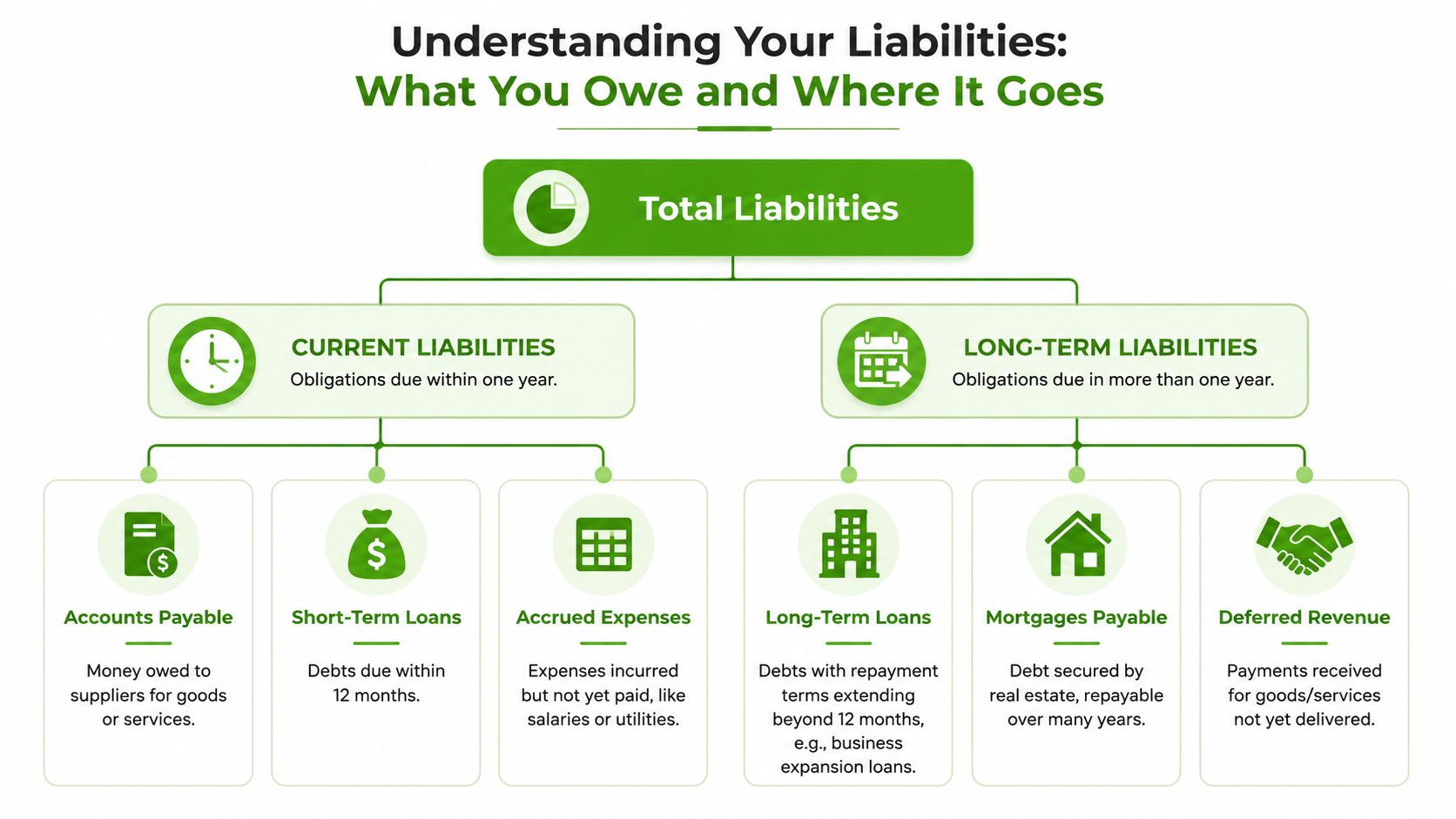
For most small businesses, the fix starts in the chart of accounts and the balance sheet detail. If you already use QuickBooks Online or Xero, you don't need a fancy setup. You need a clean one.
If your payable process is also messy, it helps to review how payables and receivables interact before reorganizing the liability side. This guide to accounts payable and accounts receivable basics is a useful refresher.
Start with two buckets
The first bucket is current liabilities. These are obligations due within a year. Typical examples include:
Accounts payable: Bills from vendors and suppliers
Credit cards: Business card balances you'll pay soon
Payroll liabilities: Employee withholdings, employer taxes, benefits payable
Sales tax payable: Amounts collected and owed to the state
Current loan portion: The next scheduled principal due on longer loans
Deferred revenue: Money collected before you deliver the product or service
The second bucket is long-term liabilities. These are obligations due beyond a year, such as term loans, equipment notes, vehicle loans, and mortgages.
That split matters because it changes how you read risk. A business can look fine at a glance and still be too heavy on short-term obligations.
Set up your chart of accounts the useful way
Generic account names create generic decisions. “Loan Payable” tells you almost nothing. “Vehicle Loan Payable. Ford Transit” tells you what the balance represents.
In QuickBooks Online or Xero, set up separate liability accounts for each major obligation. Keep them specific enough that you can reconcile them quickly and explain them without digging through old statements.
A practical structure looks like this:
Accounts Payable
Credit Card Payable. Chase Ink
Payroll Tax Payable
Sales Tax Payable
Customer Deposits or Deferred Revenue
Loan Payable. Equipment Financing
Loan Payable. Vehicle Note
Current Portion of Long-Term Debt
Line of Credit Payable
Clean liability accounts make month-end faster. They also make lender conversations much easier because you can show exactly what sits where.
For vendor debt collection issues on the customer side, it can also help to review outside ideas on strategies for outstanding balances. Even though that resource focuses on balances due, it's useful because weak collections often create the cash squeeze that makes liabilities feel harder to manage.
What to clean up this week
If your balance sheet has old liability accounts you don't recognize, don't ignore them. Investigate them one by one.
Start here:
Pull the balance sheet detail. Look at every liability account, not just the summary total.
Match each balance to a real statement. Loan statement, tax notice, card statement, vendor ledger, or customer deposit report.
Rename vague accounts. If the account title doesn't tell you what it is, fix it.
Separate current and long-term portions. Don't leave all debt in one account if part of it is due soon.
Flag stale balances. Old sales tax, duplicate loans, and unresolved payroll items are common cleanup issues.
Owners usually feel immediate relief once the liability side is organized. Not because the debt disappeared. Because the uncertainty did.
The Monthly Rhythm for Tracking and Reconciliation
A reliable process beats a heroic catch-up every time. Liability management works best when it becomes part of your monthly operating rhythm, not a panic project after cash gets tight.
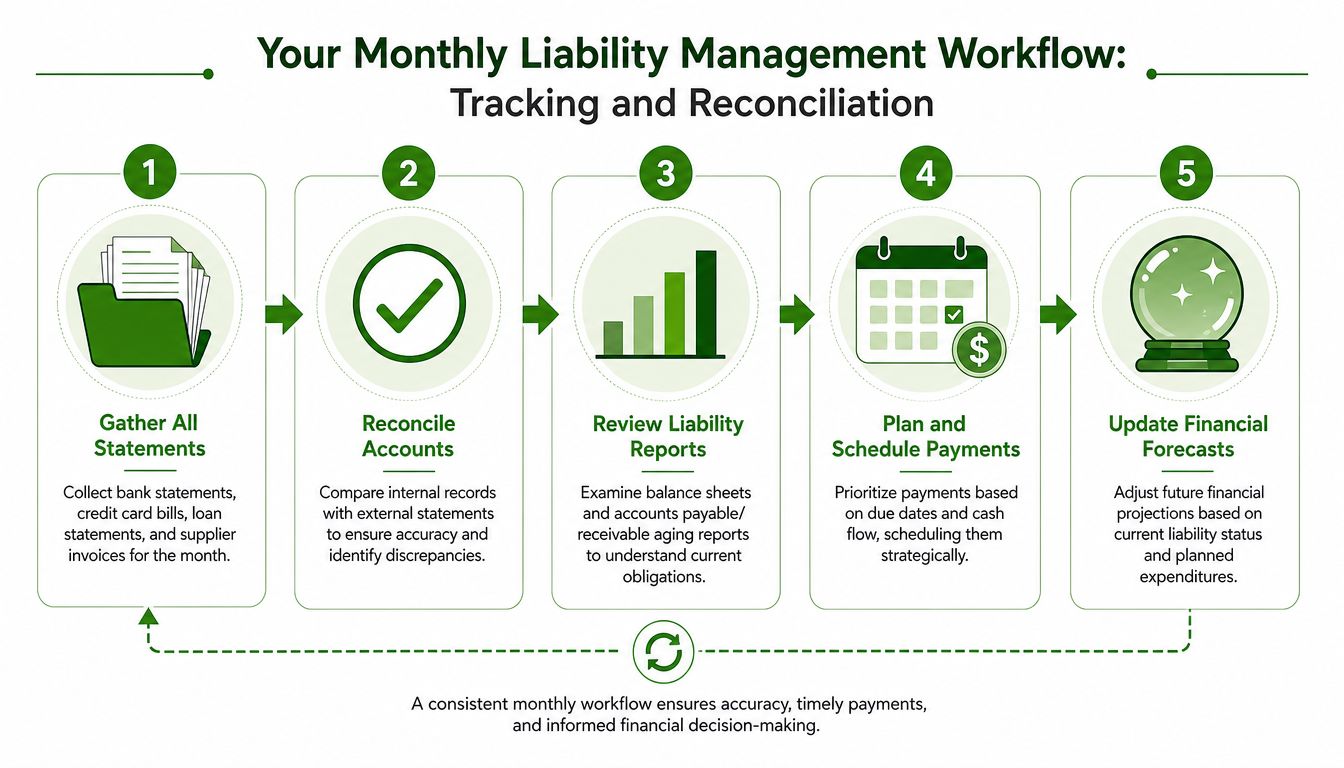
A lot of owners think they're tracking liabilities because they know which bills got paid. That's not the same as reconciling the underlying accounts. Good tracking answers three separate questions: what was owed, what changed this month, and what remains unpaid.
A solid reference on the mechanics is this walkthrough of general ledger reconciliation. If the general ledger isn't right, the payment calendar won't be right either.
The monthly close process for liabilities
Use the same sequence every month. Don't improvise it.
Gather every outside statement Pull vendor statements, credit card statements, loan statements, payroll reports, sales tax reports, and bank activity. If a liability exists, there should be a document behind it.
Enter missing bills and adjustments In QuickBooks Online, use Bills for vendor obligations instead of posting straight to expense when payment timing matters. In Xero, use Bills to Pay for the same reason. This keeps due dates visible and aging reports accurate.
Reconcile each liability account Match the book balance to the outside statement or filing support. Payroll liabilities should tie to the payroll register. Loan balances should tie to the lender statement. Customer deposits should tie to open jobs, subscriptions, or undelivered work.
Before moving to the next step, it helps to see the process in action.
Review due dates and cash timing Once balances are accurate, decide what gets paid now, what gets scheduled, and what needs a conversation with the lender or vendor.
Update the forecast Don't stop at historical bookkeeping. Push confirmed obligations into your short-term cash forecast so next month's pressure is visible early.
The accounts that cause the most trouble
Some liabilities break down more often than others. These are the accounts I'd watch most closely in QuickBooks or Xero.
Accounts payable: Enter bills when received, not when paid. Then review the A/P aging report every month. Old credits, duplicate vendor records, and bills posted to the wrong vendor are common reasons this report becomes unreliable.
Payroll liabilities: These need tight matching between payroll reports and the balance sheet. If payroll is journaled manually, check that tax withholdings, employer taxes, and benefit deductions are each posting to the right liability account.
Loan balances: A loan payment usually contains principal and interest. If you book the full payment to interest expense, the balance sheet stays wrong month after month. Use the amortization schedule or lender statement to split principal and interest correctly.
Sales tax payable: Don't estimate this from memory. Reconcile it to the sales tax center in QuickBooks or the tax report in Xero, then tie it to the return you're filing.
Deferred revenue: If you collect retainers, prepayments, subscriptions, or project deposits, that money isn't automatically income yet. It remains a liability until you earn it.
If a liability account changes every month and no one can explain why, it isn't reconciled. It's guessed.
Reconciliation discipline also improves the receivables side. If you want to tighten collections and speed cash conversion, this piece on how to reduce DSO with reconciliation types is worth reading because it connects reconciliation habits to faster customer payments.
A quarterly review that keeps small problems small
Monthly work keeps the books accurate. Quarterly review keeps the structure healthy.
Every quarter, ask:
Which liabilities grew faster than expected
Which vendors are becoming critical and may need term discussions
Whether the line of credit is covering timing gaps or ongoing operating weakness
Whether customer deposits are being cleared into income on time
Whether any old payable or tax balance should have been resolved already
This review doesn't need to be complicated. It does need to happen consistently. That's what turns liability management from clerical maintenance into financial control.
How to Prioritize Payments and Manage Cash Flow
Once your books are accurate, the hard question shows up fast. Which bill gets paid first?
The answer isn't always “the oldest one” or “the one with the loudest email.” Good liability management means ranking obligations based on business risk, cost, timing, and operational impact.
Liability management exercises were once mostly discussed in large corporate settings, but the core idea applies to small business too. Sometimes the right move is as simple as extending maturity through an amend-and-extend style conversation with a lender, rather than waiting for default pressure to force ugly decisions. Restructuring can be a mitigation tool, not a sign of failure.
Which bills come first
I'd generally sort payments in this order:
Compliance-critical items first: Payroll taxes, sales tax, and anything tied to legal filing obligations.
Operational blockers next: Vendors who control inventory, software access, shipping, or key subcontractor work.
High-cost debt after that: Credit cards and short-term borrowing with expensive carrying costs.
Flexible obligations last: Vendors or lenders who've already agreed to terms and aren't essential to next week's operations.
That doesn't mean every business should use the same debt payoff style. Some owners need the math-first method. Others need quick wins to free up attention.
Strategy | Best For | Pros | Cons |
|---|---|---|---|
Debt avalanche | Businesses carrying expensive revolving debt | Lowers interest cost faster, focuses on the most expensive balances | Progress can feel slow if the largest balance is also the costliest |
Debt snowball | Owners managing several smaller balances and decision fatigue | Creates visible wins, reduces account clutter, simplifies admin | May cost more over time if high-interest balances remain outstanding |
Due-date triage | Businesses with tight weekly cash and critical vendors | Protects operations, reduces disruption risk, supports vendor trust | Doesn't always reduce total financing cost efficiently |
Hybrid approach | Most small businesses | Balances cost, urgency, and practicality | Requires more judgment and a current cash view |
If your working capital is always under pressure, it helps to understand how cash gets trapped between receivables, payables, and inventory. This overview of the change in working capital formula gives a good framework for that.
When to ask for different terms
A payment plan isn't a failure. Silence is the bigger mistake.
If you know a payment will be tight, contact the vendor or lender before the due date. Keep it short and specific. Say what you can pay now, what you're asking to move, and when you'll update them again. Calm, early communication strengthens your position.
Use language like this:
We want to keep this account current and avoid disruption. We can pay part now and would like to spread the remainder over the next scheduled dates. Can we adjust terms for this cycle?
That kind of outreach works better when your books are current, because you can speak from facts instead of stress. Most counterparties respond better to a plan than to a surprise.
Measuring Success and Planning for the Future
Good liability management isn't just about whether bills got paid this month. It's about whether your balance sheet is getting stronger, your cash position is getting more predictable, and your borrowing options are improving.
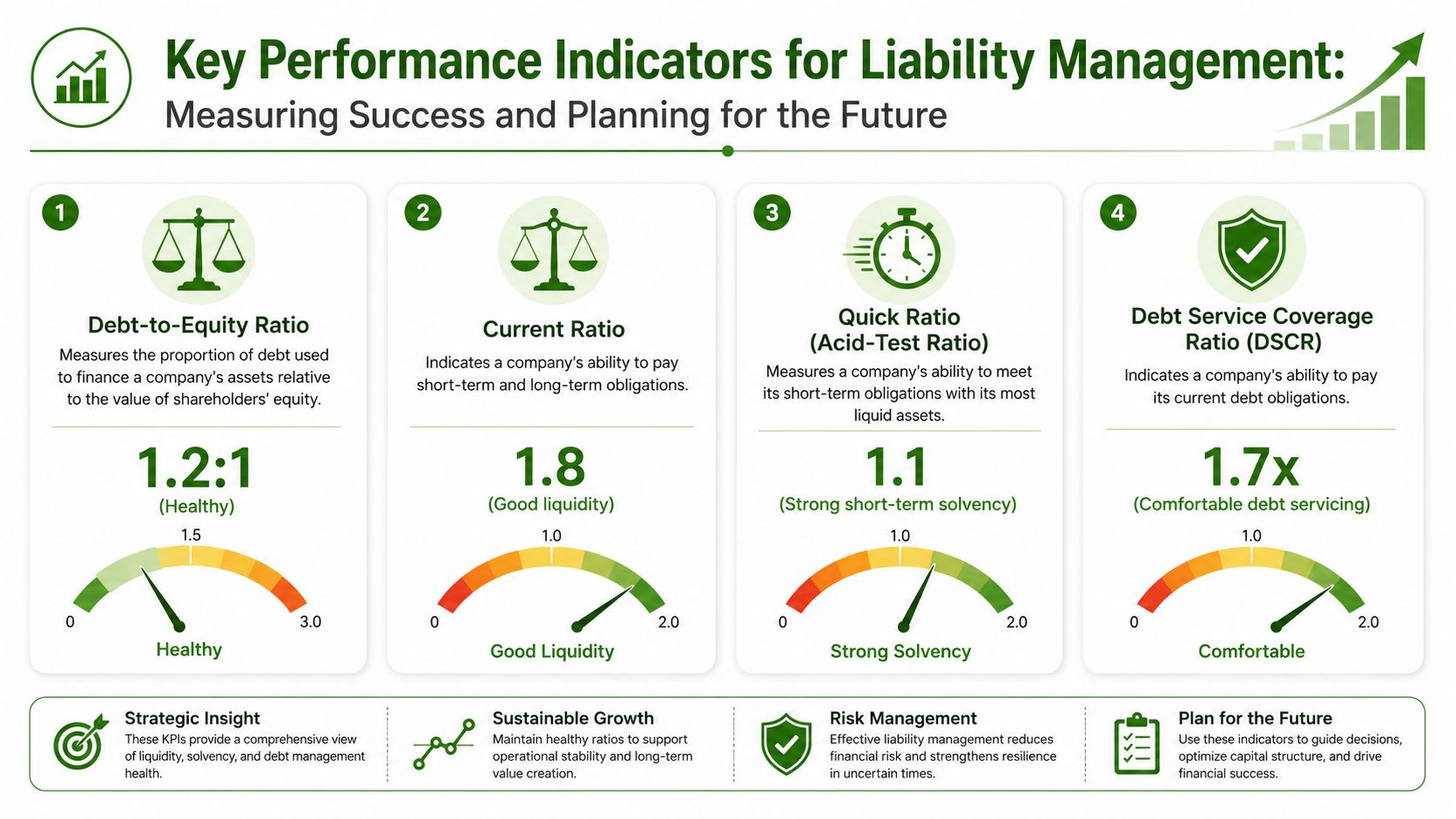
You don't need a complicated dashboard for that. You need a few ratios you understand and review.
The ratios worth watching
Start with these three.
Current ratio Formula: current assets ÷ current liabilities This shows whether near-term assets are enough to cover near-term obligations. If this ratio weakens over time, your short-term pressure is rising even if revenue looks stable.
Debt-to-equity ratio Formula: total liabilities ÷ equity This shows how heavily the business depends on debt compared with owner equity retained in the business. A rising ratio can be fine during planned growth, but it becomes a warning sign when profitability doesn't keep pace.
Interest coverage ratio Formula: earnings available for interest ÷ interest expense This shows how comfortably operations support borrowing costs. It matters most when you're considering refinancing or taking on another note.
If you want to test how those ratios would look after a refinance, a new vehicle purchase, or a line of credit increase, build a projected balance sheet first. A balance sheet pro forma is one of the simplest ways to see whether a financing move helps or just delays pressure.
Watch for the trend, not just the snapshot. One decent month can hide a weak structure. A six-month pattern tells the truth faster.
How restructuring ideas apply to a small business
In corporate restructuring, the most common liability management transactions are amend and extend, uptier transactions, and drop-down transactions. For small businesses, you usually won't use those exact structures, but the logic behind them still matters.
Amend and extend means changing terms to push out maturity. For a small business, that may look like refinancing a short-term note into a longer repayment schedule.
Uptier transactions involve new senior debt. In a smaller company, the practical equivalent might be bringing in a new facility with stronger collateral support when old debt terms no longer fit the business.
Drop-down transactions move collateral to support new financing. That's a legal and structural area where owners should move carefully and use qualified counsel, but the broader lesson is that collateral position matters when you're trying to create financing flexibility.
Expert guidance on liability management transactions also stresses that timing matters most when the borrower is still confident and maturity is years away, not when distress is already severe. Early planning, scenario analysis, and experienced advisors improve outcomes because you can assess debt capacity and reduce disruption before choices narrow [Citation: 3].
What to model before you borrow again
Before taking new financing, pressure test these questions in QuickBooks or Xero using a cash forecast and projected debt schedule:
What does the monthly payment do to short-term cash
What happens if receivables slow
Whether the debt supports growth or covers recurring losses
Which assets are being pledged
Whether a simpler restructure would solve the problem without new debt
In banking, asset-liability management focuses heavily on balancing maturities, liquidity, and interest rate risk. Expert ALM practice emphasizes current capital planning, rigorous scenario analysis, institution-specific assumptions, full risk measurement, and regular model validation [Citation: 2]. Small businesses can borrow that discipline without borrowing the complexity.
If you keep live assumptions, update pricing and debt terms promptly, and test different scenarios before signing, you'll make better financing decisions than most owners who only ask, “Can I get approved?”
From Liability Management to Financial Mastery
Most small businesses don't fail at liability management because the concepts are too hard. They struggle because the process stays reactive. Bills get paid, but no one steps back to shape the structure behind them.
The practical shift is straightforward. Get a clean picture of what you owe. Reconcile liability accounts every month. Prioritize payments based on risk and cash impact, not noise. Track a few core ratios so future borrowing decisions come from evidence.
That approach changes the feel of the business. You stop treating every obligation like a small emergency. You start using liabilities as part of a controlled operating system.
There's also a mindset piece here that matters. Restructuring, renegotiating terms, or refinancing early doesn't mean the business is weak. In many cases, it means the owner is paying attention before a manageable issue turns expensive.
The businesses that handle growth best usually aren't the ones with no obligations. They're the ones that know exactly how their obligations fit into cash flow, timing, and strategy.
That's what financial mastery looks like in practice. Not perfection. Not zero debt. Just clear books, steady habits, and better decisions made early.
If you want help building that kind of system, Book Tech LLC can support the bookkeeping side from the ground up, including QuickBooks Online or Xero cleanup, monthly reconciliations, A/P and payroll workflows, tax-ready financials, and ongoing reporting that turns your numbers into decisions.