
Rental Property Profit and Loss Template: How to Set It Up


You've got rent hitting the bank, a spreadsheet that says you're making money, and a tax bill that seems to belong to a different property. That mismatch is normal when one spreadsheet tries to answer three questions at once. A rental property profit and loss template built the right way gives you three answers on purpose, net operating income, cash flow before tax, and taxable result, so you stop treating a single bottom line as the truth.
Table of Contents
The Rental Property Profit and Loss Template Layout - The Ten Lines and Where They Belong
Recording Rent Income and Vacancy Without Overstating Profit - Money That Looks Like Income but Isn't
How to Separate Repairs From Improvements - The Mixed Invoice Problem
One Month Worked Through Three Profit Numbers - Why the Three Answers Diverge
Spreading Irregular Costs Across the Year - How the Accrual Mechanics Work
Avoid Five Errors and Run the Close - The Five Errors That Distort the Answer - The Monthly and Annual Close Checklist - Who Runs the Close
The Rental Property Profit and Loss Template Layout
A working rental property profit and loss template has ten lines in six groups, and each line lands in a different view. Income comes first, operating expenses second, then financing, cash flow, balance sheet, and tax. Lumped together, the total looks tidy and still leaves three questions unanswered.
The grouping follows tax reporting. IRS Publication 527 treats rental income, deductible expenses, depreciation, casualty and theft losses, passive-activity rules, and at-risk limitations as distinct reporting areas, and for residential rentals it requires straight-line depreciation over a 27.5-year recovery period under the applicable General Depreciation System or Alternative Depreciation System rules. That is why one month can produce different profit answers: operating result, cash result, and taxable result are built from different rows.
Build categories to match that structure from the start. A clean chart of accounts setup keeps each label tied to one account, so mortgage interest does not drift into repairs and principal never masquerades as an expense. Owners comparing category names across borders can use these bookkeeping tips for BC landlords for context, while a U.S. template should still follow Schedule E labels.
The Ten Lines and Where They Belong
Line item | Group | What to record |
|---|---|---|
Gross scheduled rent | Income | Full rent each unit should pay per month, taken from the lease |
Vacancy and collection loss | Income | Scheduled rent minus rent actually collected, kept as its own line |
Other income | Income | Late fees, pet rent, laundry; not utility reimbursements |
Repairs and maintenance | Operating expense | Ordinary fixes that restore a working item |
Insurance, property tax, utilities | Operating expense | Accrued monthly when billed annually |
Management and advertising | Operating expense | Management fees and listing costs paid to run the unit |
Mortgage interest | Financing | Interest only; sits below net operating income |
Mortgage principal | Cash flow only | Cash outflow that is not deductible |
Capital improvements | Balance sheet | Capitalized in the asset register, not the monthly P&L |
Depreciation | Tax only | Noncash deduction under the residential recovery period |
Practical rule: If a line doesn't change cash this month, don't let it sit beside lines that do. Depreciation belongs in the tax view, principal in the cash view.
Use these exact labels every month. When gross rents, vacancy, repairs, insurance, property taxes, utilities, advertising, management fees, mortgage interest, and depreciation each have their own line, your monthly totals map onto Schedule E with light reconciliation instead of a rebuild. You also preserve an audit trail, because a reviewer can trace every total back to a lease, invoice, or loan statement.
Recording Rent Income and Vacancy Without Overstating Profit
Scheduled rent isn't collected rent, and that gap is where overstated profit hides. Say a unit rents for $2,000 a month. At a 5.8% vacancy assumption, you're losing about $116 a month, before repairs, taxes, or management touch the numbers.
That rate isn't a guess pulled from a template default. The U.S. Census Bureau rental vacancy data reported a 5.8% rental vacancy rate in the first quarter of 2022, lower than any quarterly estimate during the 35-year period from 1985 through 2019. At $2,000 monthly rent, that 5.8% assumption reduces annual scheduled rent of $24,000 by approximately $1,392. Treat it as a planning assumption you adjust for your market, not a measured rate for your unit.
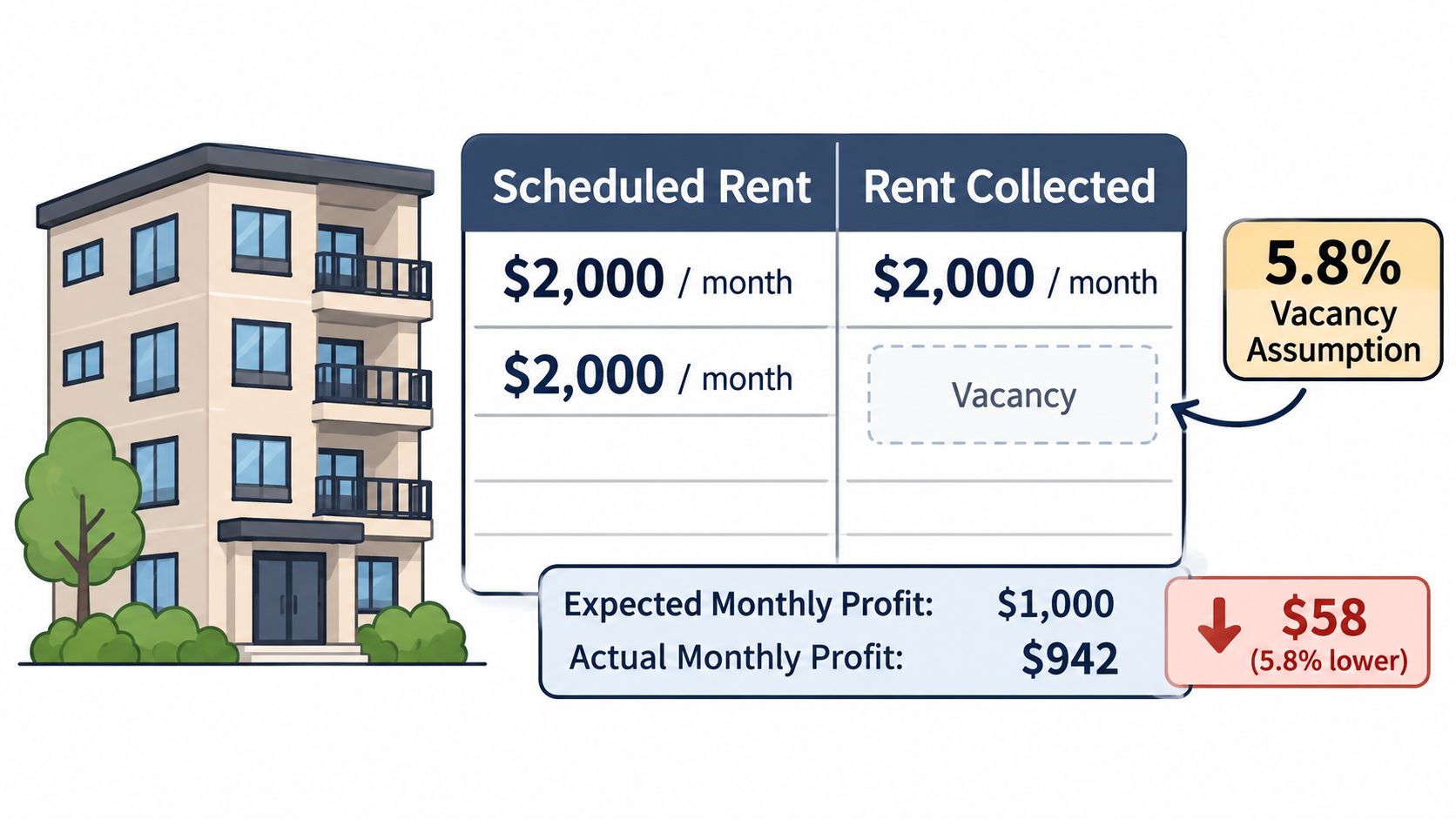
Keep gross potential rent, vacancy loss, concessions, bad debt, and rent collected as separate fields, and show the vacancy line even in fully occupied months. That consistency makes property comparisons honest. It also helps when you follow landlord insights from Richard Maize on tenant retention, because you can see whether fewer turnovers improved collected rent.
Money That Looks Like Income but Isn't
Security deposits: Record as a liability held for the tenant, not income, unless you apply the deposit to unpaid rent or damage.
Utility reimbursements: Record as pass-through money offsetting the utility cost, not as economic profit.
Partial or prepaid rent: Record what arrived and when. Cash-basis owners record rent when received, accrual-basis owners record it when earned, so prepaid months don't inflate one month in an accrual template.
Each month, match the rent roll to bank deposits line by line. If you're setting this up in software, the workflow in QuickBooks for landlords works well for that deposit matching. Any shortfall becomes a receivable or a vacancy and collection loss, not a silent adjustment to rent.
How to Separate Repairs From Improvements
A repair restores a working item to its prior condition. An improvement adds value, adapts the unit, or extends its useful life. That one sentence decides whether a cost hits this month's P&L or gets spread over years, so it's the most consequential call in the template.
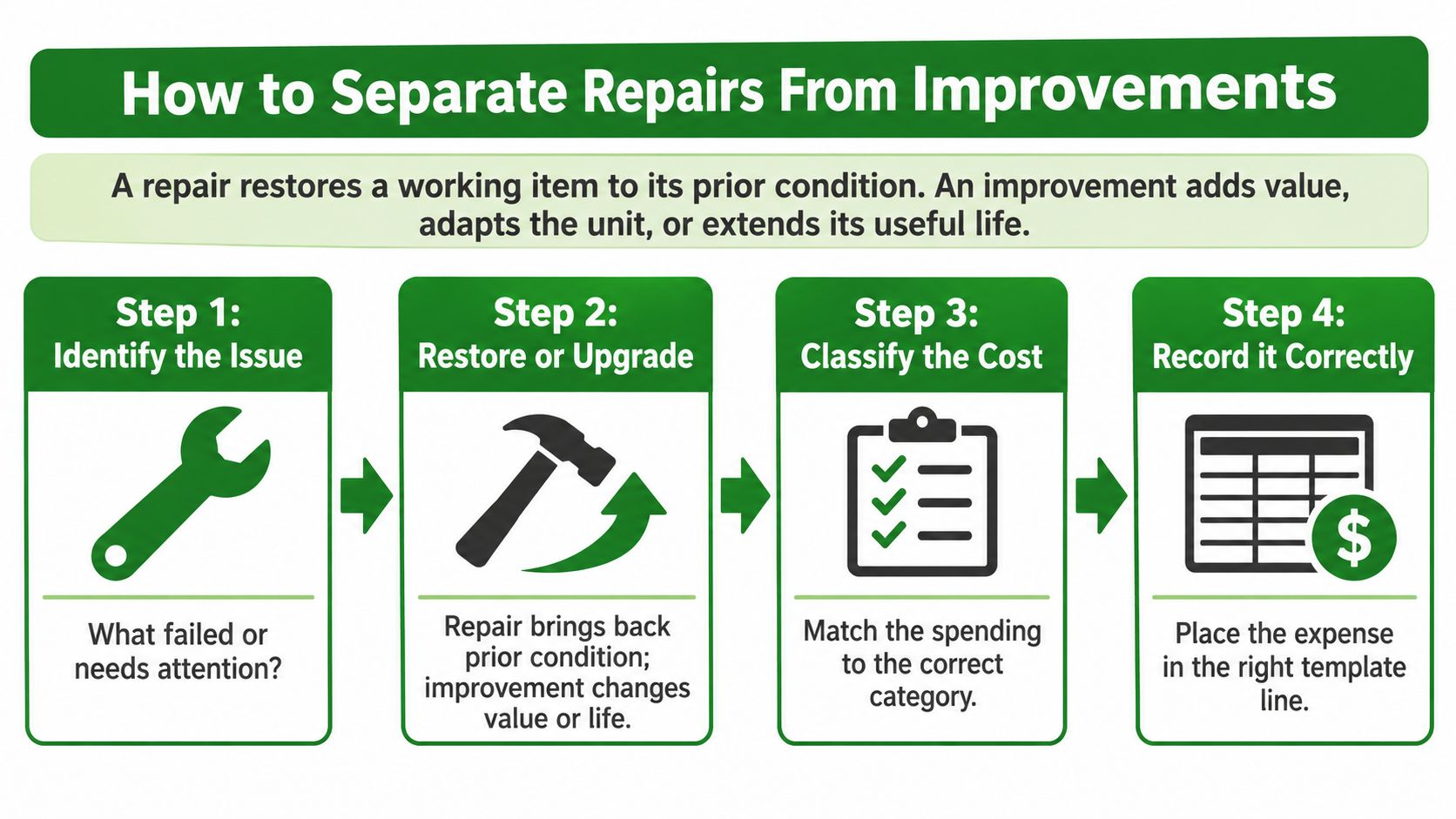
Work every invoice through the same sequence. Don't classify from the vendor name or the dollar amount alone.
Name the asset the invoice touches. Faucet, water heater, roof, HVAC. You can't judge the work until you know what it was done to.
Ask whether the work restores or changes. Does it bring back ordinary operation, or does it change capacity, quality, or useful life? As IRS Publication 527 for 2024 puts the test, you determine whether work restores ordinary operation or materially improves, adapts, or extends useful life, and the IRS instructs owners to separate repairs and improvements and retain accurate improvement-cost records because those amounts affect depreciation and gain or loss on sale.
Expense ordinary repairs in the P&L. A $900 faucet replacement that restores a leaking fixture goes to repairs and maintenance in the month it's paid. It doesn't create a new asset.
Capitalize improvements in a fixed-asset schedule. A $6,500 roof replacement goes to the asset register with its placed-in-service date, cost basis, asset class, and depreciation method. It doesn't belong in one month's expenses.
Depreciate straight-line over 27.5 years for residential rental property. That spreads the cost in the tax view while the cash already left in the month you paid the roofer.
Keep the invoice, scope of work, and ready-to-rent date. Without the in-service date, your depreciation start is a guess your CPA will have to rebuild.
The Mixed Invoice Problem
One bill often covers both. A plumber fixes a leak and upgrades a fixture in the same visit. Split that invoice into its repair and improvement parts before you post it, using the line items on the bill. Posting the whole amount one way guarantees one half is wrong.
If you can't tell from the paperwork what was restored and what was upgraded, call the vendor for an itemized scope before you close the month. Guessing costs more later.
When you're deciding which upgrades are worth capitalizing at all, it helps to prioritize rental property renovations by useful life and rent impact rather than appearance alone. For owners who'd rather not maintain the asset register themselves, that's part of what real estate bookkeeping services should handle at property level, since passive-activity, at-risk, personal-use, and casualty-loss rules make property-level documentation necessary for tax-ready reporting.
One Month Worked Through Three Profit Numbers
Take one unit with a $240,000 building basis, land excluded, and post a typical month in the order a bookkeeper would. Scheduled rent is $2,000. Less $116 vacancy, effective rental income is $1,884. That's the income the property produced.
Operating expenses come next. Repairs $75, insurance $110, property tax $150, utilities $40, and management at 10% of collected rent, $188. Total operating expenses are $563, so net operating income is $1,321. NOI answers one question only. How well does the property perform before financing?
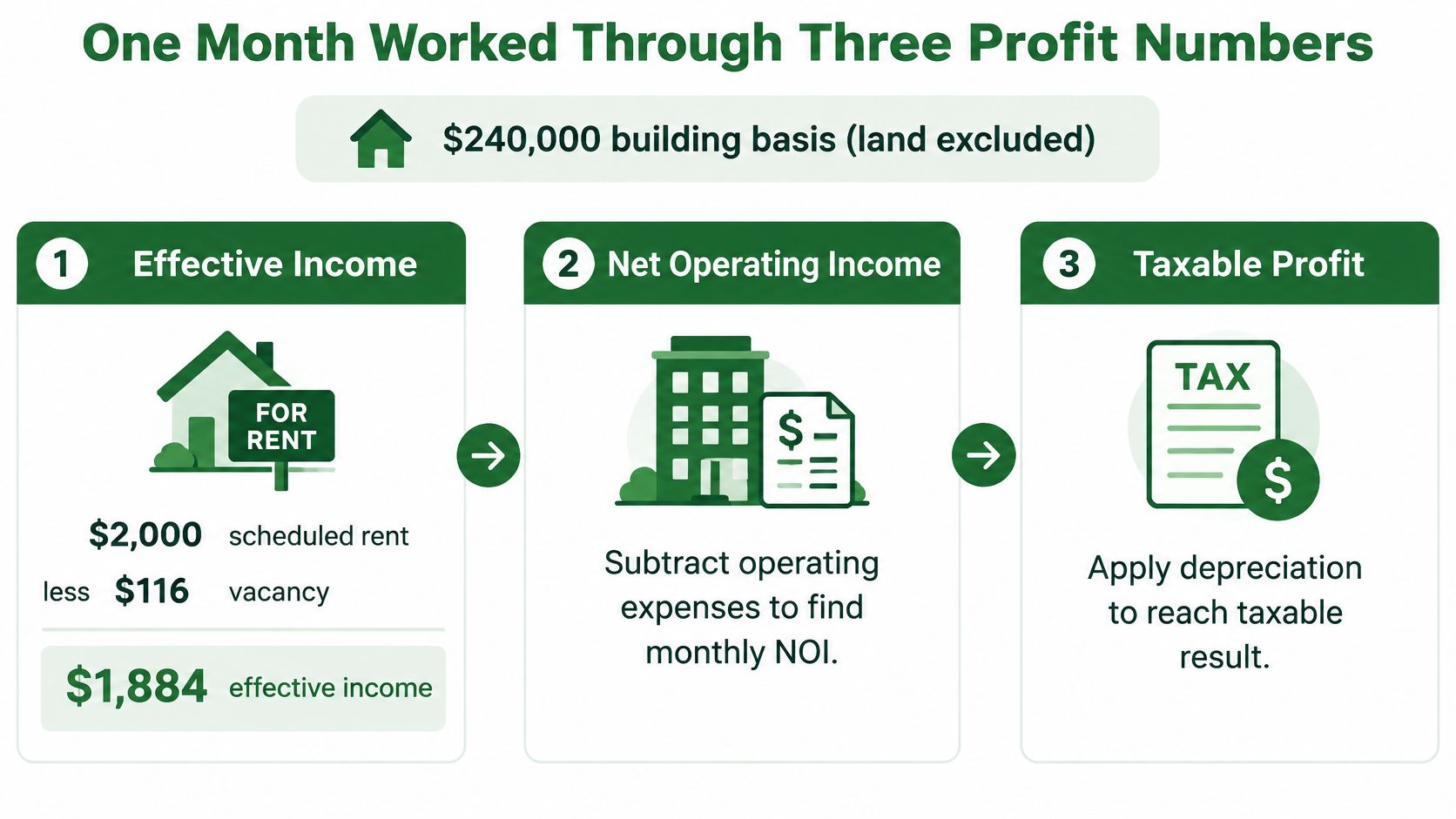
Now the loan. Debt service is $1,050, split into $650 interest and $400 principal. Cash flow before tax is NOI minus the full payment, $271. The tax view uses different pieces. Take NOI of $1,321, subtract the $650 interest and $727 monthly depreciation (that's $240,000 divided by 27.5 years, divided by 12), and the taxable rental result is a loss of $56.
Measure | Calculation | Monthly result |
|---|---|---|
Effective rental income | $2,000 scheduled rent minus $116 vacancy | $1,884 |
Operating expenses | Repairs, insurance, property tax, utilities, management | $563 |
Net operating income | $1,884 effective income minus $563 operating expenses | $1,321 |
Cash flow before tax | $1,321 NOI minus $1,050 debt service | $271 |
Taxable rental result | $1,321 NOI minus $650 interest minus $727 depreciation | -$56 |
Why the Three Answers Diverge
Principal and depreciation drive the gap, in opposite directions. As the IRS Publication 527 guidance states, rental owners generally cannot deduct mortgage principal payments, whereas depreciation is used to recover the cost of income-producing property over time. Principal is a cash outflow that isn't deductible. Depreciation is a deductible expense that isn't a cash outflow.
So this unit produces $271 in cash while showing a $56 tax loss. Neither number is wrong. A single profit line would force you to pick one and misread the property. Units with high debt can flip the other way, looking profitable on paper while generating negative cash flow after debt service.
Report all three figures together, each in its own labeled row, with your accounting basis documented. Record that $56 loss in the tax view rather than netting it against positive cash flow, since passive-activity rules can limit whether you can use it in the current year. Your CPA needs it visible, not buried.
Spreading Irregular Costs Across the Year
The bill date shouldn't decide which month looks profitable. A turnover month looks terrible and the next month looks great, not because performance changed, but because an annual bill landed in one and nothing landed in the other. Accruals fix that distortion.
The underlying issue is timing, not effort. IRS Publication 527 for 2025 identifies repairs, maintenance, insurance, interest, taxes, management fees, and depreciation as distinct rental categories, while improvements and furnishings may require depreciation rather than immediate deduction. When annual insurance or property taxes are skipped or recorded inconsistently, the month after payment shows inflated profit and the payment month absorbs the whole hit.
Irregular cost | Amount and period | Monthly accrual |
|---|---|---|
Property insurance | $1,320 per year | $110 |
Property tax | $1,800 per year | $150 |
Turnover cleaning and paint | $1,500 every 2 years | $63 |
Only deductible operating costs belong in this table. A roof or appliance replacement follows a different path entirely, and putting it here breaks the P&L twice.
How the Accrual Mechanics Work
Set up an accrual line and a reserve account for each item. Each month you record the accrual amount, and when the bill arrives, you record the payment against the accrual. Any difference sits on the balance sheet until it clears. The step-by-step mechanics in these adjusting entries examples translate directly to these rental accruals.
A reserve is not an expense on the day you set cash aside. It is a planning and cash discipline tool that smooths what you expect to spend. That distinction matters most for big-ticket items. When the roof is replaced, the invoice gets capitalized in the fixed-asset register and depreciated, matching the treatment the rest of this template already applies to improvements. The monthly savings toward it belong on a separate planning schedule, not in the P&L accrual column. Charging the roof against the reserve and depreciating it again double-counts the same cost.
Watch the turnover line: Cleaning and paint belong spread across the tenancy that caused the wear, not dumped into the month the tenant moved out.
Avoid Five Errors and Run the Close
The template fails in a small set of places. One unit can show a healthy operating result, a tight cash month, and a taxable number that disagrees with both, all because the same invoice landed in the wrong view. Fix five errors first; refinements can wait.
The Five Errors That Distort the Answer
One expenses total: A single total hides interest, depreciation, and capital spending inside operating costs. Split operating, financing, and tax lines so NOI stays clean.
Scheduled rent booked as income: This overstates profit by the full vacancy loss every month. Record collected rent and keep vacancy loss visible as its own line.
Principal counted as deductible: This understates taxable income and will not reconcile to the loan statement. Keep principal inside the cash-flow view.
Improvements expensed in one month: A replacement that belongs in the asset register makes one month look bad and lowers the basis tracked for sale. Capitalize it and depreciate it.
Annual bills booked when paid: Insurance, taxes, and reserves covered earlier turn a normal month into a fake spike. Accrue the monthly share and let the balance sheet hold the timing difference.
The Monthly and Annual Close Checklist
Run the same close every month, in the same order. Order matters because each step relies on the one before it.
Reconcile bank and card accounts to the statement balance.
Match the rent roll to deposits and investigate every shortfall before coding it away.
Record vacancy and unpaid rent so collected income is stated accurately.
Post accruals for annual bills and for charges incurred but still unpaid.
Review unusual vendor charges and label each one repair, improvement, or neither.
Update the depreciation roll-forward annually with additions and disposals.
Confirm the in-service date and basis of each improvement in the register.
Reconcile template totals to Schedule E lines before anything goes to your CPA.
Share the operating, cash-flow, and tax views together so one bottom line never stands in for the whole answer.
If you run the books in software, follow a consistent sequence for how to close the books in QuickBooks Online so reported months stay fixed after review. Locking the period protects comparisons you already made.
A close that depends on memory is not a close. Write the checklist down and check it off, even for one unit.
Who Runs the Close
Two options are honest. Keep the spreadsheet and run the checklist monthly if you will do it; for one or two units the labels are enough. Or hand the monthly close to a bookkeeper. In Book Tech's setup, a dedicated bookkeeper manages monthly financials remotely, and reporting can include a Profit and Loss report, Balance Sheet, cash flow information, and expense analysis alongside tax-ready records.
I would build the template this week either way. The labels cost an hour. Rebuilding a year of misclassified invoices in March costs more.
If the nine-step close is the task you keep postponing, Book Tech LLC can handle the monthly close with Profit and Loss, Balance Sheet, and cash flow reports, plus tax-ready records your CPA can use. Bring one property or several to Book Tech LLC and map the first close before the next statement cycle.
