
Hiring an Accountant for Contractors: The Complete Guide
Updated: Oct 15

You finish a project, send the progress invoice, and check the bank account. The job report shows a healthy margin, but payroll is due, a subcontractor is waiting, and the customer won't pay for several weeks. Meanwhile, a change order remains unsigned and several receipts are still sitting in a truck.
That situation is why hiring an accountant for contractors is not just about keeping receipts organized. Construction accounting must show what each job has earned, what it still owes, how much cash it will consume, and whether the margin in your estimate is holding up. A clean profit and loss statement matters, but it won't protect you from a profitable project that drains working capital.
Table of Contents
Why Contractors Need Specialized Accounting Help - What generic bookkeeping misses
Essential Services Every Contractor Should Expect - Job costing comes first - Payroll must follow the work - A/P and A/R need project context
Understanding Tax Rules and Cash Flow Realities - Why percentage of completion changes the risk - Build the forecast around obligations
Choosing the Right Accounting Software for Your Business - Match the system to the field
Interview Questions That Separate Experts from Generalists - Test industry experience - Test technical judgment - Test the operating cadence
Pricing Models and Onboarding Checklist - Prepare before the first meeting - Review the first close closely
Why Contractors Need Specialized Accounting Help
A residential contractor can have a busy month and still not know which project made money. Receipts may be sorted by vendor, payroll may be posted to one general labor account, and subcontractor invoices may be entered when they arrive rather than when the work occurred. At year-end, the totals may reconcile, yet the owner still can't answer a basic operating question: which job is paying for the next one?
Construction work creates several layers of financial detail at once. Each project has its own labor, materials, equipment, subcontractors, billing schedule, change orders, retainage, and expected completion date. A generic small-business ledger records money moving through the company. It doesn't reliably show whether a specific project is ahead of budget, underbilled, or using cash faster than expected.

The scale of the industry makes this more than an administrative detail. The U.S. Census Bureau's July 2025 construction spending estimate placed total construction spending at a seasonally adjusted annual rate of $2.1391 trillion, including $1.6233 trillion in private construction. Contractors, subcontractors, suppliers, and project owners all generate transactions that require more control than a simple income-and-expense list.
What generic bookkeeping misses
A generalist may reconcile the bank account correctly but still miss the information needed to manage a project. Common gaps include:
Unassigned labor: Crew time lands in overhead instead of the job that used it.
Unrecorded commitments: Open purchase orders and subcontractor obligations never reach the forecast.
Stale estimates: The original budget stays unchanged after scope, labor, or material conditions shift.
Billing disconnects: Invoices, retainage, approved change orders, and cash receipts are tracked separately.
Late financial statements: Reports arrive after the owner has already committed to another project or purchase.
A contractor-focused accountant builds controls around the way work is delivered. That means job codes that match the field operation, regular cost updates, documented change-order approvals, and reconciliations that connect the general ledger to each active project.
Practical rule: If your accountant can tell you the company's bank balance but can't explain the cash position and projected margin of each major job, you're only getting part of the service.
The same principle applies as a construction company expands into multiple crews, locations, or service lines. Owners comparing broader resources on accounting for growing companies should still confirm that the provider understands job costing, retainage, progress billing, and work-in-progress reporting. For a construction-specific view of the underlying workflow, review construction bookkeeping services and ask whether the process supports weekly decisions, not just annual tax preparation.
Essential Services Every Contractor Should Expect
The right accountant should give you a defined operating system, not a vague promise to “handle the books.” Start by mapping how money enters and leaves each project. Then match the accounting service to that workflow.
Job costing comes first
Create a project record for every contract and establish cost codes that reflect how you estimate and manage the work. At a minimum, separate:
Direct labor, including crew time and payroll burden where applicable.
Materials, tied to the project that consumes them.
Subcontractors, with invoices and payment records attached to the correct job.
Equipment, including rentals, repairs, operating costs, and usage allocation.
Overhead, kept separate from direct project costs.
The accountant should compare actual costs with the locked budget and update committed costs before the month closes. Weekly field updates are more useful than waiting for a vendor invoice to reveal a cost that was known weeks earlier.
Payroll must follow the work
Payroll errors distort both job profitability and compliance. Your accountant should review time coding, distinguish job labor from administrative time, and understand the reporting requirements that may apply to public work, including prevailing wage and certified payroll obligations.
Subcontractor administration deserves the same discipline. Collect the required vendor information, maintain payment logs, and connect each payment to the right project and contract. A practical reference for organizing broader operating costs is this home service expense tracking guide, though contractors should adapt the categories to their project structure.
A/P and A/R need project context
Accounts payable is not just bill entry. The accountant should identify invoices that are missing, duplicate, disputed, or posted to the wrong job. Accounts receivable should track progress billing, retainage, approved change orders, customer disputes, and the expected collection date.
A useful close includes a comparison of:
Project item | What to verify |
|---|---|
Contract value | Original agreement plus approved changes |
Billings | Applications submitted and amounts accepted |
Cash receipts | Payments received and deposits still outstanding |
Costs | Posted costs, payroll, subcontractors, and committed purchases |
Retainage | Amount withheld and expected release conditions |
Forecast | Estimated cost to complete and expected margin |
Tax-ready books are the result of this routine, not a separate activity that begins before filing season. The general ledger, payroll records, contractor payments, reconciliations, and project reports should already agree. More detail on maintaining that recurring workflow appears in bookkeeping services, but the deciding question is practical: can your accountant produce records that support tax filings, lender requests, and project decisions without a rushed cleanup?
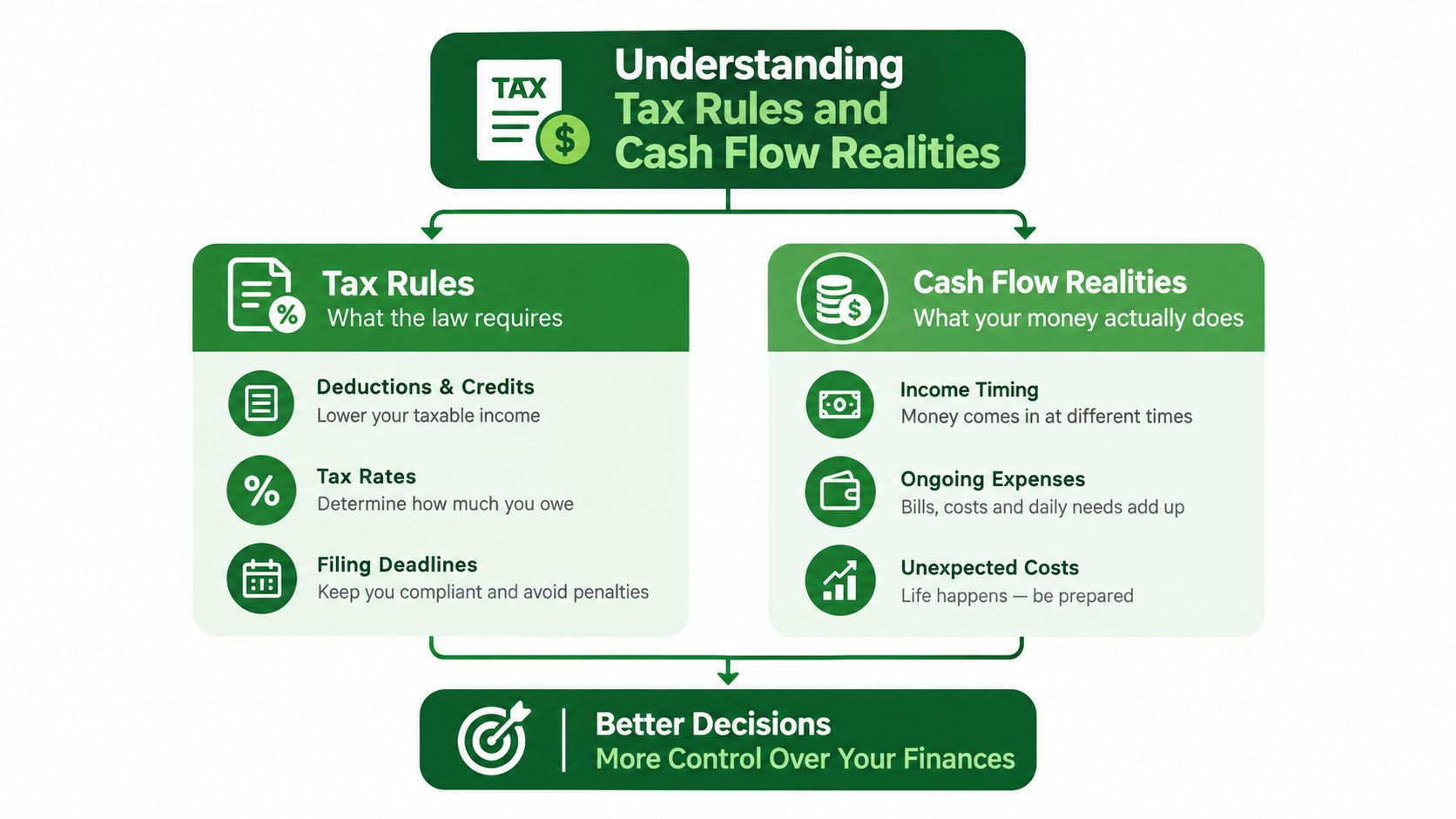
Understanding Tax Rules and Cash Flow Realities
Construction revenue can appear on the books before the related cash arrives. That timing difference becomes dangerous when the accounting method recognizes progress accurately but the contractor treats reported profit as spendable money.
The IRS guidance on long-term construction contracts recognizes both the completed-contract method and the percentage-of-completion method. Under percentage of completion, revenue reflects the portion of work completed during the period. The IRS identifies the cost-to-cost approach as a common measurement, comparing costs incurred to date with total estimated contract costs. The guidance also describes a 95% cost threshold exception when the customer has intended use of the completed subject matter.
Why percentage of completion changes the risk
Under the cost-to-cost formula:
Cumulative allocable costs incurred to date ÷ total estimated allocable costs = completion percentage
That percentage drives cumulative revenue recognition, after which prior-period revenue is subtracted to determine the current period's amount. The calculation must be revisited at each close because a revised cost-to-complete estimate changes both projected gross profit and taxable income.
The most common technical failure is leaving relevant indirect costs outside the allocation base. Jobsite equipment depreciation, equipment rental, repairs, utilities, workers' compensation, and certain officer compensation may benefit long-term contracts and require appropriate allocation. If those costs are omitted, the books understate job cost, overstate the completion percentage, and make interim profit look stronger than it is.
The profit on your income statement and the cash available for payroll are separate measurements.
Payment timing adds another layer. Research published in the Money Mobility Tracker reports that 70% of general contractors and subcontractors regularly face payment delays, while 82% wait at least 30 days beyond the expected payment date. The same research reports an average 56-day wait for subcontractors, even when general contractors believe payment occurs within 30 days. Those figures should be treated as research from a commercial source, not a universal forecast for every contractor, but they illustrate why a project can show profit while consuming cash.
Build the forecast around obligations
A monthly profit and loss statement won't show whether the next payroll and subcontractor cycle will be funded. A contractor-focused accountant should maintain a rolling cash forecast connected to project milestones, billing dates, expected receipts, materials, payroll, retainage, debt payments, and committed purchases.
Use this decision framework:
Measure the billing gap. Compare earned revenue with billings and cash received.
Identify the funding period. Estimate how long labor and suppliers will be paid before the customer pays.
Stress the estimate. Test the effect of a delayed approval, disputed invoice, or cost increase.
Set an escalation trigger. Investigate overdue invoices, concentrated receivables, or projected cash below upcoming obligations.
Change the commercial decision. Reprice, renegotiate billing terms, accelerate documentation, or decline work that requires more working capital than the company can safely provide.
For contractor tax administration and payment reporting, your accountant should also maintain a clear subcontractor process. The 1099 guidance for subcontractors is useful as a reference, but the larger control is consistent: every payment should be supported, coded, reconciled, and ready for review.
Choosing the Right Accounting Software for Your Business
Software won't fix incomplete job data. It can, however, make clean data easier to capture, reconcile, and share with an accountant.
QuickBooks Online and Xero can both support smaller contractors, but the better choice depends on project complexity, field processes, payroll needs, and the number of integrations you rely on. Treat the platform as part of the control environment, not as a substitute for judgment.
Contractor profile | QuickBooks Online | Xero |
|---|---|---|
Multiple active projects | Stronger fit when project and job-cost reports are central to the workflow | Capable with the right connected applications |
Solo operator or small team | Useful when the accountant already works deeply in the platform | Attractive when a simpler interface and mobile access matter most |
Subcontractor tracking | Works well with disciplined vendor, project, and payment coding | Works well when connected apps fill workflow gaps |
Reconciliation process | Familiar to many contractor-focused accountants and project tools | Clean bank workflows with broad third-party connectivity |
Project management integration | A practical choice when tools such as Buildertrend feed project data into accounting | Better suited to teams that prefer an app-centered stack |
Match the system to the field
A small service contractor with a limited number of recurring jobs may need straightforward invoicing, expense capture, payroll, and bank reconciliation. A growing general contractor needs stronger project structures, committed-cost visibility, progress billing support, and dependable reporting for lenders or bonding partners.
Before switching platforms, document the information your accountant needs each month:
Project identifiers: Every invoice, time entry, and purchase should point to a job.
Cost categories: The chart of accounts should mirror estimating and operational decisions.
Change orders: Approved changes must update contract value and forecasted cost without erasing the original budget.
Vendor records: Subcontractor payments, insurance documentation, and tax details should remain accessible.
Close outputs: The system should produce reconciliations, financial statements, receivables aging, and project-level reports.
Estimating software can complement the accounting platform, but it shouldn't become a second, disconnected source of truth. Contractors evaluating tools such as Exayard construction estimating software should ask how approved estimates, revisions, and awarded work will reach the accounting workflow.
The most useful test is a live month-end simulation. Enter a customer invoice, a subcontractor bill, crew payroll, a material purchase, a retainage amount, and a change order. Then ask the accountant to show where each item appears in the project report, general ledger, cash forecast, and reconciliation. If the answer depends on manual spreadsheets with no ownership or review schedule, the software selection hasn't solved the control problem.
For a broader comparison of platforms and construction workflows, use accounting software for construction companies as a starting point, then assess the system against your actual project structure.
Interview Questions That Separate Experts from Generalists
An accountant may have excellent technical credentials and still be a poor fit for construction. Ask questions that reveal whether the person understands how field activity becomes financial data.

Test industry experience
Ask:
Which contractor trades have you supported?
How do you distinguish a residential remodeler's workflow from a commercial electrician's?
How do you handle retainage, progress billing, and approved versus pending change orders?
What information do you request from project managers before closing the month?
How do you identify a job that is profitable on paper but consuming cash?
A useful candidate won't answer only with software features. They'll explain how invoices, time records, purchase orders, and cost-to-complete estimates move through the process.
Test technical judgment
Ask the candidate to explain percentage-of-completion accounting in plain language. They should be able to describe the cost-to-cost calculation, explain why current estimates matter, and identify the danger of excluding indirect costs that benefit a contract.
Then ask how they separate:
Book profit from cash available
Billings from earned revenue
Approved changes from uncertain claims
Job costs from overhead
Tax reporting from management reporting
You're not looking for a lecture. You're looking for an accountant who can show the entry, the report, and the business decision that follows.
Test the operating cadence
Ask when monthly reconciliations are completed, when financial statements are delivered, and who reviews unusual margin changes. Request a sample close calendar with responsibilities for the owner, project manager, payroll contact, and accountant.
A strong accountant can explain what happens when the field team misses a time entry, a subcontractor invoice arrives late, or a customer disputes a progress payment.
Cloud collaboration should be ordinary. A candidate who resists secure document sharing, has no defined communication channel, or relies on email attachments without a review trail creates avoidable friction. The same is true of anyone who waits until tax season to discover that job costs, contractor payments, or account reconciliations are incomplete.
Watch for these red flags:
No construction references: They speak only about generic small-business bookkeeping.
No close deadline: They can't commit to a recurring reporting rhythm.
No WIP process: They treat project reporting as an annual CPA adjustment.
No cash forecast: They use the bank balance as the entire liquidity analysis.
No plain-language explanation: They hide uncertainty behind accounting terminology.
Choose the candidate who asks informed questions about your contracts, billing terms, cost codes, and project manager responsibilities. Technical knowledge matters, but construction accounting succeeds only when the accountant can turn that knowledge into a repeatable operating habit.
Pricing Models and Onboarding Checklist
Accounting fees should reflect the work required, not just the number of bank transactions. A contractor with a modest transaction count but several active projects may need more judgment than a service business with a larger volume of simple payments.
Most engagements use one of three structures:
Hourly cleanup: Appropriate for catch-up work, historical corrections, and chart-of-accounts reconstruction. Ask for a defined scope and a stopping point.
Monthly flat fee: Useful for recurring reconciliations, payroll coordination, A/P, A/R, financial statements, and job reporting. Confirm what transaction volume and project support the fee includes.
Project pricing: Suitable for tax preparation, software conversion, lender support, or a focused accounting review.
Compare proposals by deliverables. One monthly fee may include only bank reconciliation, while another includes subcontractor tracking, job-cost maintenance, receivables follow-up, and management meetings. The cheaper proposal can become expensive if it leaves the work that protects cash flow with the owner.
Prepare before the first meeting
Gather:
Prior-year tax returns and financial statements.
Bank and credit-card statements.
The existing chart of accounts.
Active contracts, budgets, change orders, and billing schedules.
Payroll records and subcontractor payment information.
Open receivables, unpaid bills, purchase orders, and retainage details.
Current software access and connected applications.
During onboarding, agree on the monthly close deadline, document-request process, approval authority, and communication channel. A contractor shouldn't discover after the first close that the accountant and project manager use different job names or that payroll cannot be allocated between projects and overhead.
Review the first close closely
Check whether every active job has a consistent cost structure. Confirm that payroll, materials, equipment, subcontractors, customer billings, receipts, retainage, and open commitments land where expected. Then compare the accountant's reports with the field team's understanding of project status.
A seven-to-ten-day close can be a useful operating target when the records arrive on time and responsibilities are clear, but speed alone isn't quality. For broader context on fee structures, review the cost of an accountant for a small business, then ask each provider to price your actual construction workflow.
Book Tech LLC provides virtual bookkeeping for contractors, including job-cost setup, reconciliations, payroll administration, A/P, A/R, and tax-ready financial reporting through QuickBooks Online and Xero. If you need project-level books that connect reported profit with billing and cash decisions, visit Book Tech LLC to discuss your workflow and request a no-pressure consultation.
