
Accounting for a Startup Business Playbook

The popular advice is to “just connect QuickBooks and categorize your expenses.” That's a reasonable starting task, but it isn't a startup accounting strategy. A clean ledger can still hide unpaid invoices, trapped inventory cash, processor delays, tax obligations, and spending decisions that your bank balance can't support.
Accounting for a startup business should function as an operating control system. It needs to explain what happened, prove why it happened, and show what's likely to happen next. Founders need reliable financial statements, but they also need a forward-looking view of usable cash, upcoming commitments, and the actions that protect runway.
Table of Contents
Why Clean Books Are Not Enough for Survival - Replace the rearview mirror with a radar - Build controls around timing
Building Your Financial Infrastructure - Start with separation and method selection - Design the ledger for decisions
Executing a Reliable Monthly Close Process - Give each close task an owner - Stop the common backlog before it starts
Managing Cash Runway and Financial Forecasts - Build a rolling 13-week view
Creating a Defensible Tax and Audit Trail - Make every transaction explainable - Use monthly checkpoints
Your 90-Day Accounting Implementation Plan - Days 1 through 30 establish the foundation - Days 31 through 60 create the routine - Days 61 through 90 add decision support
Why Clean Books Are Not Enough for Survival
A monthly profit and loss statement is a record of performance, not a guarantee that the business can pay its bills. Accrual accounting may recognize revenue when it's earned and expenses when they're incurred, while cash may arrive much later or leave the bank earlier. A startup can therefore look profitable on paper while cash is tied up in receivables, inventory, refunds, or payment processors.
The risk is widespread. Recent small-business evidence found that 39% of businesses had less than one month of operating cash available, while 44% reported cash-flow problems. Delayed customer payments were associated with greater credit-card reliance and other financial strain, according to recent small-business cash-flow evidence.
Practical rule: Treat profit as a performance measure and cash as an operating constraint. You need both views before approving new spending.
Replace the rearview mirror with a radar
Historical statements answer questions such as:
What did we sell?
What did we spend?
Which accounts changed?
Did gross margin or operating expenses move?
Those answers matter, but they don't tell you whether payroll, vendor bills, loan payments, and taxes can be funded when due. A startup needs a rolling forecast that starts with actual bank balances, removes cash that is restricted or already committed, and layers in realistic collection and payment dates.
Credit cards make this distinction harder to see. They can preserve a bank balance temporarily while creating a liability that will soon compete with payroll or essential vendors. If delayed collections repeatedly lead to card spending, the card isn't solving the operating problem. It's financing the gap without showing the founder whether pricing, payment terms, inventory purchases, or hiring plans need to change.
Build controls around timing
The accounting system should flag timing risks before they become emergencies. That means separating customer invoices from deposits, recording processor fees independently, aging receivables, tracking unpaid bills, and reviewing expected cash movements every week.
A cleanup project can restore order after the fact, and a guide such as how to clean up QuickBooks Online can help diagnose a backlog. But cleanup isn't a substitute for a recurring control process. A founder should be able to trace a bank balance to the transactions behind it and then look ahead to the obligations that balance must cover.
The right question isn't “Are my books clean?” It's “Can these books tell me what cash is usable, what cash is committed, and which decision must change before the next payment cycle?”
Building Your Financial Infrastructure
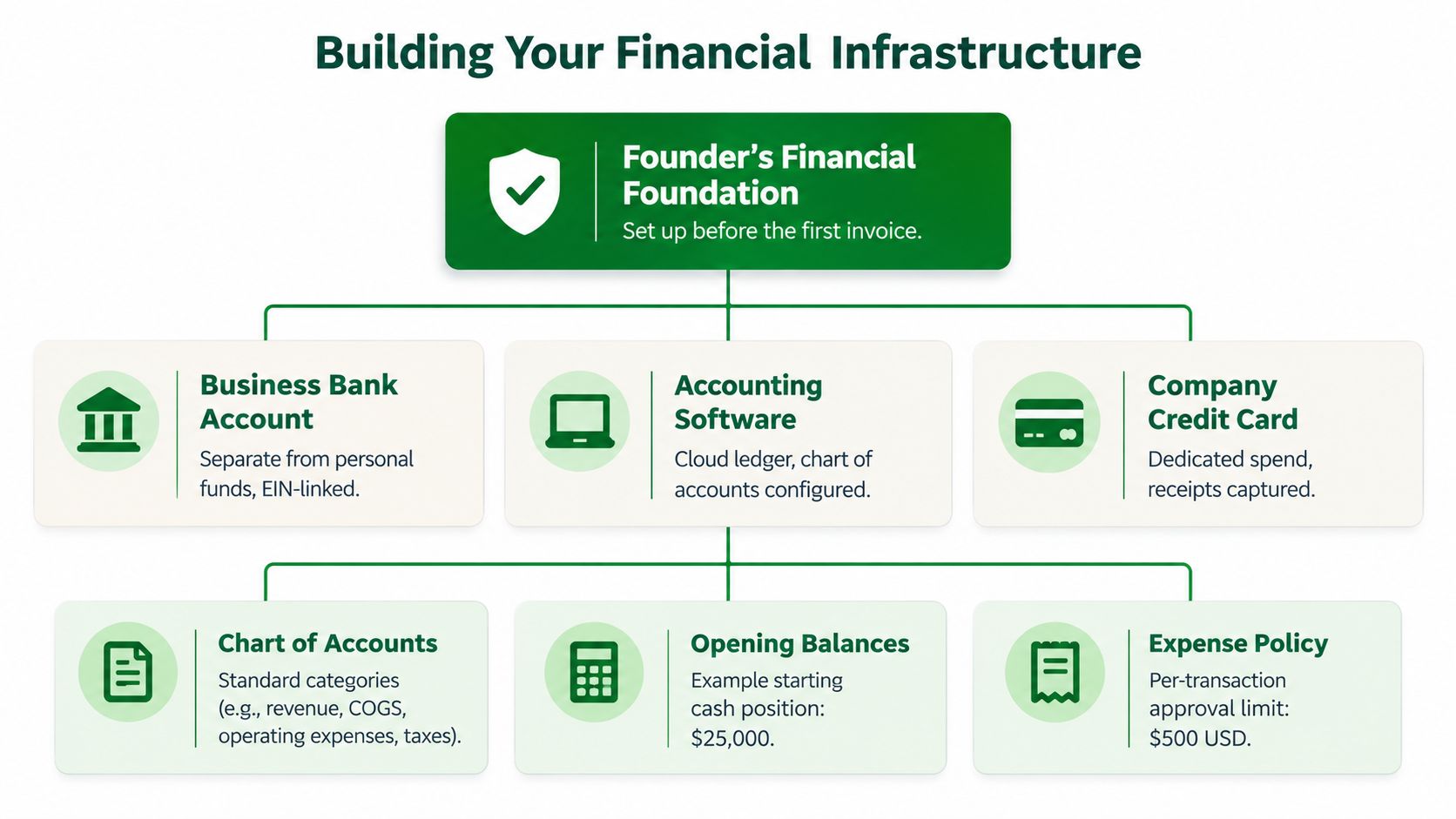
Set up the financial foundation before the first invoice, subscription, contractor payment, or company-card purchase. Retrofitting separation and reporting after transactions accumulate creates avoidable ambiguity, especially around owner contributions, reimbursements, and mixed-use expenses.
Start with separation and method selection
Open a dedicated business bank account and company credit account. Keep personal spending out of both, and document any founder funding as an owner contribution or an appropriate liability rather than allowing it to blend into sales or miscellaneous income. Separation makes reconciliations easier and gives the financial statements a clearer connection to the legal entity.
Choose cash-basis or accrual accounting with a tax professional. Cash-basis reporting can be easier to maintain, but it may obscure earned revenue and unpaid obligations. Accrual reporting can provide a more useful operating view when invoices, deferred revenue, inventory, or investor reporting matter. The choice should reflect the company's transaction pattern, tax position, and reporting needs, not merely the software's default setting.
The IRS says business records must support the income, expenses, and credits reported on tax returns, and those records are generally also used to monitor performance and prepare financial statements. Its recordkeeping guidance for businesses allows a method suited to the business as long as it clearly shows income and expenses.
Design the ledger for decisions
Create a chart of accounts that mirrors how the startup makes and spends money:
Revenue streams: Separate subscriptions, projects, products, or channels instead of placing every sale in one undifferentiated income account.
Direct costs: Capture costs tied to delivery, inventory, fulfillment, contractors, or payment processing distinctly from overhead.
Operating expenses: Use practical categories for payroll, software, marketing, professional services, insurance, and facilities.
Owner and financing activity: Keep contributions, draws, loans, and equity-related activity away from operating revenue and expenses.
Configure QuickBooks Online or Xero before importing historical activity. Connect the business bank and card accounts, establish opening balances, set a receipt-capture workflow, and define who can approve or edit transactions. For Stripe, Shopify, Amazon, or another payment processor, use a clearing account. Record gross sales, refunds, fees, chargebacks, and settlement deposits separately, then reconcile the clearing balance to the processor report.
Founders who need a more detailed control framework can review this resource on audit-ready expense tracking for startups from Coto & Waddington, Attorneys at Law. For the ledger structure itself, use this guide to set up a chart of accounts and document the purpose of each account.
Executing a Reliable Monthly Close Process
A close process turns raw transactions into information that someone can act on. It shouldn't depend on a founder remembering which expenses were personal, whether a processor deposit included refunds, or whether a contractor invoice arrived after the bank feed imported the payment.
Give each close task an owner
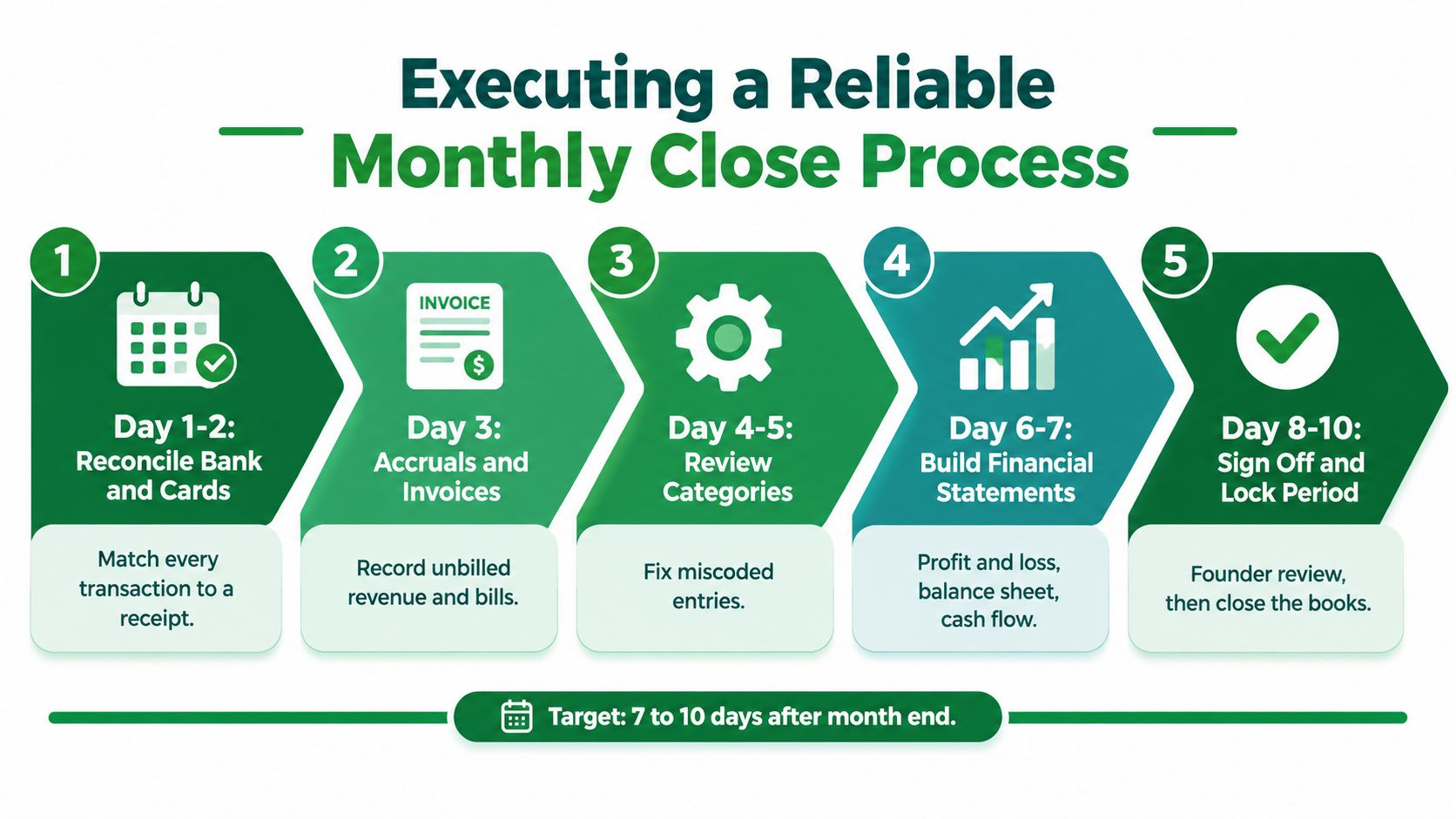
Use a 7-to-10-day close target. A practical benchmark is a 7–10-day monthly close, with every unreconciled item assigned an owner and aging category so the trail from invoice or receipt to ledger entry remains auditable, as described in the Federal Reserve survey of employer firms.
A workable sequence looks like this:
Reconcile bank and card accounts: Match every imported transaction to a statement, receipt, bill, transfer, or documented owner transaction. Investigate duplicates and missing entries instead of forcing a match.
Reconcile processors and payroll: Tie Stripe, Shopify, Amazon, or other settlement reports to clearing accounts. Confirm gross sales, refunds, fees, chargebacks, and deposits. Verify payroll cash, wages, tax withholdings, and employer liabilities.
Record outstanding activity: Enter vendor bills, unbilled revenue, accrued contractor work, payroll obligations, loan activity, and inventory adjustments that the bank feed doesn't capture.
Review classifications: Clear uncategorized transactions, inspect unusual fluctuations, and separate capital expenditures from ordinary operating costs when the facts support that treatment.
Issue statements and lock the period: Review the income statement, balance sheet, and cash-flow report. After approval, close the period against unapproved edits and retain the supporting documents.
Stop the common backlog before it starts
Personal spending on business cards creates a classification problem and weakens the evidence trail. Processor deposits recorded directly as revenue hide fees and refunds. Equipment expensed without review can distort operating results. Missing payroll or contractor liabilities make the balance sheet incomplete.
Set a weekly receipt deadline and require a business purpose for unusual expenses. Assign unresolved items to named people, record why they remain open, and track how long they've been outstanding. The monthly close should reduce uncertainty, not move it into a suspense account.
For a QuickBooks-specific workflow, follow how to close the books in QuickBooks Online. The software can automate imports and reminders, but it won't decide whether a payment is a customer deposit, an owner contribution, or a reimbursement. That judgment belongs in the documented workflow.
Managing Cash Runway and Financial Forecasts
A bank balance tells you what is in the account now. Runway analysis asks how much of that balance is available after committed payments, expected collections, payroll, taxes, inventory, and other operating needs.
Startup survival deserves this discipline. Bureau of Labor Statistics data show that five-year survival rates varied by startup cohort, with roughly half of startups in recent cohorts no longer operating five years after birth. Accounting can't remove market risk, but it can give founders earlier warning when cash timing or spending assumptions stop working.
Build a rolling 13-week view
Start with the reconciled cash position. Then list expected inflows by likely collection date, not merely invoice date. Add payroll, vendor bills, loan payments, taxes, inventory purchases, refunds, and planned capital spending by the date cash is expected to leave.
Update the forecast weekly. Use three views when uncertainty is high:
Base case: Collections and spending follow the current operating plan.
Downside case: Customer payments arrive later, sales soften, or a major cost occurs earlier.
Action case: The founder pauses discretionary spending, accelerates collections, changes payment terms, or delays hiring.
A minimum cash threshold should be an explicit rule rather than a feeling. When projected cash falls below it, define the response in advance. Possible actions include reviewing aged receivables, requiring deposits, delaying nonessential purchases, limiting card use, or postponing a hire. Those rules should be approved before the trigger appears, when decisions are less emotional.
For a clear explanation of the underlying mechanics, consult this cash flow in finance guide. Then use budgeting and forecasting practices to connect the forecast to an operating budget.
Startup Model | Minimum Cash Threshold | Forecast Cadence | Primary Cash Trap |
|---|---|---|---|
SaaS | Enough usable cash to cover committed operating obligations and the next planned hiring decision | Weekly | Annual contracts can create uneven collections and deferred obligations |
E-commerce | Enough usable cash for planned replenishment, fulfillment, payroll, and refunds | Weekly, with frequent inventory review | Inventory purchases and processor settlement timing |
Professional services | Enough usable cash for payroll and vendor commitments before client collections | Weekly, with receivables review | Work completed before invoices are paid |
Construction | Enough usable cash for payroll, materials, subcontractors, and project commitments | Weekly, with project-level updates | Payment timing, retainage, and job-cost overruns |
The forecast belongs in management reporting and, where relevant, investor updates. Show beginning usable cash, expected inflows, committed outflows, discretionary outflows, ending usable cash, and the assumptions that changed.
Creating a Defensible Tax and Audit Trail
Accounting software doesn't make books tax-ready by itself. Tax-ready records connect each material entry to evidence, a business purpose, an approval or explanation, and a consistent treatment. That standard also supports lender questions, investor diligence, and internal reviews.
A 2025 survey found that only 26% of small-business owners and freelancers felt completely confident about their taxes. The same survey reported that 46% were motivated by fear of penalties and 37% by audit concerns, according to the FreshBooks Tax Trends Report. A year-round evidence trail addresses both concerns more effectively than a last-minute deduction search.
Make every transaction explainable
Attach receipts, invoices, contracts, statements, and payment confirmations to the related transaction. For mixed-use expenses, document the business portion and the reason for the allocation. Owner draws and contributions need separate accounts. Startup costs, inventory, research spending, contractor payments, sales tax, and payroll require factual review rather than automatic categorization.
Bookkeeping classification is not the same as tax treatment. A bookkeeper can place a transaction in the right ledger account, while a tax professional determines how the item should be treated on the return. Escalate uncertain items instead of allowing them to sit in uncategorized accounts or burying them in a broad miscellaneous category.
The IRS requires supporting documents for entries, deductions, and tax-return statements. Employment-tax records generally must be retained for at least four years, while other documents should be kept as long as needed to prove income or deductions. Retention policies should be written, consistently applied, and accessible to the person preparing the tax package.
Use monthly checkpoints
At each close, review:
Source support: Every unusual or material transaction has a receipt, invoice, contract, or written explanation.
Owner activity: Contributions, reimbursements, and draws are not mixed with revenue or ordinary expenses.
Liabilities: Payroll, contractor obligations, sales-tax balances, loans, and unpaid bills agree with supporting schedules.
Open items: Uncategorized or disputed transactions have an owner and a resolution date.
Tax package readiness: The income statement, balance sheet, cash-flow report, reconciliations, fixed-asset detail, payroll reports, and processor summaries are organized for the tax preparer.
Teams comparing automation approaches can use this PledgeBox tax compliance guide as a supplementary resource. For the accounting workflow itself, document how to define an audit trail, including who entered, approved, changed, and reviewed each transaction.
Your 90-Day Accounting Implementation Plan for Startup Business
A strong accounting system doesn't need to be elaborate on day one. It needs clear ownership, consistent evidence, timely reconciliations, and enough structure to show cash reality alongside reported performance. The first ninety days should establish those habits before transaction volume makes them difficult to install.
Days 1 through 30 establish the foundation
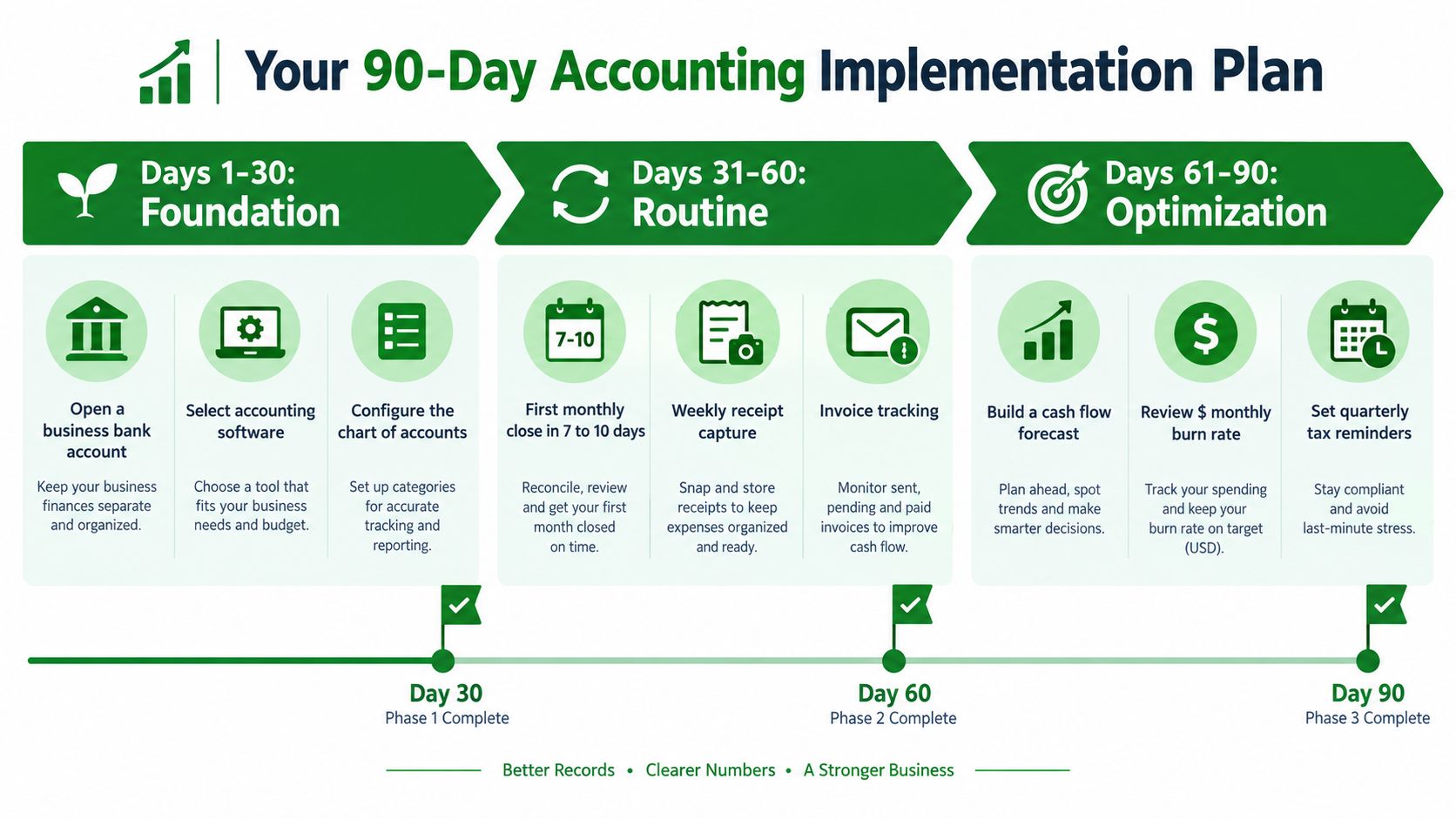
Complete the legal and financial separation first. Open the dedicated business bank and credit accounts, confirm access permissions, and choose the accounting method with a tax professional. Select QuickBooks Online, Xero, or another suitable ledger, then configure the chart of accounts around revenue streams, direct costs, payroll, software, marketing, contractors, owner activity, and financing.
Connect the bank and card feeds, define opening balances, and establish processor clearing accounts. Decide where receipts will be stored, how approvals work, and who owns each reconciliation. Create a vendor onboarding record that captures the vendor's legal name, payment details, contract, and required tax documentation.
By the end of this phase, you should be able to answer three questions:
Which account receives or pays each type of transaction?
What document supports each transaction?
Who reviews an exception before the period closes?
Days 31 through 60 create the routine
Run the first complete close, even if transaction volume is light. Reconcile the bank, cards, processors, payroll, and loans. Review accounts receivable and accounts payable, record outstanding obligations, produce the core financial statements, and assign every unresolved item to an owner.
Set a weekly receipt-capture deadline and a recurring invoice review. Establish payment approval limits and require explanations for unusual spending. If the founder paid business costs personally, record those items through a controlled reimbursement or contribution process instead of leaving them in the bank-feed history.
The close should become repeatable rather than heroic. A founder may still review the results, but the process should not depend on memory or a single person's inbox.
Days 61 through 90 add decision support
Build the rolling 13-week cash forecast from reconciled balances and realistic collection dates. Add base, downside, and action scenarios, then define minimum cash thresholds for hiring, marketing, inventory, and capital purchases. Review actual results against the forecast and document why assumptions changed.
Prepare a compact reporting package containing the income statement, balance sheet, cash-flow report, receivables and payables aging, cash forecast, and a list of unresolved items. Add a tax-readiness review that confirms source documents, owner transactions, payroll records, processor reconciliations, and liability balances are organized.
Lock each completed period against unapproved edits. If a correction is necessary, document the change and its reason rather than rewriting history behind the scenes. That practice gives the founder a reliable operating record and gives an investor, lender, or tax professional a defensible trail.
The right endpoint is not just a set of books that looks tidy. It's a system that connects transactions, evidence, cash timing, reporting, and decisions. Once those connections work consistently, software can make the process faster without replacing judgment.
Book Tech LLC provides virtual bookkeeping for startups and small businesses, including QuickBooks Online and Xero setup, monthly reconciliations, financial statements, payroll administration, and accounts payable and receivable support. Visit Book Tech LLC to discuss a tax-ready monthly close and cash-focused accounting workflow for your business.

