
Automotive Dealer Accounting: How It Works

The month-end packet is on your desk, three managers are asking for numbers, and the deal board says the store was busy all month. Then you open the books and the story gets messy, because the units moved, the cash hasn't fully cleared, the floorplan bill is still climbing, and the gross looks better than the bank balance feels. That gap is where automotive dealer accounting earns its keep.
A dealership can look strong on volume and still be fragile on margin. The work is never just posting sales, it's proving what was sold, what it cost, what's still aging on the lot, and what got buried in expense accounts that no one reviews closely enough.
Table of Contents
The High-Volume, Low-Margin Reality of Dealership Accounting - Why the cash feels tighter than the sales report - What to classify separately from day one
Core Accounting Concepts Every Dealer Needs - Floorplan debt changes the meaning of inventory - Revenue, gross sales, and the deal structure - Where each posting belongs
Variable Versus Fixed Operations and Department-Level Profit - The departments don't earn money the same way - Why higher sales can still mean weaker profit - What the manager should review each month
Required Reports, KPIs, and the Monthly Close Checklist - The reports that matter most - What gets verified before the books close - The KPIs that change decisions
Common Pitfalls, Compliance Issues, and Hidden Margin Killers - Accounting margin isn't the same as economic margin - What gets missed when inventory ages - Compliance is not just a tax issue
Workflows, Software Integrations, and When to Outsource Bookkeeping - What has to connect - When outsourcing makes more sense
Turning Monthly Close Discipline into Long-Term Profit Control - What changes once the books are trustworthy - The pattern that separates strong stores from tired ones
The High-Volume, Low-Margin Reality of Dealership Accounting
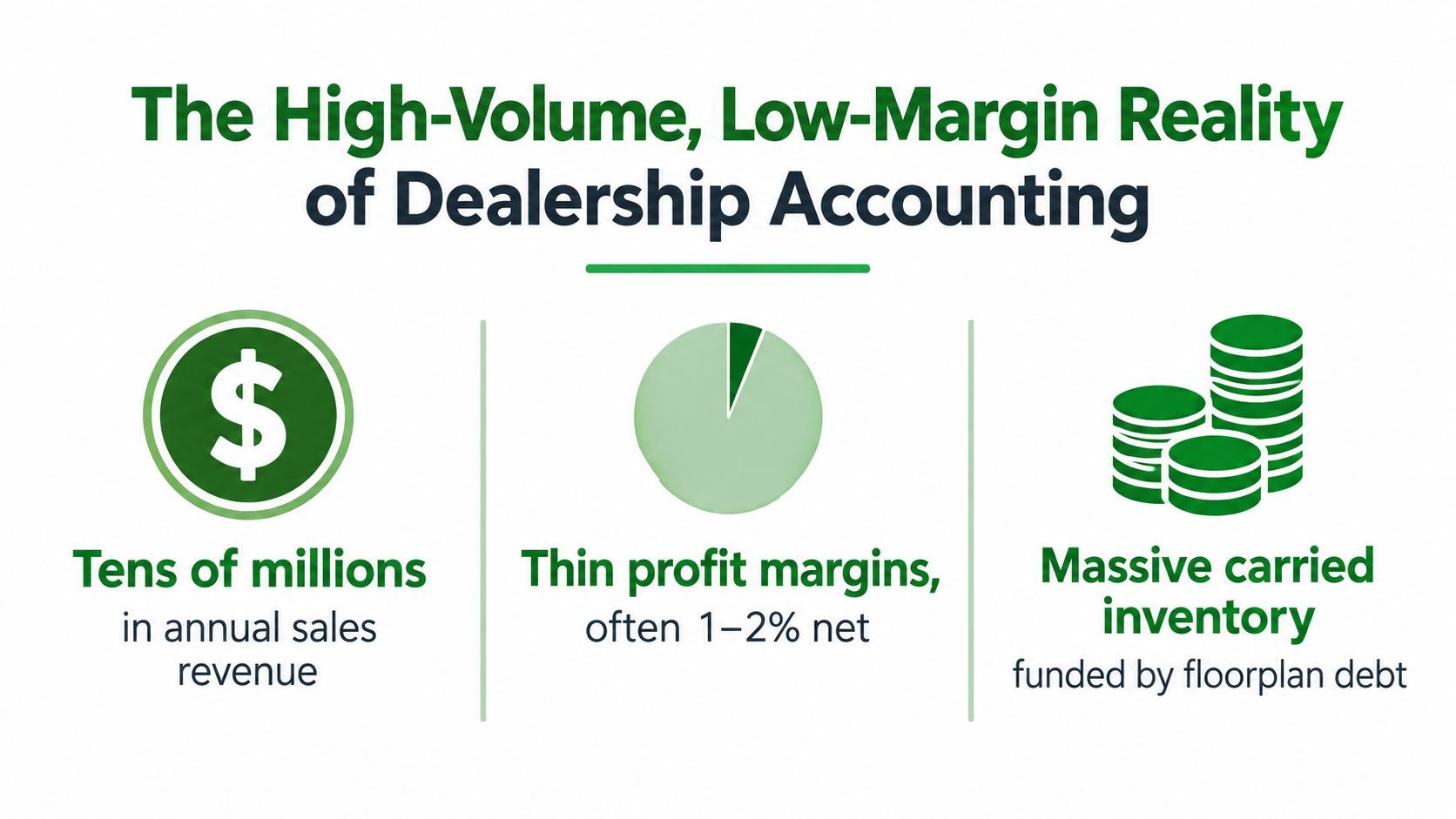
A dealership can be busy all month and still finish with very little real profit. The mistake is reading revenue as health. In automotive dealer accounting, the books have to show margin, cash timing, and aging, because a store can move large dollar volume and still live on a thin sliver of net income. NADA's 2024 midyear reporting showed $4.46 billion in total advertising expenditures across franchised dealerships, which is why expense classification matters when every line item hits at scale.
Why the cash feels tighter than the sales report
The sales meeting can sound healthy while the ledger tells a different story. Inventory purchases, floor-plan interest, payroll, recon, advertising, warranty handling, and compliance costs all live in the same business, but they do not hit cash at the same pace. Gross profit by department gives a clearer view than topline revenue because it separates the money-making parts of the store from the parts that consume it.
Practical rule: if the general ledger only tells you what sold, it is too shallow for a dealership.
NADA's 2024 data also shows how tight the margin really is. The average U.S. franchised dealership generated approximately $73.3 million in total sales in 2024, yet typical net margins were only about 1% to 2%. A missed accrual or misclassified expense can bend a result that already leaves very little room for error. Vehicle acquisition and related costs represented roughly 90% of revenue, so the remaining margin has to cover compensation, facilities, advertising, technology, insurance, and compliance. Law & Economics Center analysis of dealer franchise costs
What to classify separately from day one
Dealer books work best when every major cost has a home. Sales incentives, manufacturer rebates, advertising, payroll, rent, and floor-plan interest belong in separate buckets so management can see what is really driving results. That discipline matters on transport as well, because outside shipping charges need to flow into the right inventory or expense stream instead of getting buried. National Car Transport for dealerships
A clean chart of accounts lets you ask the right question, whether the store made money on vehicles, parts, service, or finance. It also exposes the trade-off that gets missed most often. Accounting gross profit can look fine while economic profit is weaker once floorplan interest, aging, and other carrying costs are included. That gap is where cash and margin discipline starts to matter.
Core Accounting Concepts Every Dealer Needs
The core mechanics of dealership accounting start with one simple idea. Every unit and every department has to carry its own cost, because a car deal is never just a sale price. Vehicle cost, recon, transport, interest, factory incentives, F&I income, warranty handling, and commissions all affect the actual result, and they don't belong in one blended pile.

Floorplan debt changes the meaning of inventory
Floorplan financing is not just a liability line. It's a live cost that keeps running while a unit sits, which means aging inventory changes the economics of the lot. The bookkeeping has to track principal, accrued interest, and the vehicle's age together, or the store will mistake a slow unit for a profitable one.
That's why a dealership subledger matters more than a generic inventory total. New vehicles, used vehicles, and parts don't behave the same way, so the ledger shouldn't pretend they do. New-car inventory may be supported by manufacturer incentives and holdbacks, while used-car inventory depends more heavily on acquisition cost, recon, and market resale value.
Revenue, gross sales, and the deal structure
Dealers also need a clean distinction between gross sales and true revenue recognition. If you want a plain-English comparison of those concepts outside the auto context, gross sales versus revenue explained is a useful reference point, because the same logic shows up in a dealership when front-end gross, back-end gross, rebates, and fee income all overlap. The core accounting question is not what the customer agreed to pay, it's what the store earned, when it earned it, and what costs belong with that deal.
F&I adds another layer. Finance reserve, warranty income, GAP, and product sales are real profit centers, but they can't be booked casually. Chargebacks matter because the deal isn't always final in an economic sense when refunds or early payoffs can reverse part of the margin later.
Where each posting belongs
A dealer bookkeeper has to place each item where it can be reviewed later, not just where it balances today. That means:
Vehicle cost and recon: tied to the unit and its department, not buried in overhead.
Sales commissions: matched to the department that generated them.
F&I income and chargebacks: kept separate from front-end gross.
Warranty receivables: tracked as receivables, not assumed cash.
Sales tax: handled with jurisdiction-specific care, never blended into revenue.
For a basic refresher on the statement structure these postings feed, the internal guide on what a profit and loss statement is helps frame how the income statement should read once the dealership's subledgers are clean.
A dealership chart of accounts should answer one question fast, where did the margin come from?
Variable Versus Fixed Operations and Department-Level Profit
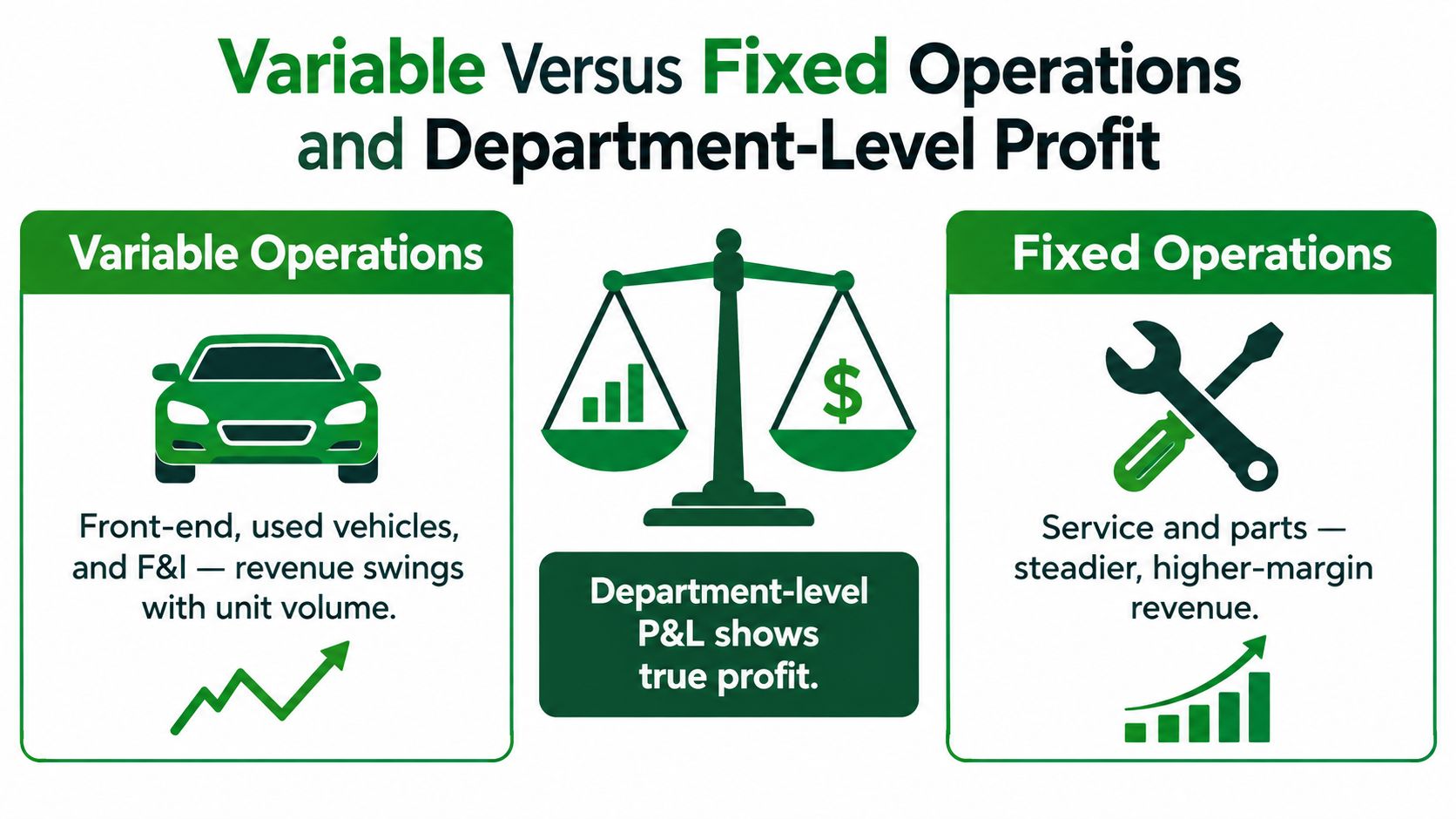
A dealership isn't one business, it's at least two operating models under one roof. Variable operations move with unit sales, while fixed operations depend on service flow, parts demand, and body-shop work. If the accounting system blurs those lines, management loses the ability to see which side is carrying the store and which side is draining it.
The departments don't earn money the same way
Variable operations include new vehicles, used vehicles, and F&I. Fixed operations include service, parts, and body-shop activity. Those categories need separate ledgers because gross profit, expense load, and operating risk behave differently in each one, and the same monthly total can hide a weak department behind a strong one.
NADA's published financial profile for U.S. new-truck dealerships shows why this matters. Average total sales rose from $58,870,394 in 2023 to $65,642,058 in 2025, while total gross profit moved from $11,619,548 in 2023 to $11,870,890 in 2025. Gross profit as a percentage of sales changed from 19.7% to 20.0% and then 18.1%. NADA financial profile
Why higher sales can still mean weaker profit
The gross profit story gets more honest when you look below the revenue line. Total expenses rose from $8,733,031 in 2023 to $9,848,173 in 2025, consuming 75.2%, 74.4%, and 83.0% of total gross profit across those years. Operating profit declined from $2,886,517 in 2023 to $2,022,644 in 2025, even though sales grew.
That's the trap. A dealership can sell more cars and still earn less if it lets expense growth outrun gross. The only way to catch that early is with a department-level P&L, not one consolidated report that makes everything look average.
What the manager should review each month
The books need to answer practical questions, not accounting trivia. Which department created the margin, which department consumed it, and which one looked fine until expenses were allocated correctly?
Practical rule: consolidated profit is a summary, department profit is a decision tool.
Variable and fixed ops should each carry their own gross profit, direct expenses, and accountable manager review. If the service department is carrying the store, that should be visible. If used cars are producing margin but F&I chargebacks are eroding it, that should be visible too. The chart of accounts exists to make those trade-offs impossible to ignore.
Required Reports, KPIs, and the Monthly Close Checklist
The monthly close should feel like a control process, not a scavenger hunt. Every dealership needs the same core rhythm, prove the balances, tie out the units, validate the interest, and make sure the statements match the subledgers before anyone distributes numbers to ownership or lenders.
The reports that matter most
A dealership close starts with the basics, but the basic reports have to be believable. The balance sheet, income statement, and cash flow statement need to reconcile to the source records, or they're just polished guesses. The same is true for aging schedules, contracts in transit, and inventory subledgers.
The monthly report stack should include:
Financial statements: balance sheet, income statement, and cash flow.
Departmental trial balances: new, used, F&I, service, parts, and body shop.
Aging schedules: receivables, payables, inventory, and floorplan items.
Exception reports: negative gross deals, chargebacks, and unusual reserve activity.
What gets verified before the books close
The bookkeeper should tie the inventory subledger to the general ledger, then confirm floorplan principal and accrued interest against the lender statement. Deal income has to be reviewed against delivery status, and F&I chargebacks need their own review before the month is locked. If a balance can't be supported by a schedule, it's not ready to publish.
For a practical close sequence in a smaller accounting stack, the internal guide on how to close the books in QuickBooks Online is useful because the same discipline applies even when the dealership has a DMS on top of the general ledger.
The KPIs that change decisions
Numbers only matter if they change behavior. The most useful ones are the ones managers can act on before month-end becomes a postmortem.
Manager checkpoint: if a KPI can't trigger a review, it's not a KPI, it's wallpaper.
A useful close meeting focuses on gross profit by department, inventory aging, receivable aging, payables, cash movement, and operating-expense ratios. Those measures tell the owner whether the store is converting sales into cash, or just into more work. They also make it easier to catch a negative gross deal before it gets buried inside the next batch of entries.
Common Pitfalls, Compliance Issues, and Hidden Margin Killers
The most expensive dealership mistakes are the ones that look normal. A unit ages a little too long, a rebate posts late, a commission lands in the wrong bucket, and no one notices until the month is already closed. That's how margin disappears in a business that has very little margin to spare.
Accounting margin isn't the same as economic margin
A clean P&L can still flatter the truth. A vehicle may show a positive accounting gross while months of floorplan interest, aging exposure, and recon spending have already made the economic result much weaker. The store didn't lose money all at once, it leaked it in small steps that looked harmless in isolation.
That's especially important for EVs, where value shifts can move faster than old habits. Recent market data show that one- to two-year-old EV values fell 7% during 2025, while their values were 30% below 2022 levels. Comparable petrol vehicles fell 11% during 2025 and hybrids 9%. In the United States, used-EV sales reached 378,140 units in 2025, up 35.1% year over year, yet used EVs still represented only 2.1% of the used-vehicle market. Cox Automotive EV market data
What gets missed when inventory ages
Aging inventory is usually a cash problem before it becomes a P&L problem. Dealers often treat floorplan interest as a simple monthly expense, but that framing misses the core issue, which is which units are consuming liquidity and whether the store is carrying them longer than the market supports.
The internal guide on lower of cost or market is relevant here because the accounting judgment needs to reflect what the unit can realistically bring in today, not what it once cost. That discipline becomes more important when VIN-level pricing moves quickly and the dealership is trying to keep its books defensible.
Compliance is not just a tax issue
Sales tax handling, warranty documentation, and F&I reserve tracking all create audit exposure when they're handled casually. The same goes for manufacturer incentives and advertising accruals, which should be posted where management can see them, not left to a month-end cleanup that assumes someone will remember later. Commissions also need department attribution, or gross profit gets distorted and incentive plans start rewarding the wrong behavior.
The practical defense is boring but effective, a repeatable close, documented schedules, and a habit of asking whether the booked result matches the unit-level reality. If it doesn't, the issue isn't cosmetic, it's operational.
Workflows, Software Integrations, and When to Outsource Bookkeeping for Automotive Dealer Accounting
A dealership can have the best people in the store and still lose control of the numbers if the systems don't talk cleanly to each other. DMS data has to move into the general ledger in a way that preserves department tags, unit detail, and reconciliation history. If not, the accounting team spends the month untangling exports instead of closing the books.
What has to connect
The core flow is simple in theory and messy in practice. Unit sales, service tickets, parts invoices, F&I postings, and payroll detail should map into the accounting system without losing department identity. QuickBooks Online and Xero can work for many smaller operators, but only if the DMS-to-ledger workflow is disciplined and someone owns the tie-out process.
The usual failure points are familiar:
Broken mapping: a DMS export lands in the wrong account class.
Duplicate entries: manual adjustments stack on top of imported transactions.
Missing subledgers: inventory or receivables don't match the GL.
Delayed review: errors sit until the next month because nobody owns the close.
When outsourcing makes more sense
In-house bookkeeping still works when the store has a stable transaction load, a trained controller, and a close calendar that gets followed. Once the team is spending more time repairing integrations and hunting support issues than reviewing margin, outsourcing becomes the safer path.
The decision isn't about size alone. It's about whether the team can produce a clean monthly close, keep subsidiary records aligned with the general ledger, and respond quickly when something doesn't reconcile. If those basics are slipping, bringing in outside bookkeeping support is usually faster than rebuilding the whole internal process from scratch.
Turning Monthly Close Discipline into Long-Term Profit Control
By the end of the year, the dealerships that stay calm aren't the ones with the flashiest sales reports. They're the ones that knew where the margin lived, closed the books the same way every month, and didn't let one department's noise hide another department's weakness. That discipline turns accounting from a reporting chore into a management habit.
What changes once the books are trustworthy
When the close is clean, ownership can stop guessing. They can see whether profit came from new units, used units, service, parts, or F&I, and they can tell whether cash was created or deferred into the next aging bucket. That visibility matters more than headline sales because it shows what the store can sustain.
It also makes planning more honest. The internal guide on budgeting and forecasting fits naturally here, because forecasts built on sloppy closes just repeat last month's mistakes with better formatting. A dealer who knows the margin by department can budget labor, inventory, and advertising with far less wishful thinking.
The pattern that separates strong stores from tired ones
The stores that stay healthy don't rely on heroic cleanup at quarter-end. They reconcile regularly, review unusual deals while they're still fresh, and make sure every balance has a schedule behind it. That's not glamorous, but it's how controllers keep a dealership from drifting into a false sense of profit.
Good dealer accounting doesn't promise perfect numbers. It gives management numbers they can act on.
That's the end goal. Once the monthly close is predictable, the owner gets better decisions, the controller gets fewer surprises, and the store stops confusing activity with performance.
Book Tech LLC helps owners keep the accounting side of the business controlled, timely, and ready for review, including monthly bookkeeping, clean-up work, and dependable financial reporting. If you want a bookkeeping partner that understands how margin, cash flow, and close discipline support better dealership decisions, visit Book Tech LLC and start the conversation.