
Your IRS Mileage Log a Guide to Tax-Ready Records
You're probably here because mileage tracking sounded simple until tax time made it messy. The year ends, you open your calendar, search old emails, scroll through card charges at gas stations, and try to rebuild where you drove and why. That's the point where a lot of small business owners realize they don't just need a list of trips. They need records the IRS will accept.
A solid IRS mileage log is less about convenience and more about proof. If you use your vehicle for business, your log needs to show exactly what happened, when it happened, and why the trip belonged to the business instead of your personal life. The difference matters because weak logs get challenged, and challenged logs can lead to a lost deduction.
Table of Contents
Why Your IRS Mileage Log Must Be Perfect - Why reconstruction creates risk - What an audit-proof log actually needs to do
The Four Pillars of an IRS-Compliant Log Entry - What every trip entry must include - What a good business purpose looks like
Standard Rate vs Actual Expenses Making the Right Choice - How the two methods differ in practice - Which method tends to fit which business
Choosing Your Logging Method From Paper to Apps - Paper and spreadsheet workflows - Accounting software and dedicated mileage apps
Audit-Proofing Your Records Retention and Common Pitfalls - How long to keep your records - The mistakes that get logs rejected
Your Top IRS Mileage Log Questions Answered - How do I handle one trip with both business and personal stops - What if two spouses use the same car for separate businesses - Can I drive from my home office to a client site and deduct it - Do I need a separate log for each vehicle - What format should I use for my log - What if I already have a messy year of mileage records
Why Your IRS Mileage Log Must Be Perfect
You sit down in March to finish the books, open your calendar, scroll through old texts, and try to rebuild a year of driving from memory. The totals may look reasonable. That is still the kind of mileage log that gets challenged.
I see this issue often with small business owners who are otherwise careful recordkeepers. They saved fuel receipts, kept client invoices, and can explain why they drove. What they do not have is a record created close to the trip itself, with enough detail to stand on its own if an IRS examiner reviews it months or years later.
That difference matters. A mileage deduction is not supported by a believable annual total alone. It is supported by trip-level records that show where you went, when you went, and why the drive was business related.
Why reconstruction creates risk
Reconstructed logs are weak because they invite questions you may not be able to answer later. If a line says "client meeting" or "errands," an examiner can ask which client, what business task, and why that route was necessary. If the answer only exists in your memory, your deduction is exposed.
The problem is not only fraud. It is vagueness.
A log can be rejected even when the miles were real. Common failure points include:
entries written months later
business purpose notes that are too general
grouped trips that combine multiple stops into one line
mixed personal and business driving with no clear split
mileage totals that do not match the vehicle's overall use
For example, "bank, post office, supplies" is weak if it does not explain the business reason for each stop. "Deposited customer checks at First National, mailed signed contract to vendor, purchased printer toner for office" gives the trip context an outside reviewer can follow.
What an audit-proof log actually needs to do
An audit-proof mileage log does more than capture miles. It shows that your recordkeeping habit is consistent, timely, and specific. That is the standard business owners miss.
A good system should do three things well:
record trips close to the date of travel
separate personal use from business use clearly
produce entries that make sense without extra explanation from you
That last point is where many logs fail. If your records only work because you can talk someone through them, they are not strong records. The entry itself should tell the story.
This is also why mileage tracking should sit inside your broader bookkeeping routine, not as a year-end cleanup project. If you already have a monthly close process, add mileage review to it along with receipt capture and account coding. A practical framework for that is this guide to tracking business expenses for small business compliance.
Keep the standard in plain terms. Your log does not need to look polished. It needs to be credible, current, and detailed enough that the IRS does not have to guess what happened.
The Four Pillars of an IRS-Compliant Log Entry
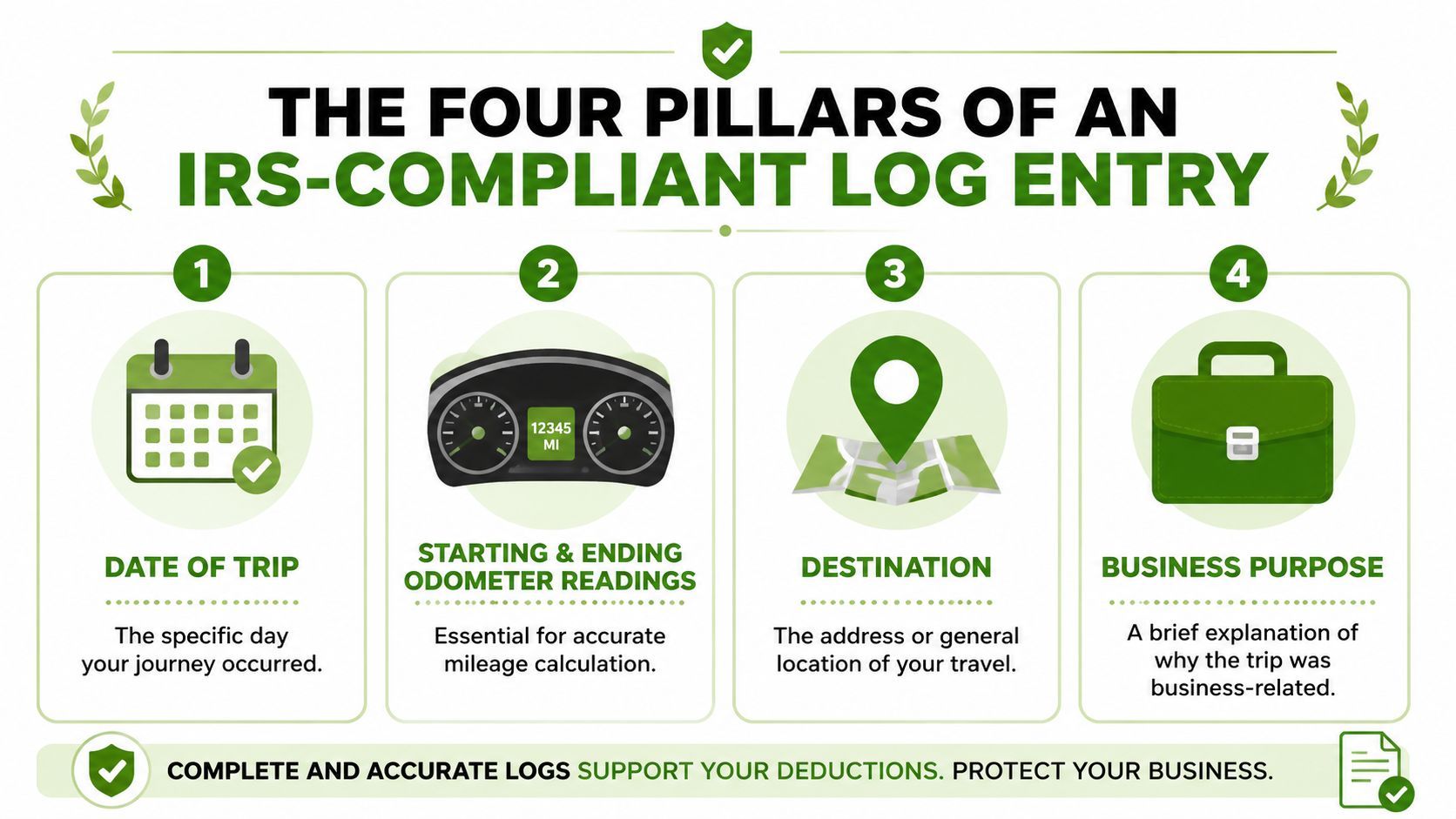
A business owner gets audited, hands over a mileage log, and expects the deduction to stand. Then the agent starts asking simple questions the log cannot answer. Where exactly did you go? Which client was this for? Why does every Thursday just say "meetings"? That is how otherwise legitimate deductions get disallowed.
An IRS-compliant mileage log has to do more than show that you drove for work. Each entry needs enough detail to stand on its own, especially if someone reviews it months or years later. For each business trip, record four pieces of information: date, business miles, destination, and business purpose.
What every trip entry must include
These four fields are the backbone of a log that holds up under scrutiny:
Date of trip. Use the actual date you drove.
Total business miles. Record the mileage for the business portion of that trip only.
Destination. Name the place with enough detail to identify it later, such as a client office, supplier, bank branch, or job site.
Business purpose. State why the trip was necessary for the business in plain language.
The first three are straightforward. The fourth is where weak logs usually fall apart.
Here is the difference between an entry that raises questions and one that answers them:
Weak entry | Strong entry |
|---|---|
Meeting | Met with Jane Doe at Acme Corp to review contract terms |
Supply run | Purchased packaging supplies for customer orders at Main Street Office Supply |
Job site | Visited Elm Street remodel site for progress review and subcontractor coordination |
Specificity matters because vague logs often look reconstructed. A reviewer who sees repeated entries like "client visit" or "errands" has no way to tell whether the trip was ordinary commuting, personal, or legitimately business-related.
If you want your mileage support to match the rest of your books, pair it with a consistent process for tracking business expenses for small business compliance.
What a good business purpose looks like
A good business purpose answers the question, "Why did this drive need to happen for the business?" It should make sense to someone who does not know your customers, your route, or your daily routine.
I tell clients to include at least one concrete identifier in the purpose field. That can be the client name, property address, vendor, project, or task performed. "Client meeting" is too thin. "Met with ABC Manufacturing purchasing manager to discuss revised pricing" is much better. It gives the trip context and makes it easier to match against invoices, calendar entries, emails, or deposits if the log is ever reviewed.
Use this standard:
Who you met, served, or dealt with
What you did
Which client, project, property, or vendor was involved
Examples by business type:
Consultant: Met with ABC Manufacturing purchasing team to present proposal revisions
Real estate agent: Showed Maple Avenue property to buyer prospect
Electrician: Drove to Jones residence to complete panel inspection and prepare estimate
Retail owner: Picked up packaging inventory from supplier for online order fulfillment
A short visual walkthrough can help if you want to see how these elements fit together in a real log:
One mistake deserves special attention. Commuting to a regular work location is not business mileage. Driving from home to your usual office, shop, studio, or other regular work site does not belong in the deductible portion of the log. A compliant record separates those personal commuting miles from trips to clients, temporary job sites, banks, vendors, or other qualifying business stops.
That distinction gets missed often, and it is one of the first places an auditor looks.
Standard Rate vs Actual Expenses Making the Right Choice
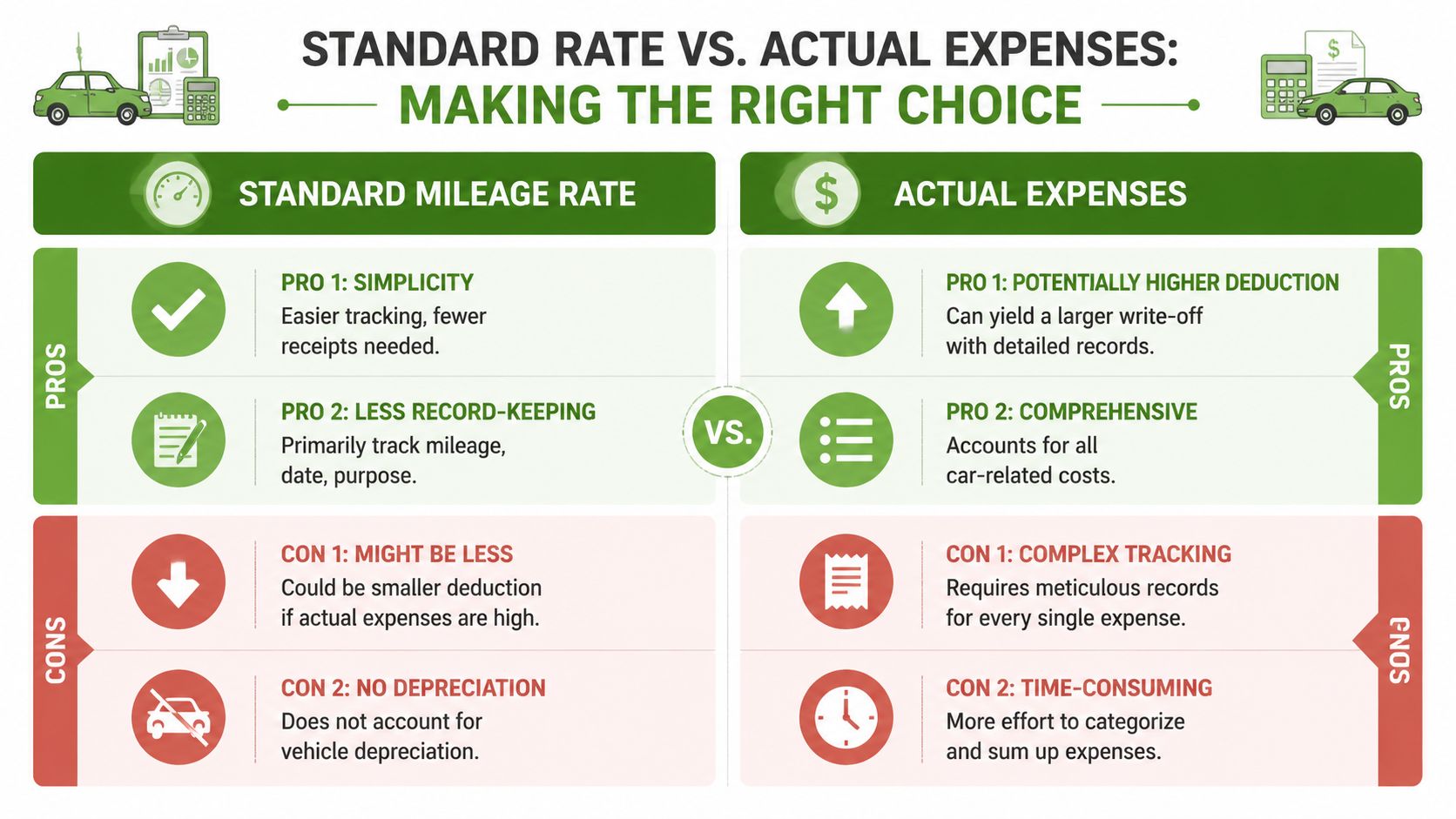
The first decision isn't about apps or templates. It's about which deduction method you're trying to support. That choice changes what records matter most and how much administrative work you're signing up for.
How the two methods differ in practice
Here's the plain-English version.
Method | What you track most closely | What owners usually like | What owners usually dislike |
|---|---|---|---|
Standard mileage rate | Business miles and trip details | Simpler recordkeeping | May not be the best fit for every vehicle |
Actual expense method | Vehicle costs plus business-use allocation | Can better reflect high vehicle costs | More paperwork and more reconciliation |
Under the standard mileage rate, you apply the IRS rate to qualifying business miles. For 2026, that rate is 70 cents per mile, as covered earlier from the IRS guidance. This method appeals to owners who drive often and want a cleaner process.
Under the actual expense method, you track vehicle costs such as fuel, insurance, repairs, maintenance, registration, and similar expenses, then apply the business-use percentage to those costs. That means your mileage log still matters because the business-use percentage depends on your business miles compared with total annual miles.
The standard rate is simpler. Actual expenses can be more precise. Simpler usually wins when the records are stronger.
That's the trade-off I see most often in bookkeeping work. Owners underestimate the burden of actual expense tracking. Receipts go missing. Charges hit personal cards. Insurance renewals get filed in email but never exported. Then the deduction depends on incomplete support.
If you're also planning your tax cash flow, this practical guide to quarterly taxes for self-employed individuals helps connect vehicle deductions to the bigger tax picture.
Which method tends to fit which business
A few common patterns help.
High-mileage service businesses often prefer the standard rate because it's easier to maintain and easier to review.
Owners with expensive vehicle operating costs sometimes examine actual expenses more closely.
Businesses with mixed personal and business use need strong total-mile tracking either way, because the business-use percentage becomes central.
For example, a consultant driving to client meetings all week may value the standard rate because the recordkeeping burden stays concentrated in the mileage log. A contractor with a dedicated work truck may want to compare both approaches with a tax professional before deciding how to track the year.
What matters most is consistency. Pick the method that matches the level of documentation you'll maintain. The best deduction method on paper is useless if the records behind it won't hold up.
Choosing Your Logging Method From Paper to Apps
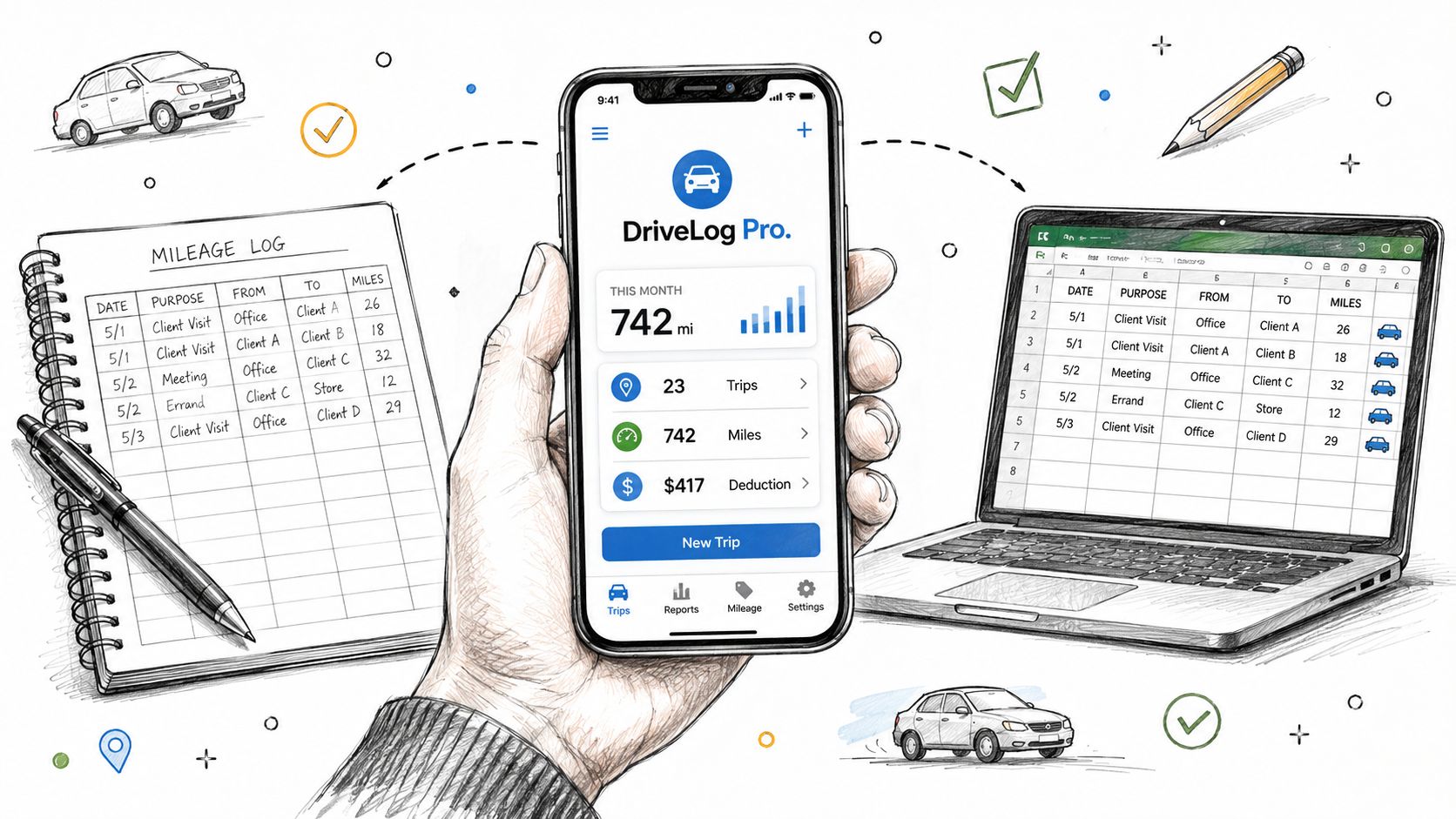
The right logging method is the one you'll use consistently in the middle of a busy workday. A perfect spreadsheet no one updates is worse than a simple app that captures every drive. For most owners, the main choice is between manual control and automated convenience.
Paper and spreadsheet workflows
Paper logs still work. So do Excel sheets, Google Sheets, and exported CSV or PDF records. The IRS doesn't require one specific format, as long as the record is complete and consistent. That makes manual systems valid, but not always efficient.
A freelancer might keep a notebook in the glove box and enter trips into Google Sheets every Friday. That setup is cheap and familiar. It also creates obvious failure points:
Trips get missed when the notebook isn't nearby
Handwriting gets vague when the day runs long
Weekly entry habits drift when work gets busy
Edits become hard to trace if several people touch the file
For some owners, a spreadsheet is the best middle ground. It's structured, searchable, and easy to back up. If that's your route, keep the columns simple: date, miles, destination, business purpose, and a field to classify business versus personal use. This small business spreadsheet for income and expenses can help if you want your mileage records to sit inside a broader bookkeeping process instead of living on an island.
Accounting software and dedicated mileage apps
Semi-automated workflows are often the practical sweet spot. Many owners already live in QuickBooks Online or Xero, so using connected tools or mileage features inside those systems reduces duplicate work. You can classify trips, connect them to jobs or customers, and preserve a cleaner audit trail.
A field service provider offers a good example. If the owner starts the day at one job site, heads to a supplier, then drives to two more customer locations, a manual log becomes easy to delay. A GPS-based app captures the route in real time, then the owner classifies each trip while the details are fresh.
If you want a solid overview of how to track business mileage effectively, that resource explains the operational side in a way many owners find easier to apply than IRS language alone.
Here's how the options usually stack up:
Method | Best for | Main strength | Main weakness |
|---|---|---|---|
Paper logbook | Low trip volume | Simple and low cost | Easy to forget and hard to audit cleanly |
Spreadsheet | Owners comfortable with manual entry | Flexible and exportable | Depends on discipline |
QuickBooks or Xero workflow | Businesses already using accounting software | Better connection to books and job records | Still needs prompt trip classification |
Dedicated mileage app | High trip volume or field work | Real-time capture and easier consistency | Requires setup and regular review |
Field-tested advice: The more often you stop and start for business, the less realistic a manual log becomes.
There's one caution with app-based systems. Automation helps capture movement, but it doesn't automatically create a complete business explanation. You still need to review trips, label them correctly, and make sure the purpose field is specific enough. GPS can tell you where you went. It can't tell the IRS why that drive was necessary for your business.
Audit-Proofing Your Records Retention and Common Pitfalls
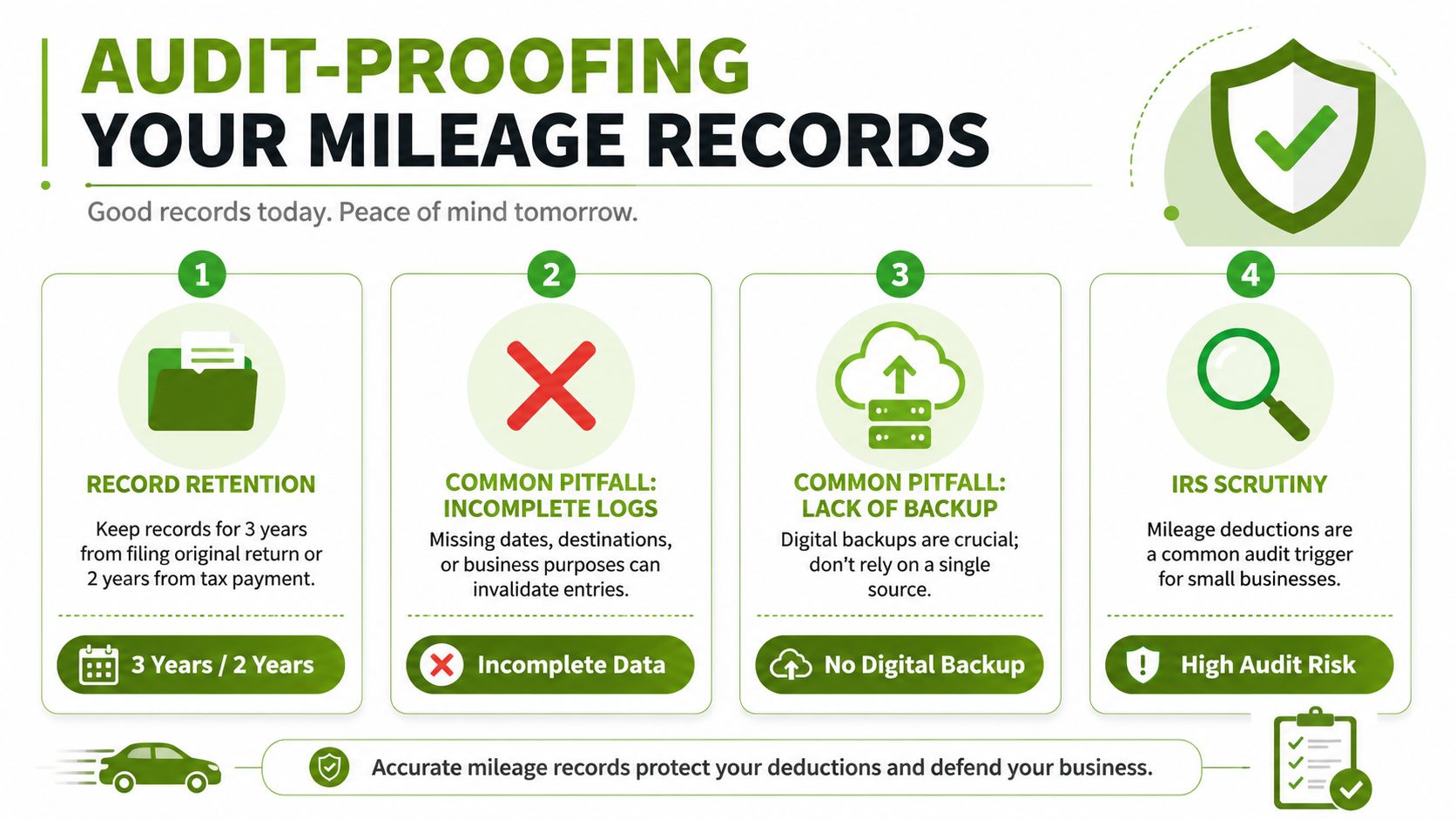
An audit-proof IRS mileage log isn't just a good trip list. It's a recordkeeping system you can still defend years later. That means retention, backup discipline, and avoiding the handful of mistakes that repeatedly sink otherwise valid deductions.
How long to keep your records
The retention rule is straightforward. Taxpayers should keep mileage logs and supporting documents for at least three years from the date the return claiming the deduction is filed, according to this explanation of IRS mileage log retention requirements. If the return is filed early, the three-year period runs from the original due date. Many tax professionals recommend keeping them for up to seven years for added protection, and that longer window is often the safer operational habit.
That means your system should preserve more than the trip log itself. Keep the exported report, any spreadsheet version, and related support such as calendar entries or invoices if they help tie the trip to real business activity.
If you want your documentation habits to mirror a stronger accounting process, it helps to think in terms of an audit trail in bookkeeping rather than a one-off tax file.
The mistakes that get logs rejected
Most guides fall short by stopping too early. They tell you what to record but not why logs fail.
One major issue is vagueness. Data from audit rejection cases shows that 68% of disputed weekly logs fail due to vague purposes like “meeting” instead of a specific explanation, according to this review of mileage log rejections in IRS audits. That doesn't mean weekly logging is automatically invalid. It means weekly logging often produces weak purpose descriptions because owners no longer remember enough detail.
Another problem is reconstructed logs. When owners try to rebuild travel months later from gas receipts, GPS history, or calendar notes, the records may look neat but still read like estimates. That's especially dangerous when the pattern shows gaps, round numbers, or identical wording over long stretches.
Here are the issues that raise the most concern in practice:
Vague purposes. “Meeting,” “errand,” and “job site” don't explain enough.
Late entry habits. The longer you wait, the thinner the business detail becomes.
No business versus personal split. Mixed-use vehicles need a clear business-use percentage.
Missing annual odometer readings. You should document odometer readings at the start and end of the tax year, and when you begin using a new vehicle for business.
Single-copy storage. If your phone dies or a spreadsheet gets overwritten, you've lost key support.
If the record makes sense only because you remember the context, it isn't strong enough.
In difficult situations, especially when a deduction is already being questioned, some owners also look into outside support such as Omni Tax Help for audit defense to understand how representation works. The better approach, though, is building records that don't need rescue later.
Your Top IRS Mileage Log Questions Answered
How do I handle one trip with both business and personal stops
Split the trip. Only the business portion belongs in your IRS mileage log.
If you drive to a client meeting and then stop for personal shopping, log the miles tied to the client visit and leave the personal portion out. Don't combine the whole outing into one business trip just because it started with work.
What if two spouses use the same car for separate businesses
Keep the record clean enough to show which business each trip belongs to. The safest approach is to label the business purpose with the business name, client, or project so the trip can be tied back to the correct activity later.
The bigger issue is clarity. If both people use one vehicle for different businesses, vague entries create confusion fast.
Can I drive from my home office to a client site and deduct it
This depends on whether your home office qualifies under IRS rules and whether the drive is business travel rather than regular commuting. A drive from home to a regular work location usually isn't deductible. A drive tied to a qualifying home office and then out to a client or temporary work location may be treated differently.
This is one of those areas where facts matter. If your setup is mixed or inconsistent, ask a tax professional before you assume the miles count.
Do I need a separate log for each vehicle
Yes, that's the cleanest way to keep records accurate. Each vehicle should have its own trip history and annual odometer documentation. Combining vehicles into one running log creates reconciliation problems and makes the business-use calculation harder to defend.
What format should I use for my log
Use the format you'll maintain consistently. Paper logbooks, spreadsheets, PDF exports, CSV files, and digital mileage apps can all work if the records are complete, readable, and timely.
The test isn't whether the format looks modern. The test is whether it captures the required trip details and can be produced clearly if someone asks for it later.
What if I already have a messy year of mileage records
Clean it up immediately while the details are still recoverable. Don't wait until return prep. Pull together calendar entries, invoices, work orders, and existing notes, then identify what you can support confidently and what you can't.
Going forward, build a repeatable process and stick to it. If your books also need cleanup beyond mileage alone, professional bookkeeping services for small businesses can help bring the whole recordkeeping system back under control.
If your mileage logs, books, and expense records all need to become cleaner and more tax-ready, Book Tech LLC helps small business owners build reliable bookkeeping systems that support compliance instead of creating last-minute stress.