
Bookkeeping for S Corp: Records That Keep Taxes Clean


Your bank balance matches QuickBooks, the credit card is reconciled, and you've transferred money to yourself whenever cash allowed. Then your tax preparer asks which transfers were wages, which were distributions, and what your opening shareholder basis was. The transactions are recorded, but the answers aren't.
That's where bookkeeping for S Corp owners gets more demanding than ordinary income-and-expense tracking. Payroll, distributions, and shareholder basis need to work as one connected ledger. A reconciled account proves that money moved. It doesn't prove that you recorded the movement correctly for the company's return or the shareholders' tax reporting.
Table of Contents
The Transaction Map Every S Corp Needs - Build accounts that preserve the distinction
Why Pass-Through Reporting Changes Your Ledger - Classification matters as much as reconciliation
Running Payroll Without Mixing Up Owner Pay - Record payroll through its liabilities - Review withdrawals against actual services
Tracking Distributions and Shareholder Basis - Apply adjustments in the proper order - Maintain a schedule for each shareholder
Monthly Close Steps for Tax-Ready Books - Run the close with explicit controls - Define completion before you begin
How Long to Keep Each S Corp Record - Preserve the chain of support
Set Up Your S Corp Books This Month - Establish opening balances you can defend - Assign responsibility for staying current
The Transaction Map Every S Corp Needs for Bookkeeping
Where each S Corp transaction posts and what it affects
Transaction | Where it posts | Tax effect | Proof to keep |
|---|---|---|---|
Owner paycheck (W-2 wages) | Payroll expense, with payroll liabilities until remitted | Wage deduction and employee wage reporting | Payroll register and duties record |
Shareholder distribution | Equity, in a shareholder-distribution account | Reduces stock basis and supports shareholder distribution reporting | Approval record and bank transfer |
Accountable plan reimbursement | Expense account matching the cost | Business expense treatment when properly substantiated and administered | Receipts, expense report, and business-purpose note |
Shareholder loan to the company | Liability, in a shareholder-loan account | May establish debt basis when the advance qualifies | Promissory note and transfer record |
Capital contribution | Equity, in paid-in capital | Increases stock basis | Deposit record and contribution memo |
Personal expense paid by the business | Reclassify as a shareholder distribution when appropriate | Removes the personal cost from deductible expenses and affects stock basis | Memo explaining the reclassification |
Business revenue and ordinary expenses | Revenue and expense accounts | Supplies the company's income and deduction reporting | Invoices, receipts, and bank statements |
The most important distinction is expense versus balance-sheet activity. Paying an owner isn't automatically an expense, and receiving money from an owner isn't automatically revenue. Classify the transaction by its purpose, not by the name attached to the bank transfer.
For reimbursements, keep the expense report with the receipt rather than relying on a merchant description. For shareholder advances, document whether the money is intended as a repayable loan or a permanent capital contribution. Don't let that decision emerge accidentally from a bank-feed rule.
Build accounts that preserve the distinction
In QuickBooks Online or Xero, create shareholder-specific distribution, contribution, and loan accounts. Avoid an all-purpose owner draw account that combines withdrawals, repayments, and personal purchases. A focused chart of accounts setup makes those distinctions visible without adding unnecessary expense categories.
Separate owner transactions: Keep wages, reimbursements, distributions, and loan repayments identifiable.
Attach supporting records: Store the approval, receipt, or loan documentation with the entry.
Escalate uncertain treatment: Ask the tax professional about questionable advances or payments before finalizing their classification.
Entity questions belong outside routine transaction coding. If you're still deciding whether your legal structure and tax election fit, Brillant Law Firm's discussion of entity choices for Walnut Creek businesses provides context for that conversation.
Practical rule: A bank description tells you who received the money. Your documentation must explain why.
Before closing the month, assign every bank line to a supported category. An unresolved owner transfer is an unresolved tax-reporting question, even when the bank reconciliation balances.
Why Pass-Through Reporting Changes Your Ledger
An S corporation's ledger must support both company reporting and shareholder allocations. The IRS overview of Form 1120-S explains that the corporation reports income, gains, losses, deductions, credits, and other information, summarizes shareholder items on Schedule K, and provides a separate Schedule K-1 to each shareholder.
Schedule K is the company-wide summary. Schedule K-1 is the shareholder-level output. If an underlying transaction is missing or misclassified, allocating the totals accurately won't fix it. You'll divide an incorrect amount correctly.
Say a company has ordinary business income and shareholders with different ownership interests. Their allocations generally follow those ownership interests, subject to the applicable allocation rules. If the bookkeeper leaves an owner contribution in sales, both shareholders can receive allocations based on overstated business income.
Classification matters as much as reconciliation
Consider a charitable contribution posted to meals. The bank withdrawal is real, the receipt exists, and the reconciliation can still balance. But the tax preparer needs to identify the contribution separately rather than inherit a misleading meals balance.
Keep these categories distinguishable:
Ordinary business activity: Revenue and operating expenses with usable account detail.
Separately stated items: Transactions the preparer needs to evaluate outside ordinary business income.
Shareholder activity: Distributions, capital contributions, loans, and repayments by owner.
Ownership changes: Transfer dates, supporting agreements, and share records.
A midyear ownership change requires more than editing an owner's percentage in a spreadsheet. Preserve the effective date and shares held, then let the tax professional determine the allocation method. A current ownership list alone doesn't describe the whole tax year.
Matching cash doesn't establish that the shareholder allocations are right.
Use a tax-season preparation checklist to assemble the financial statements, supporting schedules, and unresolved questions together. The preparer shouldn't have to infer ownership history from bank transfers.
The year-end test is straightforward: are bank, credit card, payroll, receivable, and payable accounts reconciled, and can you explain the balances behind them? Complete records establish the starting point. Correct classification makes those records usable for shareholder reporting.
Running Payroll Without Mixing Up Owner Pay
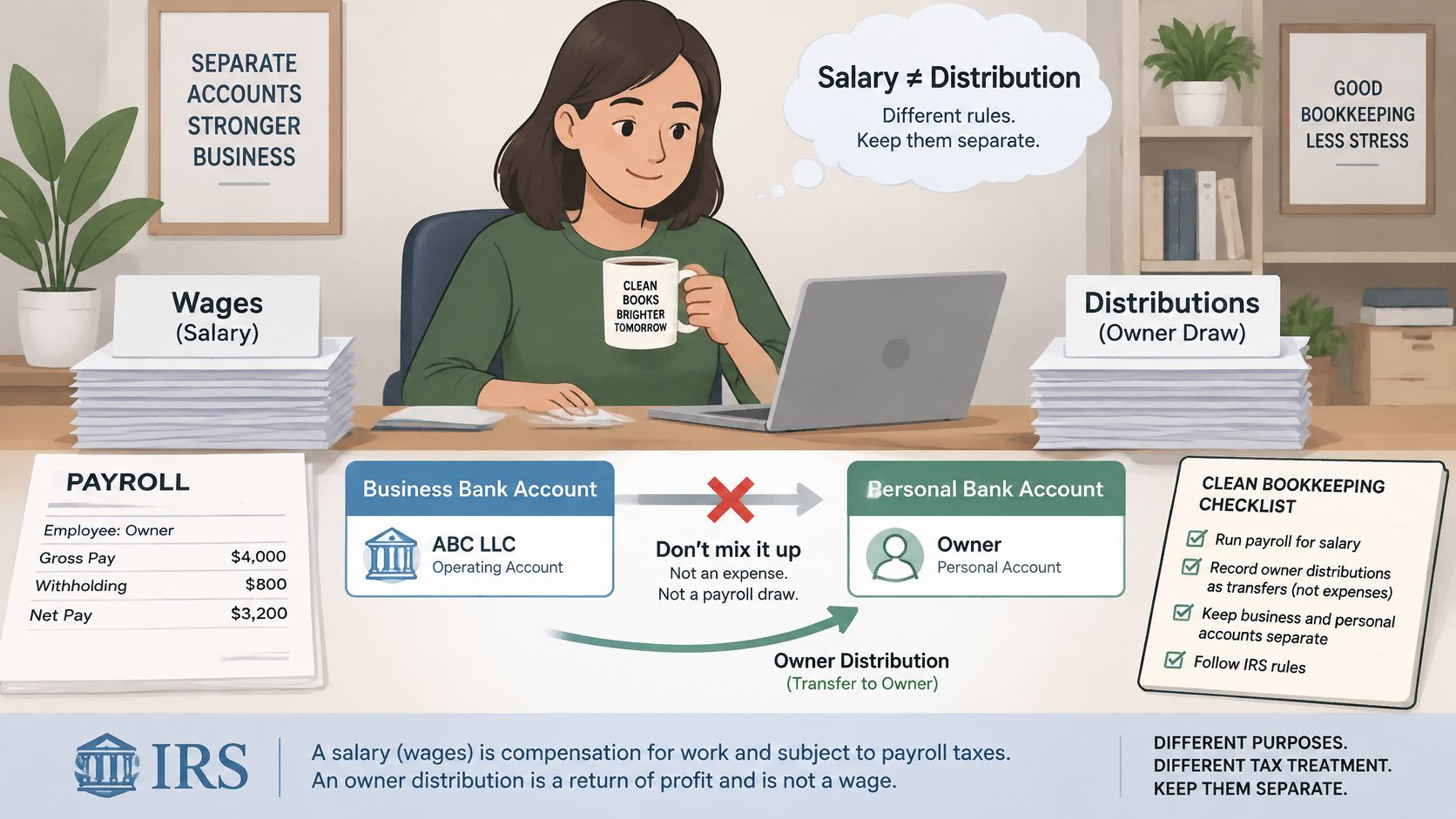
The owner-draw habit creates trouble when every transfer to the owner gets the same treatment. A payment labeled payroll draw doesn't become wages merely because someone typed payroll into the memo. Conversely, moving it to distributions doesn't settle whether compensation should have been paid.
The IRS instructions for Form 1120-S state that payments to a corporate officer must be treated as wages to the extent they represent reasonable compensation for services. They also describe employment-tax consequences when shareholder-employees receive distributions instead of adequate compensation.
The distinction needs to remain visible in the records.
Record payroll through its liabilities
Post gross wages to payroll expense. Record employee withholding as liabilities, recognize employer payroll taxes separately, and clear the related liabilities when payments are remitted. The net bank withdrawal alone isn't the full payroll entry.
A common integration mistake is importing the payroll journal and then accepting the bank withdrawal as another wage expense. Match the withdrawal to the imported transaction instead of creating a duplicate. A small-business payroll workflow should identify which system creates the accounting entry and which system supplies the payment.
Keep a compensation file that supports the salary decision:
Work performed: Job duties, responsibilities, and hours.
Pay comparisons: Relevant industry compensation information and comparable employee salaries.
Business circumstances: Profitability and the owner's role in producing company income.
The bookkeeper maintains that evidence. The tax professional reviews whether the compensation treatment is defensible.
Review withdrawals against actual services
Suppose a profitable company pays its working shareholder substantial distributions but no wages. That pattern needs review because the ledger doesn't show compensation for the owner's services. Don't attempt to solve it by renaming old withdrawals without coordinating the necessary payroll and tax corrections.
Distribution entries should remain in equity and be reviewed against ownership records and approvals. Compensation decisions shouldn't depend solely on how much cash the owner wants to withdraw.
At close, reconcile payroll reports to the general ledger, verify the applicable employment-tax filings, and match each owner-related withdrawal to its supporting entry. Investigate unexplained payroll liabilities rather than carrying them forward indefinitely. A liability that never clears may indicate a missing payment, a duplicate journal, or an integration problem.
Tracking Distributions and Shareholder Basis
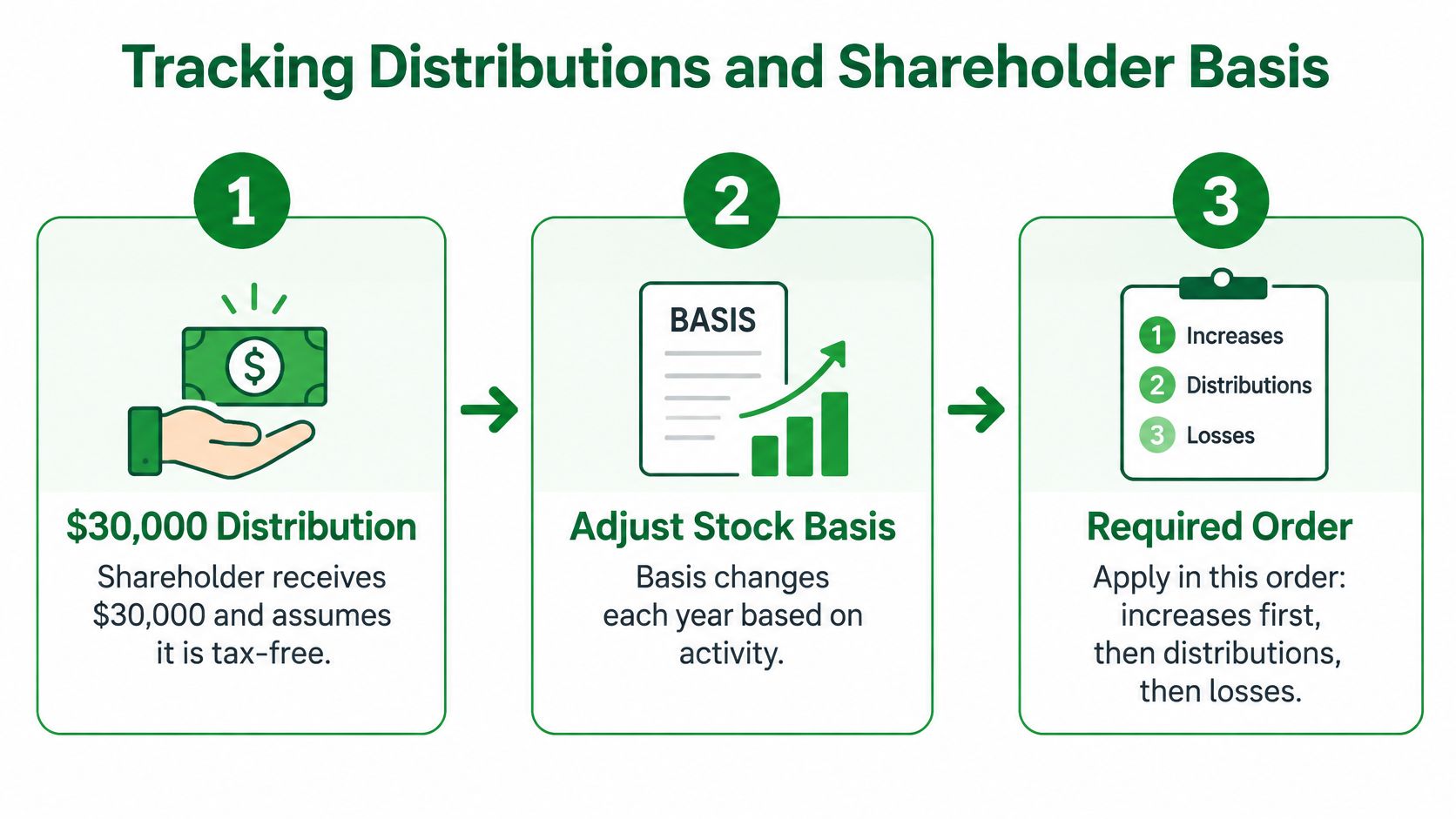
A shareholder receives a distribution and assumes the payment is tax-free because it came from an S corporation. The missing question is how much stock basis is available. Cash in the company bank account doesn't answer it.
The IRS shareholder instructions for Schedule K-1 explain annual basis adjustments, the use of Form 7203, and the information shareholders must retain; their practical implication is that a $30,000 distribution can't automatically be treated as entirely tax-free without establishing available basis.
Apply adjustments in the proper order
Begin with substantiated opening stock basis. Record relevant increases, including allocated income and tax-exempt income, before applying decreases for distributions, nondeductible expenses, and losses or deductions in the applicable order. Don't treat the year's net equity movement as a substitute for that calculation.
The IRS investment-income guidance explains that shareholders are taxed on allocated corporate income whether or not it's distributed, that distributions generally reduce stock basis, and that distributions exceeding basis can produce taxable gain. It also addresses basis limitations on losses and the carryforward of disallowed losses.
Stock basis and debt basis therefore need separate schedules. A qualifying shareholder loan may support debt basis, but it doesn't make stock basis available for a distribution. Loan repayments also need review rather than automatic treatment as ordinary owner withdrawals.
Maintain a schedule for each shareholder
Build the working schedule around transaction evidence:
Opening balances: Prior-year stock basis, debt basis, and relevant carryforwards.
Current activity: Contributions, allocated income, distributions, and nondeductible expenses.
Loan movements: Advances and repayments tied to individual loan records.
Review notes: Noncash distributions, missing support, or uncertain treatment.
Update the transaction activity monthly, then have the tax professional finalize the tax adjustments. The shareholder remains responsible for maintaining basis information, even when the corporation's bookkeeper prepares the supporting schedule.
A clean balance sheet isn't a completed basis calculation. Prior-year tax adjustments and shareholder-level information may never appear in the general ledger.
For another explanation to support the owner conversation, Allied Tax Advisors explains distribution taxation. Use that context to ask better questions, not to bypass a shareholder-specific calculation.
Have the tax professional review Form 7203, loss limitations, loan repayments, and distributions above stock basis. The bookkeeper's job is to supply a traceable schedule, not to guess the tax outcome from the ending equity balance.
Monthly Close Steps for Tax-Ready Books
A bank-feed match can look clean while an owner deposit sits in revenue or a personal charge lands in expenses. Close the books by reviewing the evidence and the accounting treatment, not by accepting every automated suggestion. Automation saves entry time; it does not establish that a transaction is classified correctly.
Run the close with explicit controls
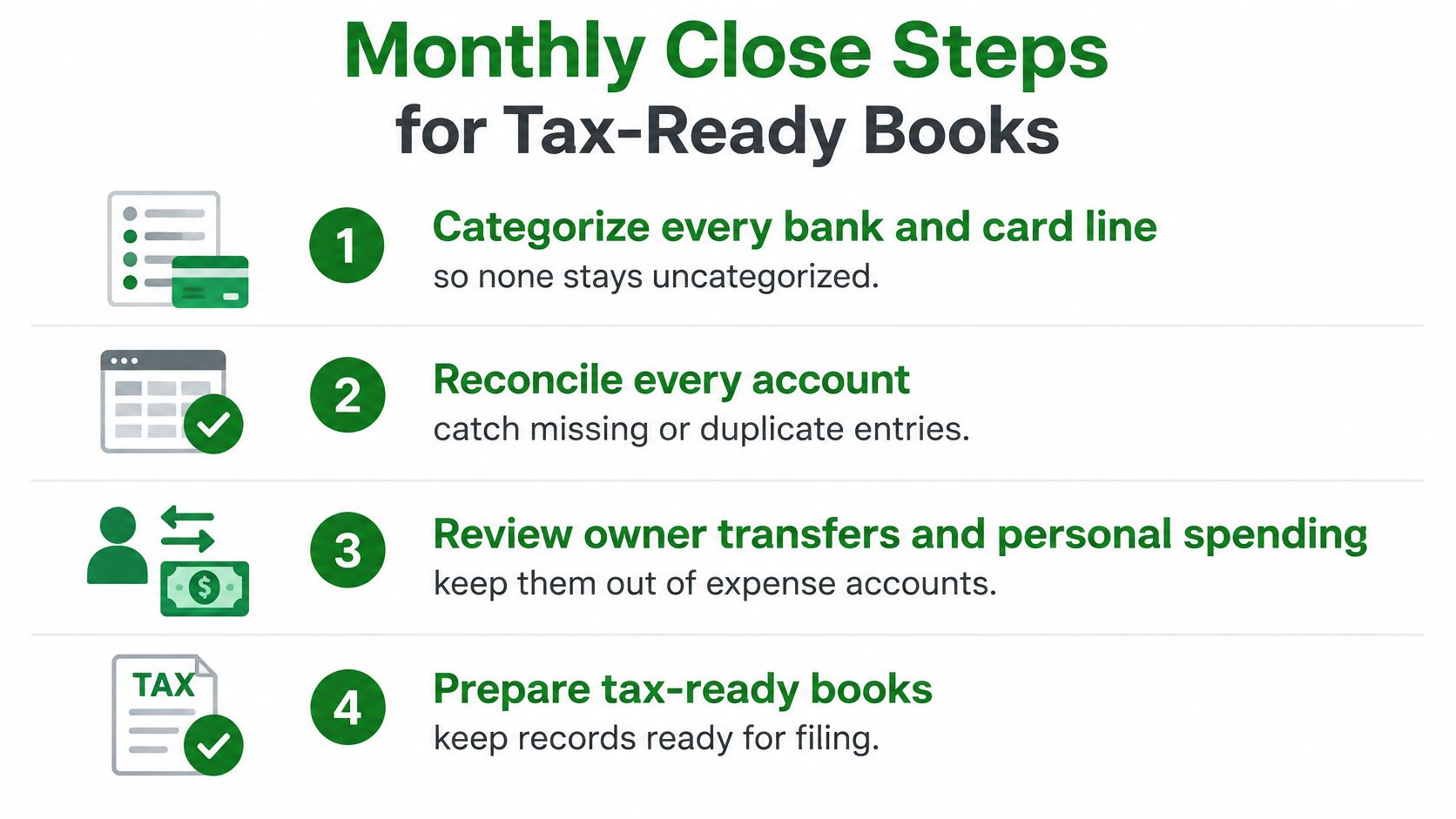
Categorize every bank and card line. Check the receipt or other support, not just the merchant name. A personal purchase can resemble a business expense, so hold ambiguous charges for review.
Reconcile accounts to statements. Match opening balances, activity, and closing balances. Review owner deposits and transfers separately so contributions and borrowed funds do not remain in revenue.
Review automated categorization before accepting it. Inspect unusual vendors, payment-processor settlements, asset purchases, and owner-related entries. A familiar payee does not guarantee that each transaction belongs in the same account. Track whether automated entries pass review without correction.
Track correction patterns. Count miscategorized lines, unreconciled items, and adjustments made after close. If a rule repeatedly creates errors, disable or narrow it instead of correcting the same mistake each month.
Review entries affecting equity, shareholder loans, or payroll. Attach supporting records, identify the shareholder, and update the basis working schedule for relevant transactions. A successful software sync does not confirm the accounting treatment.
Require approval before posting sensitive entries. Assign a reviewer to equity and payroll journals. If you work alone, leave uncertain entries in a review queue rather than approving a guess under deadline pressure.
Lock the period after review. Preserve an audit trail of rule changes, overrides, approvals, and later corrections. If the period must be reopened, document why and who authorized the change.
Define completion before you begin
A QuickBooks Online month-end close process should end with reconciled statement accounts, reviewed balance-sheet schedules, and an explanation for every equity movement. Review receivables, payables, fixed assets, and relevant clearing accounts as well as bank balances.
Keep unresolved tax questions on a short, assigned list. At year end, tie closed-month balances and supporting schedules to the totals the preparer will use for Schedule K. Leave unresolved items visible as exceptions rather than burying them in miscellaneous expenses.
How Long to Keep Each S Corp Record
Don't apply a single disposal date to every accounting document. An operating receipt supports a particular reporting period, while a capital contribution may remain relevant until the shareholder disposes of the stock. The useful retention question is when the record stops supporting an open tax position, not when the transaction occurred.
Set the precise federal and state retention dates with your tax professional. Longer examination periods, employment-tax requirements, unfiled returns, and asset or stock dispositions can change the answer. A general document policy shouldn't override those circumstances.
Retention periods for S Corp tax and bookkeeping records
Record | Keep for | Why it matters |
|---|---|---|
Form 1120-S and Schedule K-1 copies | Through the applicable examination period; preserve historical copies needed for ongoing basis support | Supports the return and shareholder questions |
Bank and credit card statements with reconciliations | Through the applicable examination period, including any extension | Proves the transactions behind each ledger line |
Payroll records and employment tax returns | Through the applicable employment-tax retention period, confirmed by the tax professional | Supports wages, withholding, and payroll tax filings |
Shareholder basis, loan, and distribution records | Throughout ownership and through the applicable period after stock disposal | Supports loss limits and distribution treatment |
Asset purchase and depreciation records | Throughout ownership and through the applicable period after final disposal | Supports depreciation and gain or loss on sale |
Records for unfiled returns or suspected fraud | Indefinitely pending professional guidance | Avoids destroying records while tax exposure remains unresolved |
Preserve the chain of support
Organize files so another person can follow the transaction from source document to ledger to return. Use consistent folders for statements, reconciliations, payroll, shareholder activity, assets, and filed returns. Store loan amendments with the original agreement rather than scattering them across email threads.
A practical accounting document-management system also needs reliable exports. Don't rely exclusively on continued bank access or an active software subscription to retrieve old records.
Keep readable copies: Save statements and reports in stable formats.
Connect related documents: Pair distributions with approvals and loans with payment histories.
Control deletion: Confirm retention dates and unresolved issues before removing files.
Ask the tax professional to confirm state-specific requirements before adopting the final policy. Written retention instructions are more useful than a folder labeled old documents.
Set Up Your S Corp Books This Month
Start with decisions, not a software migration. QuickBooks Online and Xero can both hold a well-organized S corporation ledger, but neither can decide whether an undocumented owner transfer was a loan, contribution, or distribution.
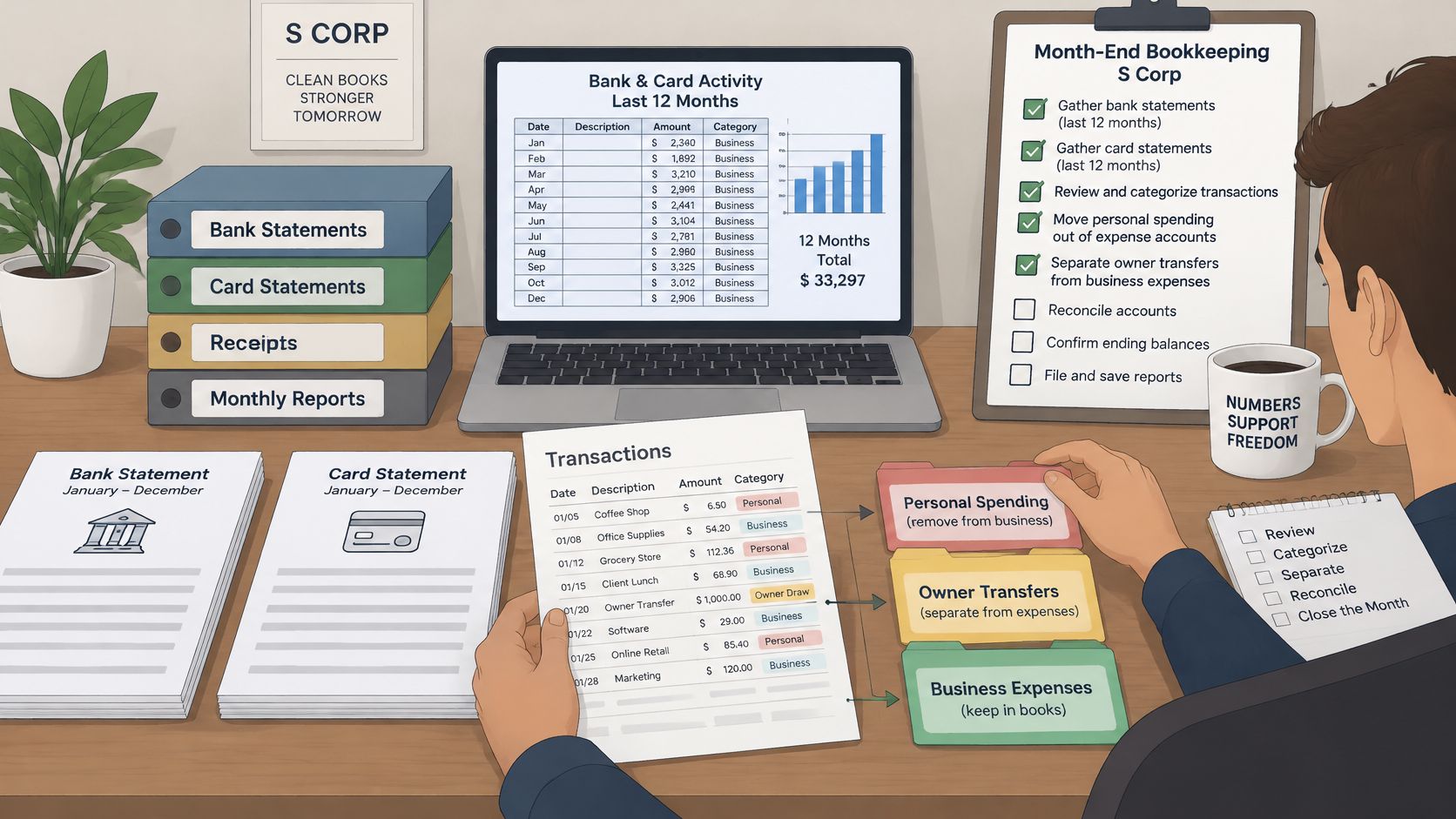
Pull the recent bank and credit card activity and search expense accounts for owner names, personal merchants, and transfers. Inspect each result before changing it. A personal purchase may need a distribution reclassification, while a documented business reimbursement or loan repayment needs different treatment.
Keep the original entry history and add a memo explaining the correction. If the transaction affects a previously filed return, put it on the tax professional's review list instead of rewriting the closed period.
Establish opening balances you can defend
Build the shareholder schedule from prior returns, existing basis calculations, capital records, and loan documents. A prior Schedule K-1 helps, but it may not establish the shareholder's complete opening basis by itself. Missing history should become an explicit reconstruction task.
Give each uncertain balance an owner and a next action. For example, the shareholder supplies the loan agreement, the bookkeeper ties payments to the ledger, and the tax professional confirms the resulting treatment.
Assign responsibility for staying current
Choose an internal owner or an outside bookkeeper based on who will complete and review the work. An owner-managed process costs less in outside fees but requires consistent time and accounting discipline. Outside support reduces the administrative load, but the owner still needs to supply documentation and approve decisions.
Transaction ownership: Name who categorizes activity and requests missing receipts.
Review authority: Identify who approves equity entries and resolves payroll questions.
Tax coordination: Schedule a review of basis, distributions, and compensation before filing.
Book Tech is one outside option. Our monthly bookkeeping typically ranges from $300 to $800, depending on complexity; after setup, we assign a dedicated bookkeeper to manage monthly financials remotely, and we work with the client's CPA or accountant inside Xero.
Compare any arrangement on responsibilities, not just deliverables named in a proposal. Financial statements are useful only when someone has reviewed the balances and identified unresolved tax questions.
Your first task this week is to reconcile the business bank account for the most recent month and tag every line using the transaction map. Attach support to owner-related entries and send uncertain classifications for review before closing the period.
Book Tech LLC offers monthly bookkeeping, cleanup, and catch-up support to organize your S Corp ledger and keep financial records ready for your tax professional. Visit Book Tech LLC to discuss your current books, owner-transaction records, and a monthly workflow with clear responsibilities.