
How to Bank Reconciliation Statement: A Practical Guide

Two days before payroll, a salon owner opens QuickBooks and sees cash that doesn't match the bank statement. The difference is $4,200, and neither balance tells her whether payroll is funded, a deposit is still clearing, or a payment has been recorded twice. That's the moment bank reconciliation stops being a routine bookkeeping task and becomes a cash-control investigation.
A good reconciliation tells you what the business has, which transactions are still moving through the banking system, and which entries need correction. It gives you evidence that the final balance is right for the right reason.
Table of Contents
What a Bank Reconciliation Statement Actually Does for You - The three categories you'll see repeatedly - A zero balance isn't automatically a safe balance
Matching Transactions and Posting the Book-Side Adjustments - Post only genuine book-side activity
Handling Outstanding Checks and Deposits in Transit - Age the open items instead of carrying them blindly
Reconciliation as a Fraud and Internal-Control Procedure - A practical split for a one-owner business - Increase the separation as the team grows
What a Bank Reconciliation Statement Actually Does for You
A bank reconciliation statement is a formal comparison between the cash balance shown by a bank statement and the corresponding balance in a company's cash book or general ledger. Its purpose is to explain the difference between those balances on a specified date, so the adjusted bank balance and adjusted book balance agree. The Washington State Auditor's bank-reconciliation guidance describes this as a process for reconciling the bank-column balance of the cash book with the bank passbook balance.
For the salon owner, the $4,200 gap might contain several ordinary timing items. A customer deposit may be recorded in QuickBooks but not credited by the bank yet. A check written to a supplier may still be outstanding. The bank may also have posted a service charge, card settlement, electronic withdrawal, or interest credit that nobody has entered in the ledger.
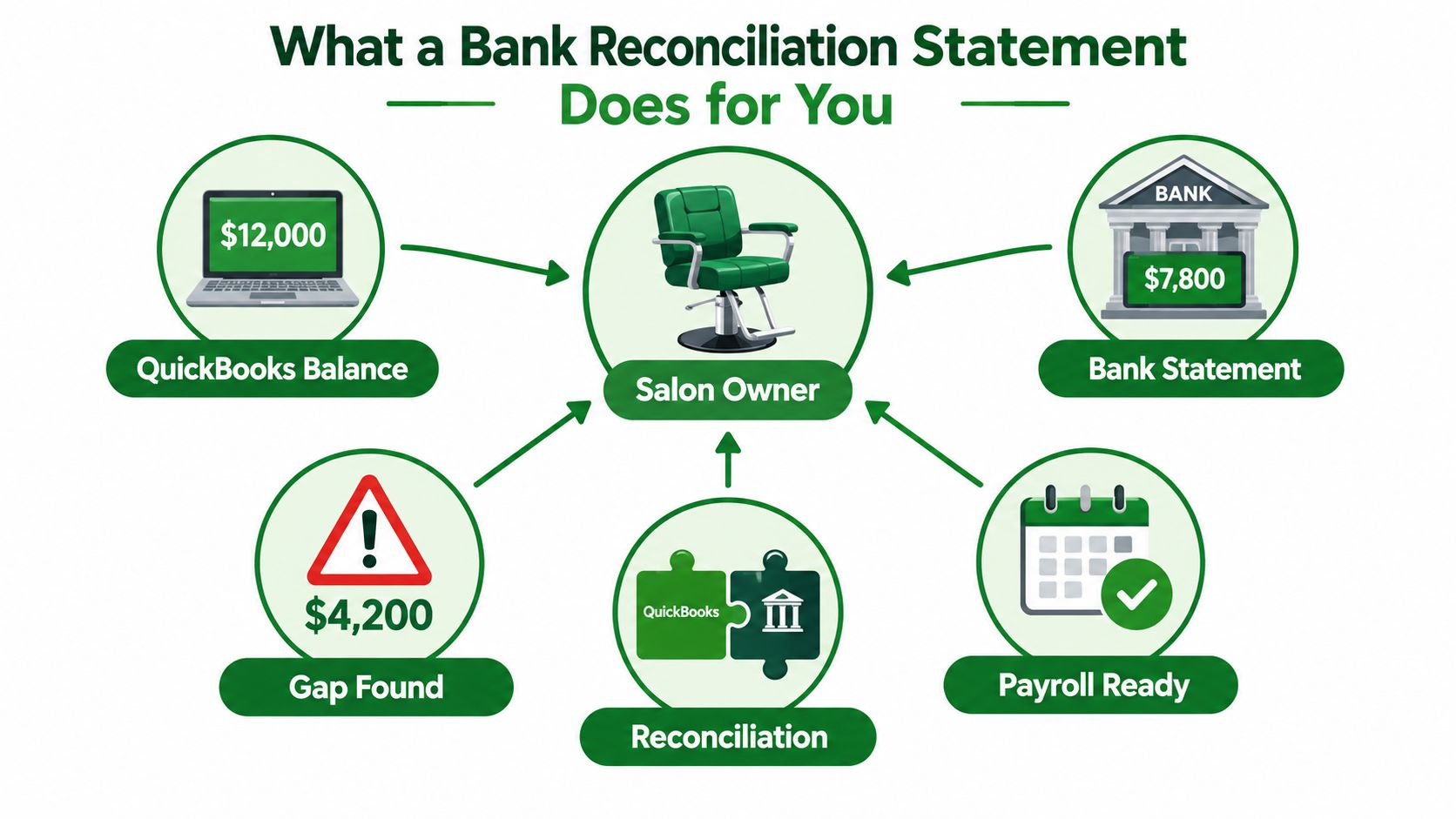
The three categories you'll see repeatedly
The same types of items surface month after month:
Deposits in transit: Money recorded in the books before the bank credits the account. It belongs in the bank-side reconciliation until it appears on a later statement.
Outstanding checks: Payments recorded by the business that haven't cleared the bank. They reduce the adjusted bank balance, but they don't require a new expense entry.
Book-side items: Bank fees, interest, direct debits, ACH activity, returned items, and other transactions appearing on the statement but missing from the ledger. These normally require journal entries.
The distinction matters because a reconciliation isn't a place to hide an unexplained variance. A timing item should be listed and tracked. An unrecorded bank fee should be posted. An unknown withdrawal should be investigated.
A zero balance isn't automatically a safe balance
A reconciliation can reach zero even when an unauthorized payment was matched to a valid-looking ledger entry. That's why I treat reconciliation as both a math exercise and a control procedure. The finished file should support financial statements, cash-flow analysis, tax records, and management decisions, while also showing that someone inspected the underlying transactions.
The salon owner shouldn't approve payroll based only on the QuickBooks balance. She needs the reconciled cash position, a list of open timing items, and confirmation that unusual activity has been reviewed. That difference between “the numbers tie” and “the cash is safe” shapes every step that follows.
Preparing Your Records Before You Match a Single Line
A small business can spend hours chasing a reconciliation difference caused by mismatched inputs. One report may end on the statement date, another on a different day, while the bank feed contains only part of the activity. Before matching anything, establish one account, one cutoff date, and one complete set of records.
Obtain the full bank statement, including its opening and ending balances and every listed transaction. Then run the general-ledger cash detail for the same account and cutoff date. Compare its opening balance with the prior completed reconciliation. If those balances disagree, resolve that break first. Otherwise, later matching can conceal an earlier error.
Keep the evidence together in one electronic workpaper or folder. Include the original statement PDF, ledger detail, cleared-transaction report, and prior reconciliation. Add deposit slips, check images, payment-processor reports, ACH confirmations, and explanations for unusual activity. Retain the reconciliation schedule, journal-entry support, preparer sign-off, and reviewer approval as well.
The purpose is control as much as convenience. A second person should be able to trace the final cash balance to the bank's source document and then to the records supporting each adjustment. For a one-owner business, separation of duties can remain low-cost: the owner prepares the reconciliation, while an outside bookkeeper or another trusted person reviews the statement, unusual payments, and proposed journal entries. Send the reviewer the statement and reports directly, rather than only a completed spreadsheet.
Software settings can create their own errors. In QuickBooks Online, set the statement date and ending balance in Reconcile before matching. In Xero, filter the account transaction view by statement date and check both opening and closing balances. For imported activity, inspect the import history for missing or duplicated transactions before accepting the file. Use this guide to importing bank transactions into Xero when a statement must be loaded manually or a feed has omitted activity.
Set the cutoff before posting adjustments. Complete the period's cash activity, obtain the statement, and reconcile before issuing financial statements. Do not post a plug entry to make an interim report appear complete. If VAT work is occurring at the same time, file the evidence with the relevant guide to VAT returns for accountants, particularly when payment timing affects both cash and tax records.
A close calendar should assign time for cutoff, matching, adjustments, and review. That schedule prevents rushed approvals and leaves a clear audit trail.
Matching Transactions and Posting the Book-Side Adjustments
Matching works best as two parallel tracks. First, compare the bank statement with the ledger line by line. Then classify every unmatched item before posting anything.
For each deposit and withdrawal, compare the date, amount, check or transaction reference, and payee. Mark only transactions supported by both records. Don't accept a similar amount as a match when the payee, reference, or purpose differs. A duplicated payment can look harmless if you match by amount alone.
Once the matched items are cleared, separate what remains:
Item | Where It Lives | Action Required |
|---|---|---|
Deposit in transit | Recorded in the books, absent from the bank statement | Add on the bank side and track until it clears |
Outstanding check | Recorded in the books, absent from the bank statement | Subtract on the bank side and monitor the check |
Bank service charge | On the bank statement, absent from the ledger | Debit bank charges expense and credit cash |
Interest credit | On the bank statement, absent from the ledger | Debit cash and credit interest income |
ACH withdrawal or direct debit | On the bank statement, absent from the ledger | Post to the correct expense, liability, or asset account and credit cash |
Returned customer payment | Bank activity reverses a prior receipt | Reverse cash and restore the customer receivable, where applicable |
The U.S. Department of Justice bank-reconciliation guidance supports this two-track approach. It calls for line-by-line comparison, classification of unmatched items, and adjusted bank and book balances that equal exactly. It also warns against forcing an unresolved difference into suspense or miscellaneous expense.
Post only genuine book-side activity
Suppose the statement shows a bank fee that never entered the ledger. The entry is:
Debit Bank Charges Expense
Credit Cash
For interest earned:
Debit Cash
Credit Interest Income
For a direct debit, debit the account that received the benefit, such as an insurance expense or software expense, and credit cash. Use the original statement and supporting invoice, not a guessed account based only on the bank description.
If the same charge appears in both systems with slightly different dates, don't post it again. Check the transaction reference, amount, and source document. Banks and accounting systems can use different posting dates, but the economic event should still be recorded once.
For a more detailed Xero workflow covering matching and adjusted balances, use this Xero bank reconciliation walkthrough. The principle is the same in QuickBooks, Xero, or a spreadsheet: timing items remain on the reconciliation, while missing book activity gets recorded in the ledger.
Handling Outstanding Checks and Deposits in Transit
Outstanding checks and deposits in transit are normal timing differences, but they become risky when nobody ages or investigates them. A check written on March 28 may not clear until April 9. A payment-processor payout recorded on April 1 may not reach the bank until April 3. Those dates don't indicate an error by themselves.
Maintain a rolling schedule with the transaction date, check number or processor reference, payee, amount, and the date the item cleared. When a deposit appears on the next statement, remove it from the schedule. Don't clear it merely because you expect the bank to process it.
Age the open items instead of carrying them blindly
An old item needs a reason. A stale check may represent a lost payment, an employee who never cashed payroll, a duplicate check, or an unauthorized transaction. A deposit that remains open may point to a missing deposit, an incorrect processor account, or a recording error.
For each aged item, ask:
Does the original source exist? Locate the check image, deposit record, processor report, or customer remittance.
Has the item cleared under another reference? Search for a different date, amount, or bank description.
Should the payment be stopped or reissued? Follow the business's documented approval process.
Does the ledger need reversal? If the underlying obligation no longer exists, reverse the stale item to the original expense or liability account rather than hiding it in miscellaneous expense.
The correct treatment depends on the facts and the business's accounting policy. A stale outstanding check may require a reversal that debits cash and credits the original expense or liability account, but confirm the obligation and any applicable unclaimed-property requirements before posting.

A construction contractor reviewing year-end cash found a check that had remained outstanding through several reconciliation cycles. The aging schedule showed that the check number and amount closely matched another payment to the same supplier. Reviewing the check image and vendor account exposed a duplicate payment risk before the contractor finalized the year-end records.
For QuickBooks Online users, a bank reconciliation report guide can help preserve the detail needed to review open items. The important habit is not the report format. It's the month-over-month comparison that prevents old reconciling items from becoming invisible.
When the Difference Will Not Reach Zero
A reconciliation that refuses to balance is evidence, not an annoyance to write off. Start by treating the difference as a possible control failure. Public-sector Treasury reconciliation procedures call for differences to be identified, cleared promptly, documented, and analyzed for recurring causes such as cutoff timing, missing documents, bank-processing errors, or posting mistakes. The same discipline protects a small business.
Begin with the cutoff dates. Confirm that the bank statement date, ledger report date, and accounting-system reconciliation date match. Then compare the current outstanding-check and deposit schedules with the prior reconciliation. If an item vanished without clearing, find out why before changing the balance.
Next, recalculate the open items independently. A transposed amount, reversed sign, or missed line can create a false variance. Sort the ledger by date and amount to locate duplicate imports, missing fees, repeated processor payouts, and transactions posted to another cash account. Compare the accounting feed with the bank's original PDF as well. Feeds can omit, duplicate, or mislabel transactions.
A Shopify seller whose reconciliation differed by varying amounts each month reviewed the pattern across three periods instead of restarting each time. The cause was a Stripe payout duplicated during an import. Removing the duplicate corrected the ledger and exposed the process failure that could have returned each month.
If the evidence points to the bank, document the suspected processing error, contact the bank, and track the case to resolution. Do not absorb the difference into an expense account just to close the reconciliation.
Set escalation rules before a variance occurs. Require investigation of every unexplained difference, with stronger review for aged items, unusual withdrawals, repeated breaks, or amounts that could affect payroll, taxes, debt payments, or vendor funding. Require owner or controller approval when one item remains unresolved beyond the agreed period or the total exceeds the business's documented materiality threshold.
A small plug is still a weak control. The Treasury guidance emphasizes prompt resolution and monthly analysis of recurring causes. For ledger-level testing, this general-ledger reconciliation resource offers a companion workflow. Keep an exception log recording the cause, correction, owner, and resolution date. That record shows whether the problem was corrected once or allowed to recur.
Reconciliation as a Fraud and Internal-Control Procedure
A reconciliation can balance while an unauthorized payment sits in plain sight. If someone entered the payment in the ledger, or used a legitimate-looking payee, the book and bank records may agree. Reconciliation therefore tests completeness and accuracy first. Authorization requires separate evidence.
Reconciled is not the same as safe. Compare the original statement with the accounting record, then review who approved unusual payments and who can release funds.
The New York State internal-controls guidance cites monthly reconciliation within 30 days of receiving the bank statement. It also recommends separating reconciliation from the recording of cash receipts and disbursements, with supervisory review and authorization of correcting entries. Those controls reduce the chance that one person can create, conceal, and correct a transaction without detection.
A practical split for a one-owner business
A solo owner may lack a second accounting employee, but the review can still be separated from the bookkeeping. The bookkeeper records transactions and prepares the reconciliation. The owner opens the original bank statement, checks unfamiliar payees and withdrawals, and compares the statement with the reconciliation rather than approving the software screen alone.
The owner should document approval for unusual payments, new payees, refunds, and bank-account changes. Before financial statements are issued, the owner reviews the reconciliation and supporting evidence for correcting journal entries. Bank credentials, payment-release authority, and accounting access should match each person's actual duties.
For a broader explanation of approval, access, documentation, and review controls, Blue Sage Tax & Accounting Inc. provides this practical internal controls guide.
Increase the separation as the team grows
Once several people handle cash, assign transaction entry, payment preparation, payment approval, reconciliation, and review to different roles where practical. Restrict bank-feed administration, secure unused check stock, and require two approvals for payments above a documented threshold. Set that threshold according to the business's cash position and risk, not an arbitrary industry rule.
Inspect the actual statement for unfamiliar payees, unusual withdrawals, secondary endorsements, duplicate payments, missing deposits, and changed account details. Payment-processor reports and card statements also deserve review when they feed the bank account. The accounting-system report supports the work, but the independent bank record remains the stronger source for detecting unauthorized activity.
Sustaining a Monthly Cadence and Knowing When to Get Help
A workable monthly close retains the statement, cleared-transaction report, reconciling-item schedule, journal-entry support, preparer sign-off, and independent reviewer approval. A seven-to-ten-day close can give a small business enough time to lock the cutoff, match activity, post adjustments, resolve exceptions, and review the final statements.
The minimum cadence for most businesses is monthly. High-volume or high-risk accounts may need more frequent review. U.S. Department of Justice guidance uses completion within 30 days of receiving the bank statement as its benchmark for monthly reconciliation, as noted in the internal-control guidance cited above.
Use this short monthly checklist:
Confirm the account and cutoff date.
Agree the opening balance to the prior reconciliation.
Match deposits and withdrawals to source records.
Classify every unmatched item.
Post supported book-side adjustments.
Age outstanding checks and deposits in transit.
Investigate every unexplained variance.
Obtain independent review and retain the evidence.
If multiple variances remain unresolved, the business is growing quickly, payroll or tax decisions depend on uncertain cash, or the owner is performing every control personally, professional support is sensible. A provider offering bookkeeping services can take over recurring reconciliations, while this resource on adjusting entries examples helps clarify the journal-entry side of the process.
Book Tech LLC provides US-based virtual bookkeeping with QuickBooks Online and Xero reconciliations, catch-up and clean-up work, payroll administration, and monthly financial statements. If your cash records take too long to close or unexplained differences keep returning, visit Book Tech LLC to discuss a reconciliation workflow that fits your business.