
Property Management Cash Flow a Practical 2026 Guide


It's late in the month, payroll is due, and the rent roll says the properties are performing. But the operating account is nearly empty. A tax installment cleared, an insurance renewal is due, and a repair invoice landed before several tenants' payments settled. The books show income. The bank balance tells a different story.
That gap is the practical problem behind property management cash flow. Profit on a P&L doesn't guarantee money is available when bills come due or distributions go out. The fix starts with tracking when cash arrives and leaves, then protecting reserves before treating a positive balance as owner money. If your records don't yet make that timing visible, real estate bookkeeping support can help establish the property-level picture you need.
Table of Contents
Why Profitable Rent Can Still Leave You Broke - Cash timing is an operating risk
What Property Management Cash Flow Actually Means - Follow the cash through the property
The Four Cash Components That Move Every Month - Rent collection velocity - Bills and reserves have their own calendars - Distributions come last
Building a Monthly Cash Flow Report You Can Trust - A practical monthly layout - Close on a repeatable schedule
KPIs and Forecasting Scenarios That Catch Trouble Early - Forecast three versions, not one
Why Mixing Reserves Into Operating Cash Breaks Everything - Give every dollar a clear home
Common Cash Flow Pitfalls and the Bookkeeping Controls That Fix Them
Your 30 60 90 Day Cash Flow Action Plan and How Book Tech Helps
Why Profitable Rent Can Still Leave You Broke
A 40-unit owner can finish the year with a healthy-looking profit and still face an overdrawn operating account in January. The rent was earned across the year, but taxes and insurance came due in large payments, and a roof reserve was never moved out of the account. Payroll doesn't wait for the books to catch up.
That's the difference between accrual profit and available cash. Accrual accounting records income when it's earned and expenses when they're incurred. Your bank account changes when tenants pay, vendors are paid, debt service clears, and money moves into or out of reserves. Those timelines don't always line up.
Cash timing is an operating risk
Start with gross scheduled rent, the rent due if every unit is occupied and every tenant pays in full. Then account for vacancy, concessions, and collection losses to get a more realistic view of effective rent. From there, track operating bills, debt service, and cash set aside for future work. Only after those obligations are covered should you calculate what's safe to distribute.
Vacancy is a direct cash-flow variable: an empty unit generally produces no rent while many property costs continue. The U.S. Census Bureau has collected quarterly Housing Vacancy Survey estimates since 1956. The national rental vacancy rate moved from 7.8% in the fourth quarter of 2000 to 10.7% in the fourth quarter of 2009, then fell to 6.4% in the fourth quarter of 2019 and 5.8% in the first quarter of 2022. Those shifts show why an owner shouldn't treat scheduled rent as collected cash. The Census Bureau's housing vacancy data offers a useful market-level reference, but your decisions still need to reflect your own units, leases, and collection history.
Operating rule: A positive P&L is not permission to distribute. Confirm cleared cash, upcoming bills, and reserve balances first.
Property management cash flow is a timing problem first and a profitability problem second. Strong bookkeeping won't prevent every expensive month, but it will show whether you can meet obligations without using tenant deposits, delaying vendors, or scrambling for owner contributions.
What Property Management Cash Flow Actually Means
Think of a rental property as a house with a plumbing system. Rent, fees, and other property income enter through the front pipe. Vacancy and collection issues reduce the flow; operating costs and debt service take their share. What remains must be divided among operating cash, capital reserves, and owner distributions.
The order matters. If you start with gross scheduled rent and skip the filters, you'll overstate what the property can safely pay out.
Follow the cash through the property
Gross scheduled rent is the rent due under the leases before vacancy or collection loss.
Effective gross income is the rent and other property income you reasonably expect to collect after those reductions.
Operating expenses are the ongoing costs of running the property, such as taxes, insurance, utilities, management, and routine repairs.
NOI, or net operating income, is effective gross income minus operating expenses. It doesn't include debt service.
Cash flow after debt service is what remains after mortgage payments are paid. Then account for reserve transfers and capital spending before deciding what's distributable.
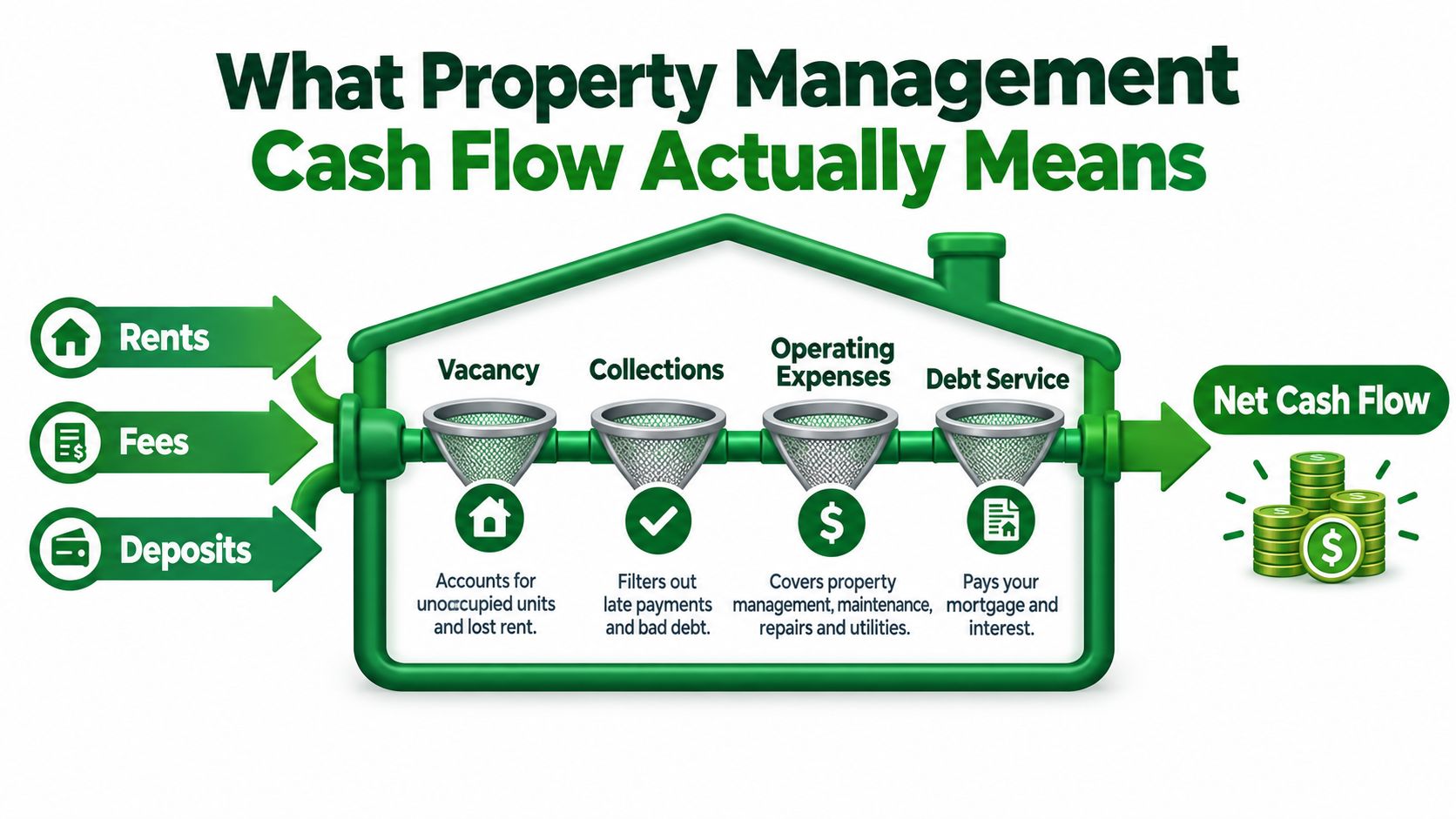
Accrual accounting can make the system look fuller than it is. A tenant's unpaid rent may appear as income on the P&L while the cash has not arrived. A vendor bill may be recorded before it's paid, or a predictable replacement cost may be missing because the work hasn't happened yet. Use the P&L to understand performance, but use reconciled bank activity and a cash-flow statement to make payment and distribution decisions.
For a plain-language overview of how rental income becomes cash flow, Edinhart Realty and Property Management explains the basic framework. Apply that framework to each property separately. A single unit's path is straightforward: rent becomes collected cash, expenses and debt service are paid, reserves are funded, and only then does a distribution become a decision rather than a guess.
The Four Cash Components That Move Every Month
A property's bank balance changes because money arrives at different speeds and bills come due on different schedules. Don't hide those movements inside one net-income number. Track rent collection, operating expenses, reserves, and owner distributions as separate cash components.
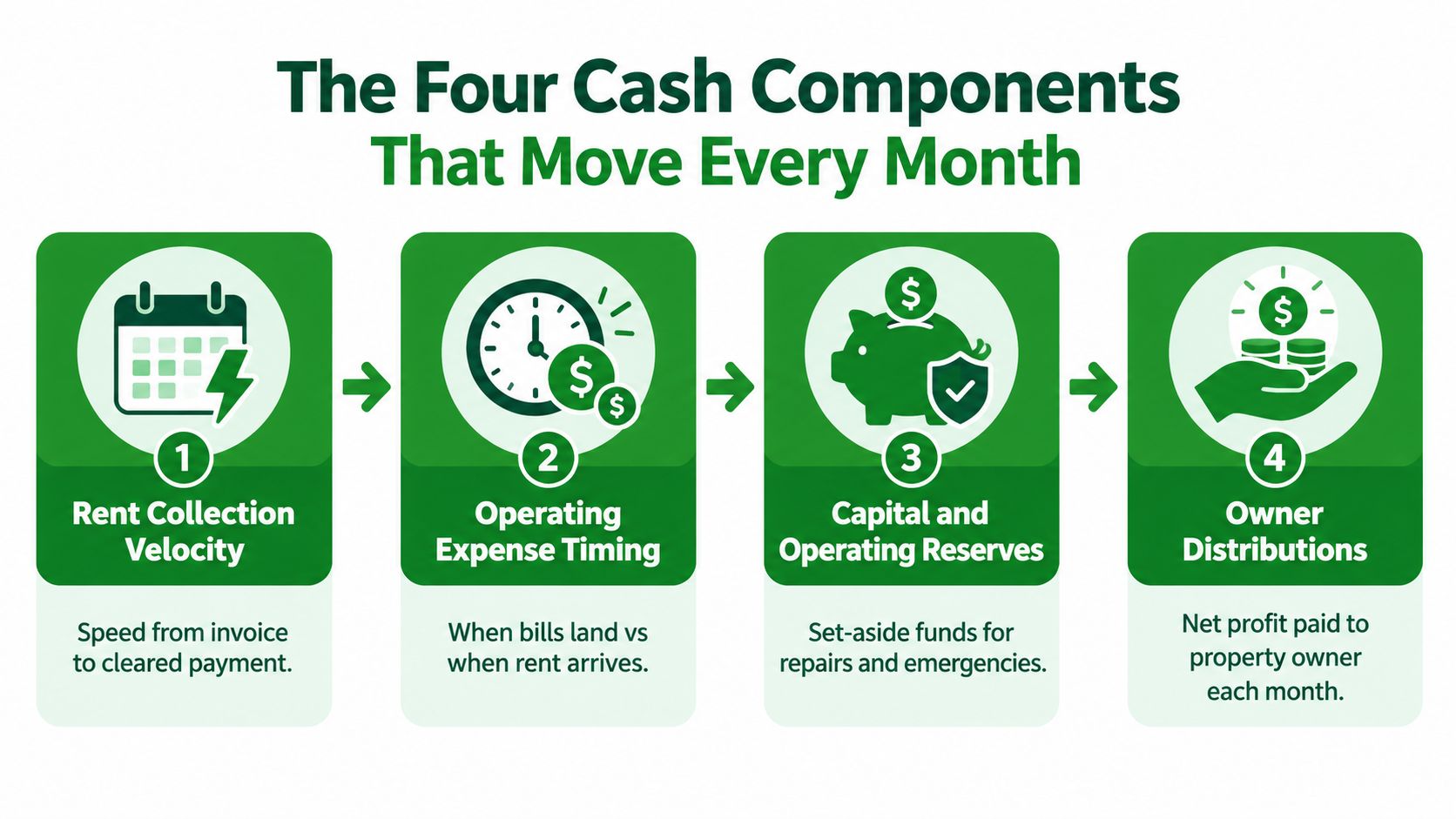
Rent collection velocity
A lease may make rent due at the start of the month, but the date on the lease isn't the date cash clears. A late payment or failed transfer can leave the operating account short while payroll or a vendor payment is already scheduled. Reconcile charges against deposits, and review unpaid balances rather than assuming billed rent has arrived.
One useful comparison is scheduled rent versus collected rent. For example, a 50-unit property at 94% occupancy with average monthly rent of $1,500 has $70,500 in scheduled rent for occupied units. A 3% shortfall in collections against that occupied rent would leave roughly $2,115 uncollected for the month. Treat this strictly as a worked example, not a market benchmark.
Bills and reserves have their own calendars
Vendor terms can delay payments, while tax installments and insurance renewals may arrive in large, predictable bills. Put each known due date on a cash calendar. Separate routine repairs from irregular turnover work and long-term replacements; otherwise, a month with light maintenance can look more profitable than it really is.
That same example property would feel the collection gap more sharply if an HVAC replacement landed in the same month. The correct distribution depends on the actual invoice, cash on hand, and reserve policy, not just the P&L. Don't invent a capex estimate to make a forecast balance. Get a vendor quote and show the timing.
Distributions come last
Owner distributions are a use of available cash, not an operating expense. Keep them distinct from security deposits and reserve transfers. If owners draw money before the account covers outstanding bills and planned reserves, a profitable month can still end in a cash shortage.
Clear accounts-payable and accounts-receivable procedures help managers see who owes money and what's scheduled to leave. Use a consistent invoice approval and payment process, then compare bills due with cash expected to clear. This accounts payable and accounts receivable guide can help teams tighten that workflow.
Building a Monthly Cash Flow Report You Can Trust
A useful property-level cash-flow report answers a basic question: What cash came in, what cash went out, what remains, and what portion is already committed? Don't rely on one P&L to answer it. Build the report from reconciled bank activity and records organized by property.
Set up each property as a class or location in QuickBooks Online, or use the corresponding tracking categories in Xero. Keep operating and reserve accounts distinguishable in the books, and make sure transactions are assigned to the right property. If a portfolio has shared expenses, document how you allocate them instead of leaving them buried in a general account.
A practical monthly layout
Section | What Goes Here | Source in QuickBooks/Xero |
|---|---|---|
Rent and other cash collected | Cleared tenant rent and recurring property income | Bank transactions, rent ledger, receivables aging |
Operating cash paid | Paid bills for utilities, management, repairs, and other recurring costs | Cash Flow Statement, Profit and Loss by Class/Location, bank activity |
Capital spending | Paid costs for major replacements and improvements | Fixed-asset schedule and bank transactions |
Debt service | Mortgage payments, separated from operating costs | Loan activity, bank feed, lender statement |
Ending cash and reserves | Reconciled balances, with operating and reserve cash identified | Bank Reconciliation screen and balance sheet |
A P&L by property shows what was earned and incurred. The receivables Aging Report shows what remains unpaid. The Cash Flow Statement summarizes cash movement, while the Bank Reconciliation screen confirms that recorded transactions match bank activity. In Xero, use its financial reports, tracking categories, outstanding invoice reports, and bank reconciliation workflow to produce the same controls.
Close on a repeatable schedule
Reconcile every bank and credit-card account, clear uncategorized transactions, review unpaid bills and rent, and compare actuals with the budget. Aim for a 7–10 day close when your workflow supports it, so owners can act on timely numbers rather than stale estimates. Homebase's property management accounting resource provides additional context on organizing property records and reporting. For a setup focused on property-level books, see this guide to QuickBooks for property management.
KPIs and Forecasting Scenarios That Catch Trouble Early
Historical reports tell you where the cash went. KPIs and forecasts help you see where it may go next. Track a small set of measures consistently, and use them to identify the reason behind a weak balance rather than reacting to the balance alone.
Physical occupancy tells you how much of the rentable space is occupied.
Economic occupancy compares rent collected with potential rent, exposing losses from vacancy, concessions, and nonpayment.
Rent collection rate compares collected rent with rent due. Review it alongside the receivables aging report to spot arrears.
Operating-expense ratio compares operating expenses with revenue from the same period. The right comparison is a property-specific budget and similar properties, not a universal rule.
NOI margin shows how much effective income remains after operating expenses but before debt service.
Debt service coverage ratio compares NOI with required debt payments. It helps an owner judge whether operations cover financing obligations.
Reserve months expresses how long current reserve cash could cover the property's planned obligations. Define what counts as a reserve before comparing properties.
Published benchmarks place operating expenses around 35–55% of gross rent for many rental properties, excluding debt service and capital improvements, but property type, age, taxes, insurance, and management structure can shift the result substantially. Use that range as context, not a target. Calculate your own ratio using expenses and rent from the same period, then investigate changes against your budget. The operating-expense-ratio overview discusses the measure and why property-level comparisons matter.
Forecast three versions, not one
Build a base case from current leases, expected collections, known bills, and planned work. In a downside case, reduce expected collections and raise expenses where evidence supports the change. In a stress case, add a major repair or a prolonged vacancy. Don't assign arbitrary percentages just to fill a spreadsheet; use lease dates, vendor estimates, renewal notices, and property history.
A rolling cash forecast makes timing visible. If an insurance renewal is expected later in the year, include it in the forecast when you know about it, then plan reserve transfers in advance. That's safer than waiting for the invoice and holding distributions only after the account is already tight. For a practical way to organize that process, use this budgeting and forecasting guide.
Why Mixing Reserves Into Operating Cash Breaks Everything
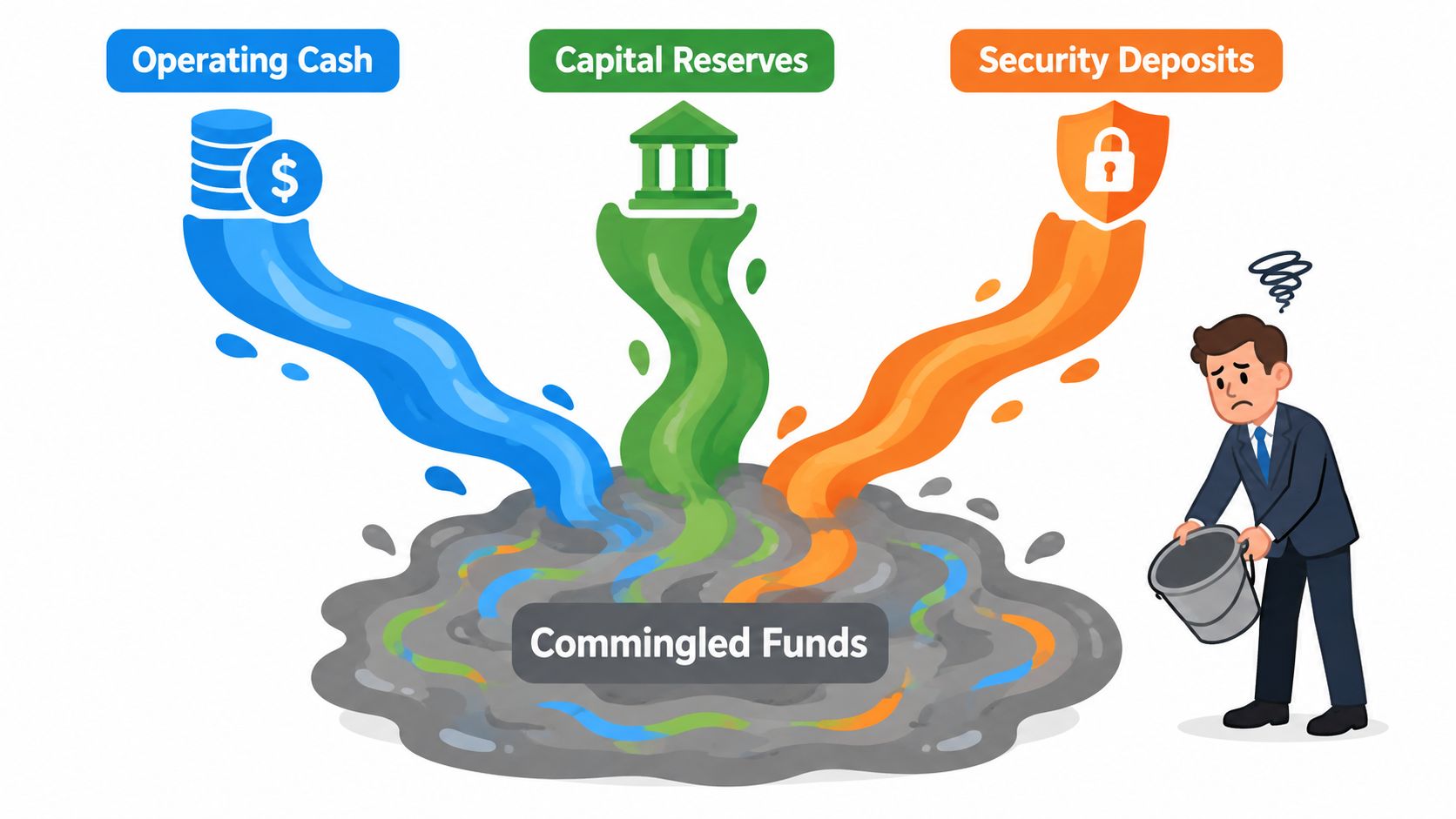
One bank balance that combines operating cash, capital reserves, tax money, and tenant deposits may look convenient. It isn't. It hides which dollars are available for ordinary bills and which already have a job.
A 2025 analysis of standardized operating statements and lender-underwritten appraisals reported that 89 cents of every rent dollar went to mortgage payments, operating costs, taxes, payroll, and capital-expenditure reserves, leaving 11 cents as owners' return. It reported mortgage payments at 43 cents per rent dollar, day-to-day operating costs at 27 cents, property taxes at 10 cents, and payroll at 7 cents. The same analysis put annual operating expenses at $8,213 per unit, up 4.6% from $7,848. Those figures help explain why a strong rent roll doesn't mean the full balance is free to distribute. The National Apartment Association's operating-cost analysis also emphasizes the weight of costs beyond day-to-day maintenance.
Give every dollar a clear home
Use separate accounts or clearly segregated balances for operating cash, planned tax and insurance payments, capital reserves, and tenant deposits. Follow applicable trust-account rules for tenant deposits, and don't treat those funds as working capital. A clean setup makes it easier to see whether a planned distribution leaves enough for obligations already on the calendar.
Don't bury capital reserves in routine operating expenses. Track recurring repairs separately from major replacements, and maintain a fixed-asset schedule for capital work. This preserves a clearer view of NOI and helps the owner distinguish a normal operating month from a month when the property used cash for a long-term asset.
Reserve sizing should reflect the building, not a one-size-fits-all rent percentage. Review system age, unit count, recent replacement history, inspection findings, and known future work. Then set a funding rule and revisit it when the property's condition or upcoming costs change. A reserve is not spare cash. It's money assigned to a future obligation.
Common Cash Flow Pitfalls and the Bookkeeping Controls That Fix Them
Cash shortages often come from weak controls, not mysterious economics. These are common bookkeeping failures and the practical fix for each:
Owner draws from operating cash: The balance drops without a clear record of what was distributable. Record distributions separately and require an owner review against upcoming bills and reserve balances.
Fees that never reach the ledger: Late fees, pet fees, or other charges may be missing from the tenant ledger. Reconcile lease charges to the rent roll and review recurring charge codes.
Vendor bills paid before approval: The owner sees an unexpected outflow because no one confirmed the work or amount. Set approval thresholds and keep an invoice trail before payment.
Tenant deposits mixed with business cash: The account looks healthier than the property's usable funds. Track deposits as liabilities and keep them segregated according to applicable requirements.
Tax or HOA obligations underfunded: A large bill lands without a plan. Maintain a due-date calendar and transfer money to a dedicated account as funds become available.
Capital work booked as routine expense: The P&L no longer gives a clean view of recurring operations. Use a capitalization policy and update the fixed-asset schedule when work qualifies.
Stale receivables hiding occupancy problems: The rent roll suggests income that hasn't been collected. Review aging, vacancy days, concessions, and collection notes together so the manager can distinguish nonpayment from a vacant or mispriced unit.
These controls work only when someone follows them consistently. Reconcile bank and credit-card accounts, review unapplied transactions, and resolve old balances rather than carrying them forward month after month. A structured general ledger reconciliation process helps keep cash accounts and property balances aligned.
For community associations, reserve planning also needs a longer horizon than the monthly operating cycle. This resource on understanding reserve funds for HOAs offers useful context for planning future shared-property expenses. Your bookkeeping control should still show which money is restricted, what it's intended to fund, and who approves its use.
Your 30-60-90 Day Cash Flow Action Plan and How Book Tech Helps
Start by making the cash visible, then make the reporting repeatable.
First 30 days: Separate operating, reserve, and deposit tracking; assign classes or locations by property; and reconcile recent bank activity. Resolve old receivables and identify unpaid bills.
By 60 days: Produce a monthly property cash-flow statement, agree on a reserve-funding rule, and review the KPIs that explain collection and expense changes.
By 90 days: Begin a rolling forecast and hold regular owner reviews. Use those meetings to decide whether to fund reserves, delay distributions, address delinquency, or revisit rents and expenses.
A property bookkeeping partner can run the recurring work: rent and bill tracking, reconciliations, payroll, and property-level reporting in QuickBooks Online or Xero. Book Tech LLC offers monthly bookkeeping, catch-up and clean-up projects, payroll administration, and accounts-payable and accounts-receivable support for property managers and real-estate investors. Its workflow includes a 7–10 day monthly close, a secure client portal, and tax-ready records for the CPA.
If your P&L looks healthy but the operating account still surprises you, review the next month's bills, reserve balances, and distribution policy before sending another owner payment. Book Tech LLC provides property bookkeeping and cash-flow reporting support to help managers reconcile the books and make distributions from a clearer picture of available cash.
