
Sole Proprietorship vs LLC vs S Corp: Which Fits You


“Form an LLC, then elect S corp status to save taxes” is incomplete advice. It treats liability protection as a purchase and tax savings as an automatic benefit, when both depend on how you operate the business.
A useful sole proprietorship vs LLC vs S corp comparison starts with what could go wrong, not what sounds most established. Your exposure to creditors, recurring profit, state requirements, and ability to maintain accurate books matter more than the label on your business.
Table of Contents
Sole Proprietorship vs LLC vs S Corp at a Glance - Separate the decisions before comparing the labels
Liability Protection and How to Keep It Working - What the shield does and doesn't cover - Make separation visible in daily operations - Records should explain transactions, not just total them
How Each Structure Gets Taxed - Where the potential savings actually come from - Track the tax categories before filing season
Setup Costs and Ongoing Compliance Workload - Separate unavoidable costs from optional services - Count the owner's workload too
Which Structure Fits Your Business Situation - Choose based on obligations, not appearances - Know when the lifecycle bends
Confirm Your Structure Before You File - Bring usable books to the review
Sole Proprietorship vs LLC vs S Corp at a Glance
Criterion | Sole Proprietorship | LLC | S Corp |
|---|---|---|---|
Legal status | Not separate from the owner | Separate state-law entity | Federal tax status elected by an eligible corporation or LLC |
Owner liability | Unlimited personal liability | Generally limited, subject to exceptions | Limited liability comes from the underlying entity, not the election |
Default federal tax | Business profit generally reported on the owner's Schedule C | Disregarded entity for a single owner; partnership treatment generally applies with multiple owners | Elected pass-through treatment, with owner-employee compensation handled through payroll |
Formation | Begins automatically without forming another entity | State formation filing, generally articles of organization | Form an eligible entity, then make the federal election |
Owner limit | A single owner | One or more members | Restricted shareholder count and eligible shareholder types |
These aren't rungs on a ladder. A sole proprietorship answers the question of how you can begin, an LLC addresses legal separation, and an S election changes federal tax treatment. An owner can therefore choose an LLC without choosing S corporation taxation.
The distinction matters immediately for a solo business. The IRS explanation of single-member LLC treatment confirms that a disregarded single-member LLC generally reports business activity like a sole proprietor; net earnings of $400 or more generally trigger self-employment tax reporting. Forming the LLC doesn't, by itself, change that federal income-tax computation.
Separate the decisions before comparing the labels
Make the choices in this order:
Liability exposure: Identify obligations or claims that could threaten assets outside the business.
Tax treatment: Compare how profits reach your personal return and whether another classification could produce a net benefit.
Administrative capacity: Decide whether you can sustain separate records, state requirements, and any necessary payroll workflow.
A freelancer who wants legal separation but doesn't have enough profit to support owner payroll may reasonably choose a default-taxed LLC. Another owner might accept sole proprietorship exposure while testing a low-risk activity. Neither decision requires treating S status as the eventual destination.
The federal comparison also isn't a nationwide cost benchmark. State reports, franchise taxes, professional-licensing restrictions, and insurance requirements can change the economics substantially.
Choose the rows that matter most to your situation before choosing a structure. If ownership eligibility, liability exposure, or payroll administration rules out an option, an attractive tax headline won't rescue it.
Liability Protection and How to Keep It Working
A sole proprietorship leaves the owner and business legally connected. A supplier's unpaid invoice or a business lawsuit can therefore become a personal financial problem, rather than remaining confined to business property.
The Small Business Administration's business-structure guidance distinguishes that exposure from an LLC's general protection against business debts and lawsuits, while recognizing exceptions such as personal guarantees, fraud, and failure to maintain separation. The practical question isn't whether you filed formation documents. It's whether the obligation belongs to the entity, whether you accepted personal responsibility, and whether you operate the entity as separate from yourself.
What the shield does and doesn't cover
An LLC generally puts a legal boundary between business obligations and the owner's personal assets. An S election doesn't strengthen that boundary, because the underlying LLC or corporation supplies the legal protection.
Say a contractor forms an LLC and buys a work truck using a loan that requires a personal guarantee. If the business can't repay the loan, the contractor can't rely on the LLC to erase the promise they personally signed. The guarantee creates a route to personal liability for that debt.
The same issue can arise when reviewing a commercial lease, equipment financing, or business credit agreement. Before signing, identify exactly who is promising payment: the entity, you individually, or both.
The work carries the same underlying risk under every structure. An LLC generally separates business creditors from personal assets, but it doesn't cancel personal guarantees or replace the owner's obligation to keep the entity separate.
Fraud and misuse of the entity are different from ordinary business failure. Don't assume formation papers protect conduct that creates personal liability, and ask legal counsel how state law treats your own negligent acts. A separate entity isn't permission to ignore safety, professional standards, or contractual duties.
Construction, food service, and professional advice deserve particularly careful review because the work can involve bodily injury, property damage, or claims arising from recommendations. That doesn't establish an industry ranking. It identifies the kinds of exposure an owner should discuss with an attorney and insurance professional before relying on a structure.
Make separation visible in daily operations
The SBA qualifies LLC protection as applying “in most instances”, not as an absolute shield. Good bookkeeping doesn't guarantee a legal outcome, but disorganized records can make it harder to demonstrate where the business ends and personal activity begins.
Use this operating checklist:
Dedicated banking: Maintain a business bank account and card. Deposit business receipts there rather than routing customer payments through personal accounts.
No personal spending through business accounts: Pay household expenses personally. If a mistake happens, identify and classify it rather than burying it among business deductions.
Consistent entity identity: Use the entity's correct name on contracts, invoices, and relevant insurance documents. Review signature blocks so you're clear about the capacity in which you're signing.
Documented owner payments: Distinguish draws, contributions, reimbursements, loans, distributions, and payroll. Don't label every transfer to yourself as an expense.
Monthly reconciliations: Match bank and card activity to the books, investigate unmatched transactions, and document transfers between personal and business funds.
Our guide to bookkeeping for an LLC provides a practical starting point for organizing that separation.
Records should explain transactions, not just total them
A bank statement shows that money moved. It doesn't explain whether an owner funded the company, received a reimbursement, borrowed from it, or withdrew earnings. Those distinctions affect how the books describe the business's obligations and ownership.
Keep supporting documents with the accounting entry. For an owner contribution, retain evidence of the transfer and its classification; for a reimbursement, retain the receipt and business purpose. If an owner loan exists, have the arrangement documented appropriately rather than improvising its treatment at tax time.
Also review the documents outside your accounting software. Clean books won't fix a contract signed under the wrong name or insurance that doesn't match the operating entity. Financial records, contracts, and administrative records should tell a consistent story.
A sole proprietor can adopt these controls before forming an entity. That won't create limited liability, but it establishes habits that make a later transition easier to manage. An LLC or S election without operational discipline can add compliance obligations without fixing the underlying confusion.
How Each Structure Gets Taxed
Structure | Federal Return | Owner Tax Treatment | Recurring Workflow |
|---|---|---|---|
Sole proprietorship | Individual return with Schedule C | Business profit generally subject to income and self-employment taxes | Maintain expense records and evaluate estimated payments |
Single-member LLC, default | Generally the same as a sole proprietorship | Generally the same as a sole proprietorship | Maintain separate entity records and address state requirements |
Multi-member LLC, default | Partnership return | Members report their allocated shares; self-employment tax treatment requires review | Maintain member accounts and issue partner tax schedules |
S corporation, elected | S corporation return with shareholder schedules | Reasonable salary subject to employment taxes; qualifying non-wage distributions treated differently | Run payroll and reconcile wages, liabilities, and distributions |
According to the IRS S corporation guidance, an eligible LLC or corporation can elect treatment using Form 2553, generally files Form 1120-S, and handles payroll filings such as Forms 941 and 940. The election is restricted to eligible domestic entities with allowable shareholders and no more than 100 shareholders.
An owner-employee generally must receive reasonable compensation before taking non-wage distributions. That's the constraint missing from simplistic claims that an S corporation lets owners avoid employment taxes on their business income.
Where the potential savings actually come from
Consider a hypothetical owner whose business produces substantial profit before owner compensation. She establishes a market-supported salary based on her duties, then accounts for employer payroll taxes, retirement contributions, state taxes, and the additional administrative expense.
Only the eligible profit remaining after those costs enters the distribution analysis. She can't treat the whole pre-salary profit as money available for a payroll-tax advantage, and she shouldn't assume the remaining amount is automatically available to withdraw.
The salary benchmark is defensible compensation for the work performed, not the smallest paycheck the owner would prefer. If a supportable salary absorbs most of the recurring profit, the potential benefit may be too small to justify the extra workflow.
Decision test: Model the after-salary, after-tax result, not a percentage of gross revenue. An election that lowers one tax expense can still leave the owner worse off after compliance costs.
Track the tax categories before filing season
S corporation books should separately identify wages, payroll liabilities, shareholder distributions, and retained cash. A transfer to the owner's bank account isn't enough information to determine its treatment.
Sole proprietors and default-taxed solo LLC owners have a different cash-planning problem: business income doesn't arrive with employer withholding automatically attached. Use our guide to quarterly taxes for self-employed individuals to organize the payment-planning workflow with your tax professional.
Stable recurring profit makes the S election easier to evaluate, but stability alone doesn't prove savings. Ask your CPA to model the expected outcome and a weaker-profit scenario before committing to payroll and corporate-return administration.
Setup Costs and Ongoing Compliance Workload
The same legal structure can be economical in one state and expensive in another. Compare your actual formation requirements and recurring state obligations before relying on a national startup-cost estimate.
The visual provides a broad comparison, but its advertised ranges aren't a substitute for a state-specific quote or filing-office check.
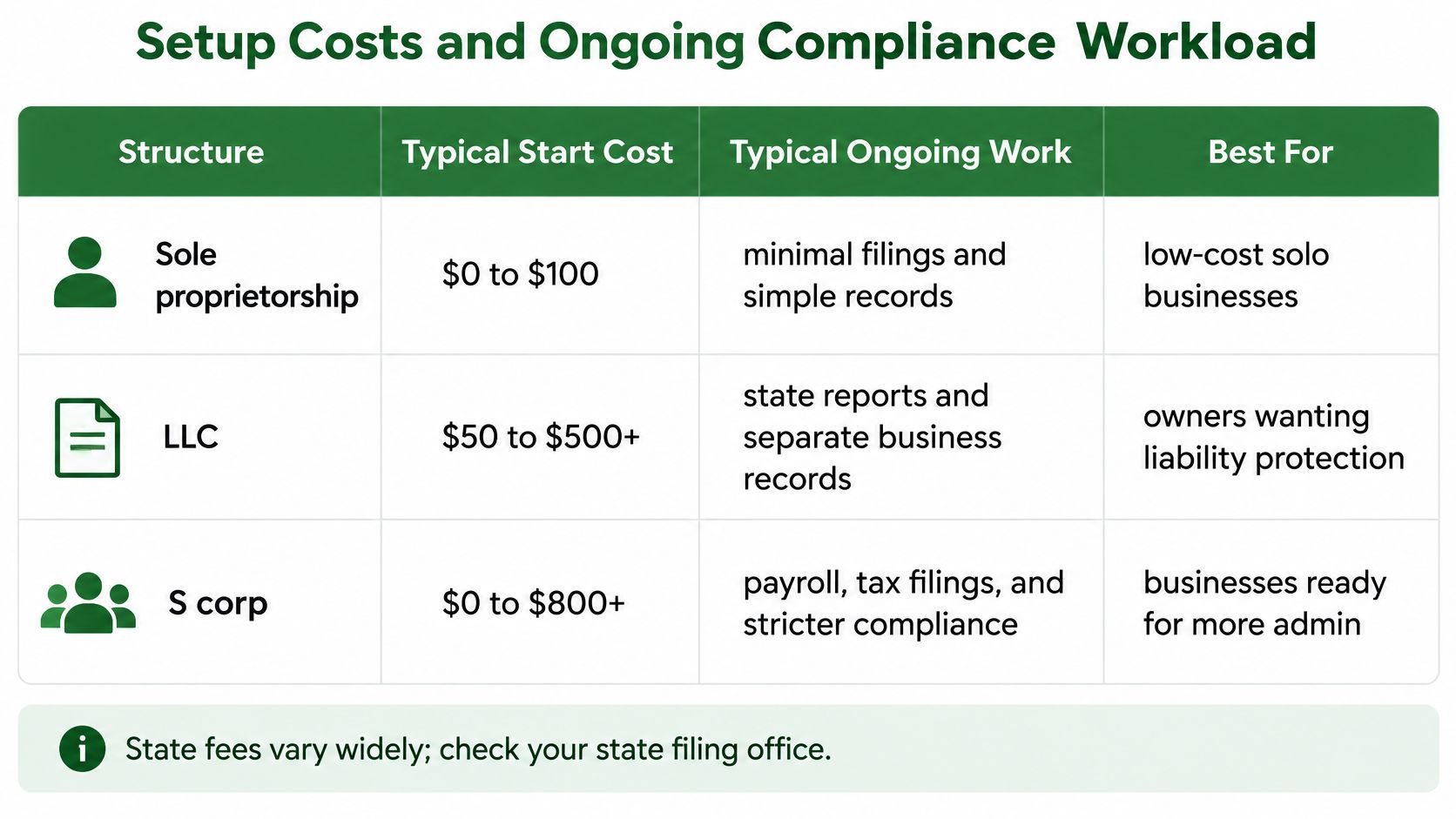
Cost Item | Sole Proprietorship | LLC | S Corp |
|---|---|---|---|
State formation fee | No separate entity formation | State filing fee | Underlying entity formation cost |
Annual state report or franchise tax | Usually no separate state report | Annual or biennial state report in most states; some states also charge a franchise or privilege tax | Same state reporting as the underlying entity; some states also tax the entity directly |
Federal election filing | No S election while operating as a sole proprietor | No election under default treatment | Federal election paperwork |
Registered agent | No separate entity agent | Follow state entity requirements | Follow requirements for the underlying entity |
Payroll processing | Needed when employing workers | Needed when employing workers | Owner-employee payroll adds recurring work |
Bookkeeping and tax preparation | Business records and individual-return support | Entity records; return scope follows tax classification | Payroll reconciliation and corporate-return preparation |
Separate unavoidable costs from optional services
Don't confuse a registered-agent requirement with a requirement to buy a particular commercial service. Likewise, don't assume a single-member LLC automatically needs a separate federal income-tax return because it exists under state law. An entity formed for liability purposes only adds cost where the state or the tax classification creates a new obligation.
Request an itemized comparison covering formation, recurring state obligations, bookkeeping, tax preparation, payroll, and software. Separate costs you'd incur anyway from costs caused specifically by an S election. At Book Tech LLC, our average hourly rate is $50 to $99 per hour, and pricing varies with account complexity, additional accounts, merchant accounts, loans, accounts payable, accounts receivable, payroll requirements, sales tax requirements, and other bookkeeping needs. The entity label alone isn't enough to price the work.
Count the owner's workload too
Payroll requires more than sending yourself money. Someone must maintain employee information, process compensation, account for liabilities, and keep payroll records aligned with the general ledger. Our small-business payroll guide can help you map that workflow before adopting it.
When selecting tools, use TopToolAdvisor to compare operational software options, then evaluate whether a candidate supports your accounting and payroll handoffs. A low subscription price doesn't help if someone must repeatedly correct exports or reconcile duplicate entries.
The relevant cost is the incremental cost. Ordinary bookkeeping supports every structure. Where records fall behind, the protection an LLC or S election was meant to provide erodes: missed reports, unreconciled payroll, and incomplete filings turn a compliance tool into a compliance risk. The election's additional payroll, return preparation, and state obligations must justify themselves against its expected benefit.
Which Structure Fits Your Business Situation
Use liability exposure to choose the legal structure, then use sustainable profit to evaluate the tax election. This lifecycle approach allows a business to change without assuming every owner should end up with the same arrangement.
Situation | Likely Starting Structure | Trigger to Revisit |
|---|---|---|
Freelancer with low-risk work and no employees | Sole proprietorship | Commercial lease, personal guarantee, or more consequential client obligations |
Creative or consulting business with signed client contracts | Single-member LLC | Hiring, business debt, or materially different contract exposure |
E-commerce seller holding inventory on marketplaces | LLC | Inventory financing, expanded product exposure, or consistent surplus profit |
Construction or field service business with crews | LLC, with multiple members if there are partners | More complex payroll and recurring profit that supports an election analysis |
Owner-operator with steady, high recurring profit | LLC with S election if eligible and economically justified | Profit no longer supports defensible compensation and added administration |
These are starting recommendations, not industry-wide rules. A freelance assignment can carry significant contractual exposure, while an established business can have substantial revenue but little profit left after expenses.
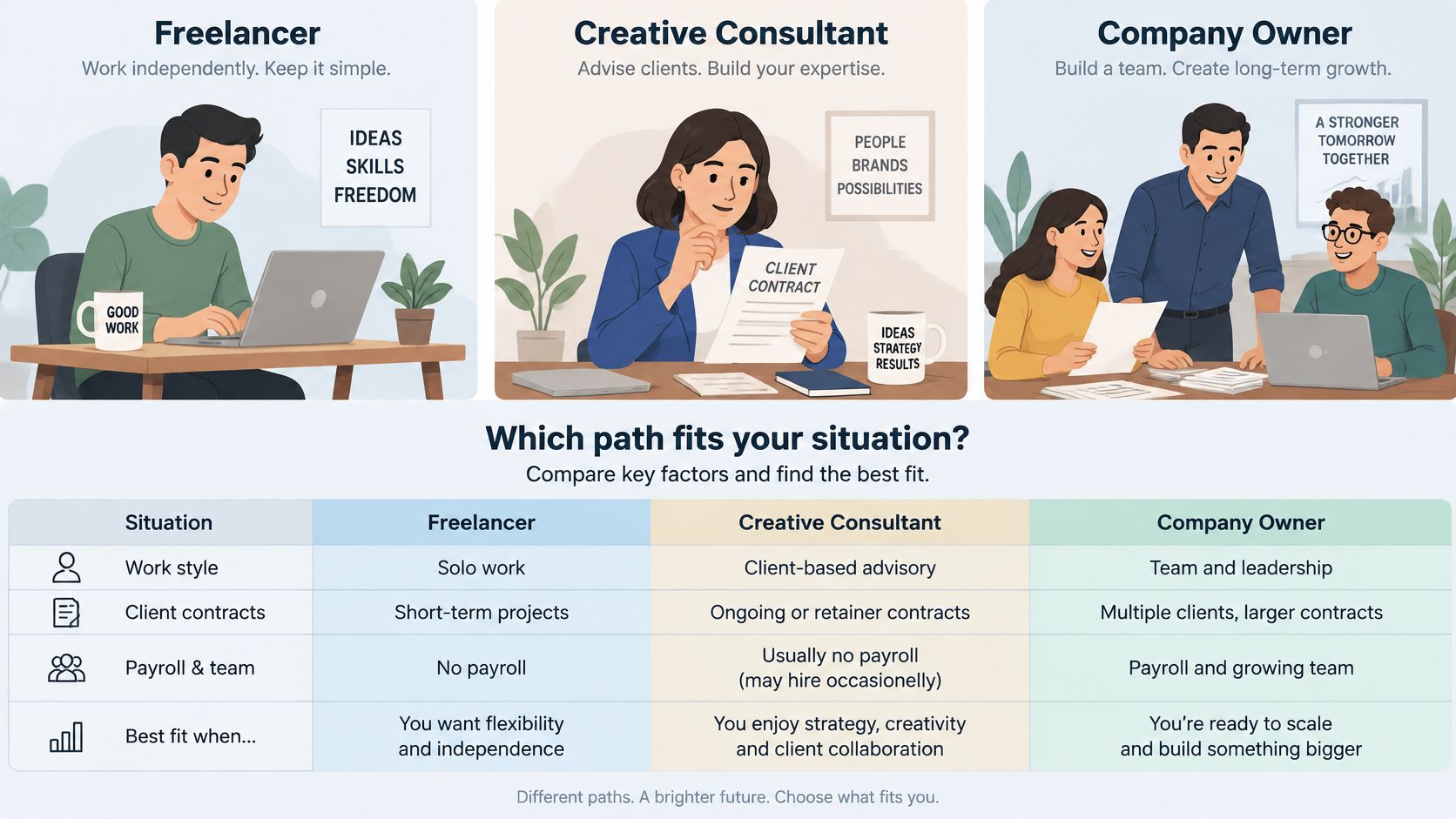
Choose based on obligations, not appearances
For a consultant, review the actual client agreement. Payment disputes, indemnification language, and the consequences of an error tell you more about exposure than whether the business uses a polished brand.
For an e-commerce seller, examine inventory commitments, borrowing, product risks, and cash tied up in stock. Sales growth isn't the same as spendable profit, so rising marketplace receipts alone aren't a sound reason to start owner payroll.
For a field service operator, distinguish the structure decision from the financing decision. Forming an LLC may be sensible, but signing a personal guarantee still requires a separate assessment of the owner's exposure.
Our guide to accounting for a startup business can help founders organize the records needed to evaluate these changes.
Know when the lifecycle bends
Licensed professionals should check state restrictions before assuming a standard LLC is permitted for their practice. Ownership plans also matter: an arrangement that works for today's owner may not support tomorrow's intended shareholders.
High recurring state costs can justify retaining a sole proprietorship longer when the work is low risk. They don't make serious liability exposure disappear. Conversely, a business with meaningful exposure may need an entity before it has enough profit to make an S election worthwhile.
A business can need liability protection before it needs tax complexity. Those decisions don't have to happen together.
The practical verdict is conditional, not evasive: choose the simplest arrangement that addresses the actual risk, then add tax administration only when the expected net result supports it.
Confirm Your Structure Before You File
Check state requirements before submitting formation paperwork. A filing service can process documents without resolving whether the structure fits your ownership, licensing, liability, or tax situation.
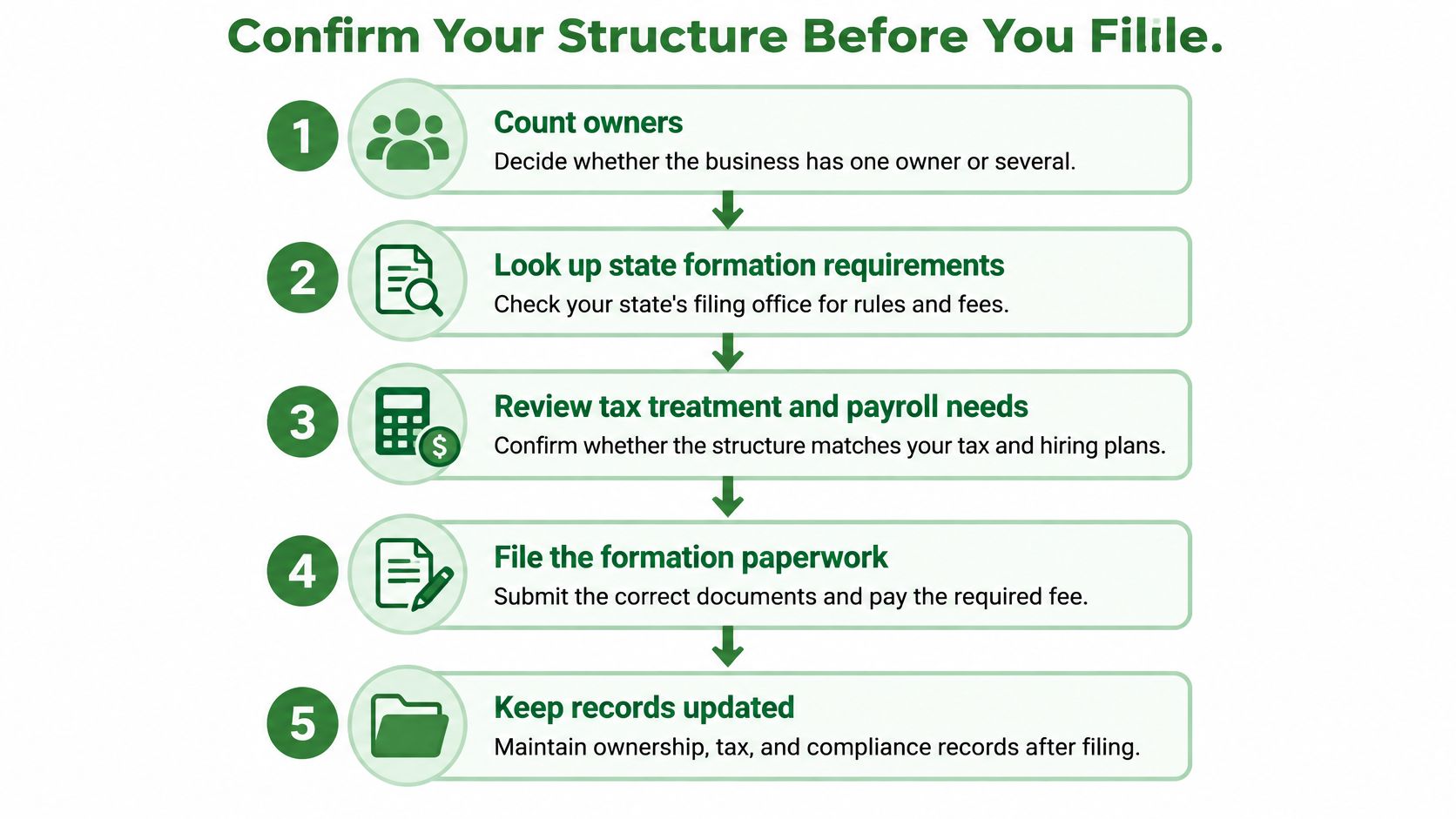
Count the owners. Identify who will own the business now and whether another owner is expected soon.
Check the state filing office. Confirm formation requirements, annual reports, franchise taxes, and any professional-entity restrictions before filing.
Arrange separate banking. Establish dedicated business banking and a card before collecting revenue where practicable; form the entity first when the account must be opened in its name.
Model the tax election. Have a tax professional evaluate profit after market-supported compensation, employer payroll taxes, and incremental bookkeeping and compliance costs.
Complete the appropriate formation process. File the state documents if an entity fits, or retain sole proprietorship treatment when the risk assessment supports it.
Establish the monthly close. Assign responsibility for transaction classification, reconciliations, owner transfers, and required filings.
Bring usable books to the review
If records are behind, a CPA or bookkeeper can help identify what needs correcting before ongoing monthly work begins. Our onboarding starts with a free consultation to understand monthly bookkeeping needs, followed by setting up or streamlining the books for accuracy.
After a few quick questions, we help determine whether clean-up or catch-up bookkeeping is the right fit. Use our guide on preparing for tax season to organize supporting records.
This week, write down the business situations that best match yours, check your state's filing requirements, and schedule a review with a CPA or tax professional. Bring current financial statements and a list of debts, guarantees, and planned ownership changes.
Book Tech LLC offers monthly bookkeeping, clean-up and catch-up work, payroll administration, and tax-ready financial reports to support the structure you choose. Visit Book Tech LLC for a free consultation about organizing owner transactions, reconciling your accounts, and establishing records your tax professional can use to evaluate the next move.